SimonDoom
Kink Lord
- Joined
- Apr 9, 2015
- Posts
- 21,705
Oh, I love birds. I don't trust them. But I love them.
I don't blame you for not trusting them.
They're rather . . . flighty.
Follow along with the video below to see how to install our site as a web app on your home screen.
Note: This feature may not be available in some browsers.
Oh, I love birds. I don't trust them. But I love them.


If by “someone,” you mean another loon, I've never heard this, but it seems quite possible. If you mean “a person”— no. Loons don't give a hoot about people.I still have that burning question, is it true that Loons call out in significant numbers when someone dies? I swear, I read that someplace
I don't know where this weirdly upside-down ageist belief comes from. I've loved and fed and been fascinated with birds my entire life. The only thing that's changed with age is having more time to devote to them.

How exactly does it represent an ageist belief? It’s a belief I completely relate to, hence why I shared it.I don't know where this weirdly upside-down ageist belief comes from. I've loved and fed and been fascinated with birds my entire life. The only thing that's changed with age is having more time to devote to them.
When I say “weirdly ageist," I mean that it's not necessarily so in the sense of discrimination, but is, in the thinking that a particular activity is exclusive to a certain age. As I said, I've always had a deep interest in birds (from age 8, at least— maybe earlier), and I know from my interactions with other bird people that I'm far from alone in that. So to me, it seems like a silly stereotype.How exactly does it represent an ageist belief? It’s a belief I completely relate to, hence why I shared it.


It's obviously about people who have a different experience from you.I don't know where this weirdly upside-down ageist belief comes from. I've loved and fed and been fascinated with birds my entire life. The only thing that's changed with age is having more time to devote to them.

Almost certainly not. Some scavengers locate their food by smell, and that can work at night, but the vultures in North America find it by sight. Also, the updrafts they use to gain altitude and circle aren’t active at night, so, it would cost them energy to stay aloft in the dark.There's also usually a few buzzards or vultures circling high in the sky. I wonder if they do it all night.

Almost certainly not. Some scavengers locate their food by smell, and that can work at night, but the vultures in North America find it by sight. Also, the updrafts they use to gain altitude and circle aren’t active at night, so, it would cost them energy to stay aloft in the dark.

That makes sense. They're such a constant fixture during daylight hours that I wondered.Almost certainly not. Some scavengers locate their food by smell, and that can work at night, but the vultures in North America find it by sight. Also, the updrafts they use to gain altitude and circle aren’t active at night, so, it would cost them energy to stay aloft in the dark.
I've got a YouTube video playing on the TV while I work, that's soft instrumental christmas music, with different birds in snowy scenesDepending on where you live, winter can be a great time for birdwatching. It is where I live, although you have to know where the best locations are. I haven't gone on my winter birdwatching foray yet, but I probably will soon.

They don't. I've been quite close to turkey vultures when they were settling down for the night— up on high, rocky ridges, preferably with dead trees. They roost in groups, and they make soft, cuddly noises as they settle in. Yes, really.a few buzzards or vultures circling high in the sky. I wonder if they do it all night.
This is wonderful.I saw the reddest cardinal I’ve ever seen yesterday morning before work. He flew into some naked forsythia bushes where you could really see the contrast. I wish I had a good camera.
He flew closer to our house and a bunch of forsythia there where he and his mate probably nest. They typically mate for life and we have been watching them for four or five years. I’m not sure if it’s the same birds or not or they’re offspring but we seen them have many many children.
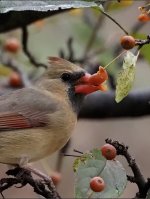
Female cardinal 2021.
View attachment 2584681
A fine photo, and such a very characteristic pose.View attachment 2584690
Been photographing birds for a few years, here’s a white-breasted nuthatch, midwest USA.

My wife and son used to do regular work for a rehabber who had a turkey vulture, among other regulars. The vulture thought he was mated to the rehabber, but still considered my wife as part of his flock. He liked people, but somewhat viewed us as great big squeak toys. One time he didn't want to do something when my wife was caring for him and he climbed up on her back. He was not intending harm, but his talons sank into the flesh of her back before she convinced him to get off. She still has a bit of a scar from it.I also had the privilege of spending a few hours with a vulture in a rehab center (it was a permanent resident, due to a bad injury). It was very intelligent, curious, and playful. It loved to untie my shoelaces. And although I wasn't with it long enough to experience it myself, I gather it was also very affectionate with its regular people.