For Those Who Might Be Wondering Why We Might Be In Ukraine

oh its ok, you wouldnt be the first online troll to jerk off to thoughts of me.
I see you're carrying a crystal ball of assumptions, confidently reading minds you've never met. Point to a time when I have "trolled" you. Why would you conclude that I'm going to rub one out over a pair of earphones framing an emotionless face?
 
fair fair. He has some man boobs at least

Putin is also a soulless psychopathic authoritarian, and Russiaguide finds that type irresistible. See also: Russiaguide’s love of DonOld Trump (of course, DonOld has man boobs as well, so…)

😑
 
Putin is also a soulless psychopathic authoritarian, and Russiaguide finds that type irresistible. See also: Russiaguide’s love of DonOld Trump (of course, DonOld has man boobs as well, so…)

😑
I think you masturbate to the thought of Trump. I don't care about what happens to Putin, only what comes after he is gone, because he is a pussy compared to those lined up behind him.
 
Well, President Taco wouldn't sell Ukraine Patriots systems to defend Ukrainian cities from Russian missiles, so Ukraine took out the aircraft launching the missiles instead. If this brings the world closer to WW3, that's entirely on Taco and Putin.

1748826206145.png
 
I think you masturbate to the thought of Trump. I don't care about what happens to Putin, only what comes after he is gone, because he is a pussy compared to those lined up behind him.

🙄

Actual orange toadstool slurping MAGAt (Russiaguide) says what???

🤔

😑
 
I think it wiped out seven of their Bear-type bombers, which is not catastrophic, but it is enough to make the Russians look bad. Three other such attacks on other airbases failed, according to the news. The worrisome part is if the man on the street in Moscow is calling this their "Pearl Harbor" as is being reported, we might recall how we paid the Japanese back for our Pearl Harbor and contemplate what might be coming.

41 bombers from their strategic air force and that may climb a bit, none of whichb can be replaced. Reports are that a mumber of others being cannibalized for parts were also taken oyt, along with, possibly, one nuclear submarine.

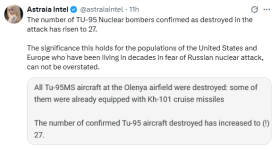
Reports indicate that at least 41 aircraft were hit. The unofficial tally (numbers are continually being updated - this was an awesomely effective attack) indicates
- 24 Tu-22, (27 now I think) - out of 58 in service)
- 8 Tu-95MS (Bear)- out of 47 in service
- 5 Tu-160 (Blackjack)were hit. (out of 15)
- a A50 AWACS (the last one - Russia is now effectively blind)
- MiG-31 fighters and Il-76 transports were also hit.

To put this in context, open-source data says Russia's bomber inventory is around 58 Tu-22, 47 Tu-95MS, and 15 Tu-160. These planes are the ones used to launch most of the missiles fired at Ukrainian cities.

Another report said just on 100 Russian aircraft were eliminated overall.

The Tu-22 and Tu-95MS production lines are closed, and the Tu-160 production is one a year. For all intents and purposes, this represents a permanent decrease in the size of the Russian strategic bomber fleet.
 
This was a brilliantly conceived offensive operation. It did a lot of harm to the Russian Air Force but will it change the trajectory of the War or change the balance of power? Not likely. The Russians are already calling this their "Pearl Harbor." We can bet there will be a response, and I suspect it will be overwhelming. Harsher voices than Putin's may now prevail.

2025 is the turing of the tide - Russian Navy has been eliminated as a serious threat. Russian aircraft near the front likewise. Now it's the turn of the strategic air force. Russian Army is not advancing and their summer offensive will be wiped out. Then the counterblows will start....

The important thing now is to keep Taco from getting in the way of a Ukrainian victory.
 
I think it wiped out seven of their Bear-type bombers, which is not catastrophic, but it is enough to make the Russians look bad. Three other such attacks on other airbases failed, according to the news. The worrisome part is if the man on the street in Moscow is calling this their "Pearl Harbor" as is being reported, we might recall how we paid the Japanese back for our Pearl Harbor and contemplate what might be coming.
You'd better scroll up and read up on the various video posts showing multiple bases hit. According to one video, a fifth base attack was not successful. The news reported that one-third of the Soviet aircraft were obliterated.

The man on the street is probably asking behind closed doors, how could this happen when Putin says we are winning on all fronts and there at a million dead Russians in fields across Ukraine?
 
You'd better scroll up and read up on the various video posts showing multiple bases hit. According to one video, a fifth base attack was not successful. The news reported that one-third of the Soviet aircraft were obliterated.

The man on the street is probably asking behind closed doors, how could this happen when Putin says we are winning on all fronts and there at a million dead Russians in fields across Ukraine?

Other aircraft beyomd the strategic bombers too. Their last A50 AWACS. Mig 31 fighters. Il76 transports.....
 
Ukraine is not only writing the manual of drone warfare, they have shown to other nations particularly to China, Eastern Europe and their own minorities just how weak the Russian frontiers are. It is particularly interesting how much the 'Stans' have turned their attention from Moscow to Beijing.
 
The Chicken Kyiv Speech

The Chicken Kiev speech is the nickname for a speech given by the United States president George H. W. Bush in Kiev, Ukraine, on August 1, 1991, three weeks before the Declaration of Independence of Ukraine and four months before the December independence referendum in which 92.26% of Ukrainians voted to withdraw from the Soviet Union. The Soviet Union collapsed 145 days after the speech, partially pushed by Ukraine. The address, in which Bush cautioned against "suicidal nationalism",[1] was written by Condoleezza Rice—later Secretary of State under President George W. Bush—when she was in charge of Soviet and Eastern European affairs for the first President Bush.[2] It outraged Ukrainian nationalists and American conservatives, with the conservative New York Times columnist William Safire calling it the "Chicken Kiev speech", named after the dish of stuffed chicken breast, in protest at what he saw as its "colossal misjudgment", weak tone and miscalculation.[3]
 
Operation Spider Web

In 2022, Russia entered this war with a total of following number of bomber airframes (following figures are based on literal ‘counting’ of aircraft visible on photographs from the last 10 years, during the work on the book War in Ukraine, Volume 6):
  • 55 Tupolev Tu-22M-3 ‘medium’ bombers,
  • 57 Tupolev Tu-95MS, and
  • 16 Tupolev Tu-160 strategic bombers.
All of these are big aircraft, and all are old: their production ceased in the early 1990s (this is valid for Tu-160s, too, despite the Russian claims about resumption of their production). They are maintenance intensive (indeed, Tu-160s are ‘renowned’ for their chronical engine-related problems) and thus there was always the question of their actual availability. In military terminology, this is summarised with the number of ‘fully mission capable’ (FMC) aircraft: aircraft with all systems in operational condition. Not only their age, but also three years of the war in Ukraine are showing their effects: earlier Ukrainian UAV-strikes on the DA’s bases have knocked out at least 2-3 Tu-95s and several Tu-22M-3s.

Indeed, the situation with Ukrainian UAV-strikes on Russia’s bases became serious enough to force the Russians to move their Tu-95s and Tu-160s away from their primary base at Engels, and re-distribute them to more distant facilities. This further complicated their maintenance. Correspondingly, as of early this year, Russia on average had less than 10 Tu-95MS’ and only 4-6 Tu-160s in FMC-condition. Similarly, only some 27 Tu-22M-3s were operational on average. The others would have taken anything between 24 and 168 hours to bring to that state. Rather unsurprisingly, in March this year two major Russian factories were contracted to overhaul six Tu-95MS’.

According to the Ukrainian accounts, the planning and execution of the Operation Spider Web began as much as 18 months ago. First, the SBU had to smuggle the necessary 150 FPV drones to Russia. These were stored in several discrete storage facilities rented for that purpose. There, the Ukrainians rebuilt a number of commercial containers into ‘UAV-launchers’ looking like housing modules. At the desired point in time, containers were then loaded on randomly selected commercial trucks, and their (Russian) drivers ordered to drive to selected points near the air bases of Olenya, Ivanovo, Daghilevo, and Belaya. Once there, and per remote control (the Ukrainians used Russian telecommunication networks for this purpose), their tops were opened, the UAVs activated, and sent into the attack. As far as is known, a total of 116 UAVs were actually launched.

Their appearance is certain to have taken the Russians completely by surprise: the air bases that came under attack were well-protected by electronic warfare- and air defence systems, but their crews expected UAV-strikes by big, ‘winged’, long-range UAVs by night. Not an attack by ‘FPVs’, and even less so ‘in the middle of the day’. Unsurprisingly, the SBU claimed damage or destruction of 41 bombers, surveillance and transport aircraft, which it characterised as ‘34% of Russia’s bomber-fleet’, worth ‘US$7 billion’.

What can be concluded about the ‘results’ of this operation?

Based on visual evidence provided so far (less than 24 hours since this operation was executed), only a small portion of claims for ‘41 aircraft destroyed and/or damaged’ can be confirmed at this point.

Olenya AB

One report says that a truck arrived in Olenegorsk near Olenya air base. As FPVs flew out of his trailer the driver reported to the traffic police that he was told to drive there and that someone would meet him.

Conclusion: 2 Tu-95MS’ were definitely destroyed, 1 ‘at least’ damaged. Additionally, a transport aircraft variously described as ‘An-12’ or ‘An-22’ was destroyed (if this was an An-22: this was the World’s largest turboprop-powered transport; 67 were manufactured, of which 60 remained in Russia after the dissolution of the Soviet Union; 5 were in storage; 6 written off in accidents, leaving only 4 in operational condition; reportedly, their operations ceased in late 2024).

Daghilevo AB (outside Ryazan)

A report that Ryazan air base was attacked and smoke of some kind was seen.

Ivanovo AB

There are reports that a single A-50 was hit at Ivanovo but no visual confirmation for this: merely ‘noise’ and ‘yet more noise’, and an image of smoke.

Conclusion: presently-available evidence is not enabling a confirmation of the claim that an A-50 was destroyed there.

Belaya AB

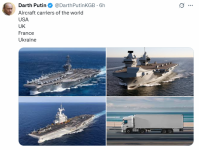
It is indisputable that drones for this attack were launched out of cargo trucks towards Belaya Airbase - over 4,000km from Ukraine. Russians climbed on a truck to try to stop the drones from flying. The truck then exploded.

Conclusion: presently available visual evidence is indicative of the destruction of 3 Tu-95MS and 3 Tu-22M-3s at Belaya AB. One, two, or even three additional Tu-95MS have been damaged.

Voskresensk AB


Individual fires can be seen in the distance at Voskresensk air base.

Ukrainka AB


There is a report that the Ukrainka air base in Amur (the Russian Far East) was targeted but, the truck with drones never reached it. The report said the truck started burning and a man entered the trailer when it exploded.

ek, entirely another type of targets the next day/week etc.).
 
What can be assessed about the overall effects of the Operation Spider Web?

It is first and foremost a major propaganda coup. All too many people are still considering ‘strategic bombers’ as a ‘symbol of military might’ - although these were replaced by intercontinental ballistic missiles in the role of ‘primary means of strategic deterrent’ back in the early 1960s. Arguably, bombers have recovered some of their strategic capability through the widespread addition of cruise missiles, initiated in the 1980s: indeed, much of the Russian pride in themselves as a ‘superpower’ came from the posession of a fleet of strategic bombers capable of deploying such weapons.

No doubt, propaganda is a fundamental part of warfare: whoever can impress the public opinion in one or another fashion, can appear as ‘victorious’ even when not successful at all (should there be any doubts, check the latest ‘success’ by Pakistan against India… at least in ‘the West’).

However, one has to keep ‘military realities’ in mind all the time. With this war going on into its fourth year, not only much of Russa’s bomber-fleet is worn out, but even the Russian capability to manufacture cruise missiles like the Kh-101 has been greatly degraded - to no small degree due to the dependence on imports of (principally) US-made chips and motherboards. Indeed, much of the Tu-22M-3-fleet was ‘doing nothing’ for the last year: the stocks of their Kh-32 air-to-surface missiles are largely exhausted, and the downing of one such bomber by Ukrainian S-200/SA-5 Gammon long-range clearly exposed their vulnerability to air defences. Contrary to the Russian claims, the fleet was never upgraded to an advanced standard, nor re-equipped with what is wrongly called the ‘Kh-47’ (actually: 9-S-7760 Kinzhal/AS-24 Killjoy): the only type in Russian service capable of deploying that weapon remains the MiG-31K - and there is no evidence that any of these were hit yesterday. The point is: before this Ukrainian operation, the actual value of Tu-22M-3s for Russia was degraded to the level where it’s surprising Putin didn’t order their crews to be re-trained as infantry and sent to assault Pokrovsk…

Moreover, the SBU’s claims to have destroyed ‘Russian aircraft worth US$7 billion’ - is entirely pointless: whatever the type, all were manufactured during the time of the USSR, and Putin didn’t spend a single cent of his… erm… Russian money to acquire them.

From the military point of view, much more important is the evidence that the Ukrainians seem to have managed to knock out 2-5 Tu-95s: due to the decreased number of FMC-airframes, those few aircraft that have been confirmed- or can be concluded as destroyed represent up to 50% of the fleet actually involved in operations against Ukraine (through releasing Kh-101s).

That said, Russia’s fleet of Tu-160s seems to still be around: as of 24 hours after these attacks, there is no evidence that any of these have been hit.

The same is valid for the Russian fleet of A-50s: even if one was damaged or destroyed, their losses as of early 2024 have already forced the Russian Air-Space Force (VKS) to keep them away from the battlefield. The fleet was down to seven, perhaps eight A-50s a year ago, while the A-100-project was cancelled in February 2024, because the Russians couldn’t obtain the necessary electronics from ‘the West’. Thus, sorry, but the effects of any kind of damage from an attack on the Russian A-50s is going to remain extremely limited.

What’s more: presently, there is no evidence that the SBU has attempted targeting any Russian units operating Shahed/Geran attack-UAVs, nor those operating Iskander ballistic missiles: the types of weapons deployed to execute the mass of strikes deep into Ukraine over the last two years, and causing the most damage and casualties.

Combined, this means that the Russians are going to remain capable of striking Ukraine both with Kh-101 cruise missiles, with Shahed/Geran (and similar) long-range attack-UAVs, and with Iskanders (not to talk about cruise missiles launched from their warships and submarines in the Black Sea).

From our point of view, much more important is going to be the ‘cummulative effect’ of this effort: during the last two weeks, the Ukrainians have carved’ out at least two major ‘SAM-corridors’ through the Russian air defences deployed along the international border. This was achieved through systematic assault (usually by UAVs, but by a few Storm Shadow/SCALP-EG missiles, too) against Russian ground-based air defence systems (foremost Buk/SA-17 Grizzly and Tor/SA-15 Gauntlet).

The resulting corridor/s is (are) enabling the Ukrainians to deploy dozens of their UAVs against targets deep inside Russia. Last night, two such corridors were exploited to deploy UAVs into strikes at Borisoglebsk and Lipetsk air bases, for example; additional strikes were reported from Kursk, Ryazan, Voronezh - and also from Rostov, in the south. Exactly what kind of damage was caused where, remains unclear, but: the Keystone Cops in Moscow (the Russian Ministry of Defence) claimed to have shot down 164 Ukrainian UAVs during the night, indicating the size of this effort.

Provided the SBU (and other Ukrainian services) now continue systematically deploying long-range attack UAVs to hit, damage, perhaps even disable major elements of the Russian arms-manufacturing industry (including at least two UAV-factories), and then continue keeping this sector of the Russian economy under pressure (nobody ever won any war by striking one arms factory just one time), this is near-certain to have clear and lasting consequences.

In this regards, one has to hope the Ukrainians have learned from their - and Russian, too - earlier failures, caused by haphazard selection of targets, and strikes run in entirely random fashion (see: one type of targets on one day, or in one we
 
Slava Ukraini!

This attack is ballsy and brazen. I do not know what this will mean for negotiations or for the war, but I’m glad that the Ukrainians were able to pull it off.
 
Back
Top