I see my score is 4.18

I have merely presented a system that would, in my opinion, produce more fair and accurate scores, and nothing more than that.

I accept that this is your intention. I just don't think you've made your case. Your analysis rests upon too many unproven assumptions and you choose not to take into account the very many potential downsides of your approach, which bear directly on the issue of "fairness" as much as they do on things like site traffic.

I STRONGLY believe there's nothing inherently unfair about allowing anonymous, unregistered readers to vote. I also believe that demonstrating that there is a RISK that such voters MIGHT POTENTIALLY vote in an unfair way, and pointing out that there are some such examples of such unfair voting, is insufficient to prove that there is a problem of unfairness that needs remedying. I pointed to your own body of stories, not to accuse you of caring only about your scores, because I don't believe that, but because your example would seem to be one of the stronger pieces of evidence that there's a problem, and yet in looking at your story results I see no problem at all.

Where's the problem? The mere possibility of unfair voting is not a problem.

If there's not a sufficiently serious problem, then there's no good case for changing things.
 
I'm not saying SNL doesn't ever do politics, but this says SNL doesn't ever not do politics. Which is ludicrous.
They don't do it all the time, but to the point it has overshadowed their 'straight up' material and given them the reputation as another platform where wealthy people preach.

The fact they still have Baldwin on there, a long time drunk and abuser and now murderer, but then they condemn politicians says it all.

You can have them, there's a time and place to deal with these things, and entertainment used to be a place to escape real world crap, now most of them are that crap.

But anytime the topic comes up, I always consider myself fortunate to have seen the beginning with the not ready for prime time players. I was young and some of the humor went over my head, but all through middle school, one of the coolest things to do was stay up to watch it then talk about it Monday with your friends. Martin, Belushi, Radner all the others. They peaked at their start.
 
I accept that this is your intention. I just don't think you've made your case. Your analysis rests upon too many unproven assumptions and you choose not to take into account the very many potential downsides of your approach, which bear directly on the issue of "fairness" as much as they do on things like site traffic.

I STRONGLY believe there's nothing inherently unfair about allowing anonymous, unregistered readers to vote. I also believe that demonstrating that there is a RISK that such voters MIGHT POTENTIALLY vote in an unfair way, and pointing out that there are some such examples of such unfair voting, is insufficient to prove that there is a problem of unfairness that needs remedying. I pointed to your own body of stories, not to accuse you of caring only about your scores, because I don't believe that, but because your example would seem to be one of the stronger pieces of evidence that there's a problem, and yet in looking at your story results I see no problem at all.

Where's the problem? The mere possibility of unfair voting is not a problem.

If there's not a sufficiently serious problem, then there's no good case for changing things.

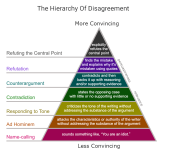
I am truly thankful to whoever has posted Graham's pyramid in one of the more recent threads.


1748686518839.png

You, my dear Simon, are somewhere in the light green area. You are contradicting my idea by claiming that there is no problem in the present system, thus, my idea is obsolete. You are also basing this on your impression of the way things work in the present system. Not great, but not bad either, considering how discussions go in AH. ;) Well, especially if you take a look at some others who are firmly in the orange area in most threads.

Anyway, I want to make it clear that, in this thread at least, I haven't tackled any of the questions contained in some of the replies. We likely disagree, at least partly, about whether the present system is fair and accurate or not. But I didn't really talk about that in my post. The central point of my post was that the scoring system could be improved by taking away the possibility of voting fraudulently. Well, maybe significantly reducing it would be more accurate. That's ALL I am saying.

I chose not to go into detailed math in my post, and I am now quite happy about it, as no one even touched on that bit.
 
I am truly thankful to whoever has posted Graham's pyramid in one of the more recent threads.


View attachment 2544659

You, my dear Simon, are somewhere in the light green area. You are contradicting my idea by claiming that there is no problem in the present system, thus, my idea is obsolete. You are also basing this on your impression of the way things work in the present system. Not great, but not bad either, considering how discussions go in AH. ;) Well, especially if you take a look at some others who are firmly in the orange area in most threads.

Anyway, I want to make it clear that, in this thread at least, I haven't tackled any of the questions contained in some of the replies. We likely disagree, at least partly, about whether the present system is fair and accurate or not. But I didn't really talk about that in my post. The central point of my post was that the scoring system could be improved by taking away the possibility of voting fraudulently. Well, maybe significantly reducing it would be more accurate. That's ALL I am saying.

I chose not to go into detailed math in my post, and I am now quite happy about it, as no one even touched on that bit.

With respect, I think he's in the black. Your central premise is that the system is so broken that needs a wholesale fix. He pointed out why that might not be the case: "there's not a sufficiently serious problem."

Like a number of these proposals, this strikes me as a solution in search of a problem. Is the rating system perfect? Nope. Will yours be any more perfect? Maybe, but probably not; systems have a way of revealing their unintended consequences over time.

More to the point: does the present system work for the site? Why yes. Yes it does. So if it works for the site, then no major change is needed. It doesn't work well for the writers, but that's never been its intent.

You'd need to show both that your system is better, and that the present system is a failure. And it's not, frankly, despite what many writers here think.
 
With respect, I think he's in the black. Your central premise is that the system is so broken that needs a wholesale fix. He pointed out why that might not be the case: "there's not a sufficiently serious problem."

You'd need to show both that your system is better, and that the present system is a failure. And it's not, frankly, despite what many writers here think.
I disagree.

Let's try to be truly honest about our perceptions here. There is no proof for your and Simon's claim that the present system is working fine. The same goes for my apparent claim that the present system isn't working fine. No real proof. What we all have instead are impressions of the way the website works or doesn't work. And in a way, that's fine, because obtaining actual proof would require an immense empirical undertaking that's well beyond our capabilities.

But I'll also dare to say that I have a bit more than just an impression. I can prove quite easily that it's possible to vote fraudulently and significantly alter the score of a story. So there is an undeniable potential for fraud with the present system. THAT is my central premise. There are also past experiences with Stacnash and crew, with LW, etc., so there is proof of such fraudulent voting actually happening.

Once again, as I've explained above, I can't possibly deduce or obtain any proof that the scale of such fraudulent voting is significant enough to make the system problematic. Maybe it is, maybe it isn't. I am simply basing my idea on the fact that a significant potential for fraud exists in the current system, while it's almost negligent in my own. That's all I am saying.
 
The central point of my post was that the scoring system could be improved by taking away the possibility of voting fraudulently.

I'll probably regret this, and I'm sure it will draw some well-deserved eye rolling, but here goes. Let's treat this argument the way it might be treated as a college policy debate.

The proposition: Resolved, that the Literotica story voting system should be changed to make it fairer.

The affirmative case and plan: Unregistered voting should be eliminated. Only registered voters can vote on stories. The 1-5 system will be eliminated. It will be replaced by a system in which registered reader/voters can vote thumbs up or not vote, and a score will be derived from the ratio of thumbs up to total views. Claim: This plan eliminates the unfairness of targeted, bad faith downvoting, and therefore makes the system fairer.

The negative case (my case):

Topicality: I'll skip this. The plan is topical.

Inherency: The affirmative fails to meet its burden of proving that there is a problem inherent in the system that needs fixing.

1. While the current system contains some risk of unregistered voters voting "unfairly," the affirmative fails to prove that the incidence of this is, in fact, widespread or significant enough to take seriously.
2. Without proof of some threshold level of actual harm, there is no inherent problem in the system and therefore no need for change.
3. In fact, a review of the evidence of the site's practices and story scores reveals that there does not seem to be a widespread problem.
4. The fact that a small number of participants in the Author's Hangout complain about downvoting and its alleged unfairness carries little to no evidentiary weight because we have no reason to believe their veiws and experiences are representative of the experiences of the whole.
5. The affirmative speaker's own story oeuvre appears to show that there is no problem.
6. The status quo carries at least some weight. The current system seems to be working well enough to satisfy most readers and most authors.
7. About as many members of the Author's Hangout have opposed proposed changes as have supported them, further undercutting the argument that there is a problem to solve.
8. The current system already has a method of minimizing the potential but apparently small risk of unfair downvoting: sweeps. The evidence indicates that over time this method works reasonably well.

Solvency: The affirmative's proposed solution does not solve the problem of unfairness.
1. The affirmative's case fails to take into account that there are many things that go into making a voting scheme fair or unfair. The affirmative only focuses on one. Without explicitly addressing all the different ingredients of the system that make it fair we can have no confidence that the proposed plan improves fairness.
2. Determined bad-faith downvoters will find workarounds to continue to defeat fairness if they want to.
3. While we cannot know all the ways they might do this, they might do this, for example, by registering multiple accounts and then viewing your story without giving it a thumbs up, thereby driving down, to some degree, the thumbs up:view ratio. This is MORE plausible in a system with a much smaller voter pool.
4. There is no reason, a priori, to believe the score that results from a thumbs-up:view ratio is inherently fair or useful; therefore we cannot have any confidence that it will be "fairer."

Disadvantages: The affirmative's proposed plan will make the problem of fairness worse and will result in other bad things that far outweigh the purely theoretical good.
1. The affirmative plan makes scores less fair by eliminating over half the voters, the great majority of whom probably vote fairly and in good faith and whose views should count. This is unfair.
2. By decreasing the voting sample size the affirmative plan makes the score that results less stable and less representative of the opinion of all readers. That increases unfairness.
3. By decreasing the sample size the affirmative plan increases the story's susceptibility to score manipulation. That increases unfairness.
4. The affirmative plan eliminates useful and legitimate negative information, i.e., bad votes, from the system. This is unfair.
5. The affirmative plan disincentivizes people from voting at all. Fewer will vote. This is unfair.
6. The score that results from this system will be cruder and less useful to potential readers. It will be less fine grained. This is unfair.
7. The existing problem of skewed votes for late chapters of stories will get worse. Only those who like the early chapters will read later chapters, and if they're only given the chance of thumbs up or no vote they'll all give thumbs up, rendering the system of little value for late chapters, i.e., everything will have 100%. This is unfair.
8. The affirmative plan disadvantages those authors who appreciate and want negative feedback. This is unfair.
9. The affirmative plan will negatively impact site traffic, making the site less valuable and more financially unstable and increasing the risk that it could disappear altogether. This is not just unfair but very bad. Existentially bad.
10. If Literotica disappears, sexual frustration will increase worldwide. Anger and instability will result.
11. The affirmative plan will result in an increased incidence of sexual abuse, death in the Third World, and a higher risk of Global Thermonuclear War. (this is an inside joke)


That's what I say to your pyramid.
 
Last edited:
10. If Literotica disappears, sexual frustration will increase worldwide. Anger and instability will result.
11. The affirmative plan will result in an increased incidence of sexual abuse, death in the Third World, and a higher risk of Global Thermonuclear War. (this is an inside joke)
If you give a mouse a cookie...
 
I'll probably regret this, and I'm sure it will draw some well-deserved eye rolling, but here goes. Let's treat this argument the way it might be treated as a college policy debate.

The proposition: Resolved, that the Literotica story voting system should be changed to make it fairer.

The affirmative case and plan: Unregistered voting should be eliminated. Only registered voters can vote on stories. The 1-5 system will be eliminated. It will be replaced by a system in which registered reader/voters can vote thumbs up or not vote, and a score will be derived from the ratio of thumbs up to total views. Claim: This plan eliminates the unfairness of targeted, bad faith downvoting, and therefore makes the system fairer.

The negative case (my case):

Topicality: I'll skip this. The plan is topical.

Inherency: The affirmative fails to meet its burden of proving that there is a problem inherent in the system that needs fixing.

1. While the current system contains some risk of unregistered voters voting "unfairly," the affirmative fails to prove that the incidence of this is, in fact, widespread or significant enough to take seriously.
2. Without proof of some threshold level of actual harm, there is no inherent problem in the system and therefore no need for change.
3. In fact, a review of the evidence of the site's practices and story scores reveals that there does not seem to be a widespread problem.
4. The fact that a small number of participants in the Author's Hangout complain about downvoting and its alleged unfairness carries little to no evidentiary weight because we have no reason to believe their veiws and experiences are representative of the experiences of the whole.
5. The affirmative speaker's own story oeuvre appears to show that there is no problem.
6. The status quo carries at least some weight. The current system seems to be working well enough to satisfy most readers and most authors.
7. About as many members of the Author's Hangout have opposed proposed changes as have supported them, further undercutting the argument that there is a problem to solve.
8. The current system already has a method of minimizing the potential but apparently small risk of unfair downvoting: sweeps. The evidence indicates that over time this method works reasonably well.

Solvency: The affirmative's proposed solution does not solve the problem of unfairness.
1. The affirmative's case fails to take into account that there are many things that go into making a voting scheme fair or unfair. The affirmative only focuses on one. Without explicitly addressing all the different ingredients of the system that make it fair we can have no confidence that the proposed plan improves fairness.
2. Determined bad-faith downvoters will find workarounds to continue to defeat fairness if they want to.
3. While we cannot know all the ways they might do this, they might do this, for example, by registering multiple accounts and then viewing your story without giving it a thumbs up, thereby driving down, to some degree, the thumbs up:view ratio. This is MORE plausible in a system with a much smaller voter pool.
4. There is no reason, a priori, to believe the score that results from a thumbs-up:view ratio is inherently fair or useful; therefore we cannot have any confidence that it will be "fairer."

Disadvantages: The affirmative's proposed plan will make the problem of fairness worse and will result in other bad things that far outweigh the purely theoretical good.
1. The affirmative plan makes scores less fair by eliminating over half the voters, the great majority of whom probably vote fairly and in good faith and whose views should count. This is unfair.
2. By decreasing the voting sample size the affirmative plan makes the score that results less stable and less representative of the opinion of all readers. That increases unfairness.
3. By decreasing the sample size the affirmative plan increases the story's susceptibility to score manipulation. That increases unfairness.
4. The affirmative plan eliminates useful and legitimate negative information, i.e., bad votes, from the system. This is unfair.
5. The affirmative plan disincentivizes people from voting at all. Fewer will vote. This is unfair.
6. The score that results from this system will be cruder and less useful to potential readers. It will be less fine grained. This is unfair.
7. The existing problem of skewed votes for late chapters of stories will get worse. Only those who like the early chapters will read later chapters, and if they're only given the chance of thumbs up or no vote they'll all give thumbs up, rendering the system of little value for late chapters, i.e., everything will have 100%. This is unfair.
8. The affirmative plan disadvantages those authors who appreciate and want negative feedback. This is unfair.
9. The affirmative plan will negatively impact site traffic, making the site less valuable and more financially unstable and increasing the risk that it could disappear altogether. This is not just unfair but very bad. Existentially bad.
10. If Literotica disappears, sexual frustration will increase worldwide. Anger and instability will result.
11. The affirmative plan will result in an increased incidence of sexual abuse, death in the Third World, and a higher risk of Global Thermonuclear War. (this is an inside joke)


That's what I say to your pyramid.

As an old Parli debater, I gotta say... this works for me.

There is no proof for your and Simon's claim that the present system is working fine.

The proof is in its continued utility over a couple of decades. What is the purpose of the rating system? To help READERS choose stories.

It fits that purpose. As a reader myself for most of those couple of decades, I know that in my bones; I am, granted, a small sample, but given all the access Laurel and Manu must have, over many years of countless views, reads, votes, and ratings, and with an eye on all the trends? I'd say you have an uphill climb when proving an improvement is desirable.

The writers have never been the focus here, and that is an important part of every debate we love to have here: categories? Ratings? Anonymity? All of that is designed to maximize the READERS' experience. The site has always been consistent about that. We're left to either accept it, buy the site and change it, or go start a competing site that works as we'd prefer.
 
Actually, this isn't entirely true or utterly a lie. Once a vote is registered from an IP, you cannot cast another (for at least a specific amount of time). I don't know if multiple identities allows a person to cast numerous votes on those other handels. However, with a VPN, you change locations and cast as many times as you can create those alternate locations. But my question is, why would anyone go to that much trouble just fuck up your day? Maybe for a contest, but again, it's a lot of fucking work.
2. In the present system, where unregistered users are allowed to vote, there is no way to tie the vote to the reader who cast it, so by using simple technical tricks, readers can cast as many votes as they like on each story.
 
You are also basing this on your impression of the way things work in the present system.

You base your whole system on the same premise.

Actually, arguments from folks like me and Simon are all heavily in the top 3 levels of that pyramid. We have refuted and backed up with varying degrees (bust mostly lots) of evidence.

Anyway, I want to make it clear that, in this thread at least, I haven't tackled any of the questions contained in some of the replies. We likely disagree, at least partly, about whether the present system is fair and accurate or not. But I didn't really talk about that in my post.

So, ou point out one of the huge flaws in your own stance.

The central point of my post was that the scoring system could be improved by taking away the possibility of voting fraudulently. Well, maybe significantly reducing it would be more accurate. That's ALL I am saying.

And we have addressed and refuted that point repeatedly, yet you just keep repeating your same argument as if we'll be convinced if you just say it enough times. As if you shouting it louder will force us to see your logic that we cannot deny. We already see your logic, thoroughly, and we have denied it and its inherent flaws, which we have pointed out.
 
But my question is, why would anyone go to that much trouble just fuck up your day? Maybe for a contest, but again, it's a lot of fucking work.

It seems this way to me too, but apparently some people are willing to go to some trouble to spoil other people's scores. And if you have a system that results in a base of fewer scores overall, it takes less such effort to alter the score.
 
You'd need to show both that your system is better, and that the present system is a failure. And it's not, frankly, despite what many writers here think.

Oh, the present system is a failure for sure, just not in the way that AwkwardlySet claims it to be.

The system is a failure in promoting stories that are a cut above. Instead it promotes stories that are very average as a cut above. This is misleading, certainly not helpful to anyone (except to people who write averagely received stories want to falsely feel like they're awesome). It certainly does not help writers who do score really well yet are not separated from the chaff. So in that sense the system that we have is an epic failure.

The system is also a failure in fairness, as some categories are super easy to score a hot rating and a few are much more difficult, and a bunch are somewhere in between. This is hardly fair to the niche writer who writes controversial stuff and is slanted heavily in favor of those who spam easy categories with formulaic pandering.

On the other hand, AwkwardlySet does not address any of these issues with his proposal at all. His only concern is fraudulent votes which he feels strongly is a major problem ruining the experience here. Well, fraudulent voting isn't that large of a problem. It's a problem, sure but it's not that large and it does not ruin the experience for the vast majority of writers here. It's an itch that we all must inconveniently scratch from time to time absolutely, but all in all its quite copacetic - no biggie. And let me be clear, personally as one of the least popular (very low profile) and most hated writers here, I'll put my bomb ratio up against anyone. If anyone should have their experience ruined by fraudulent voting it should be me, yet I find it a mere disappointment, no biggie. Furthermore, his proposal will not put much of a dent in fraudulent voting like he believes that it will. The occasional bomb-vote is not a problem. Co-ordinated mass downvoting is the real problem and that is usually done with multiple accounts anyways, so his system will not solve this.
 
But I'll also dare to say that I have a bit more than just an impression. I can prove quite easily that it's possible to vote fraudulently and significantly alter the score of a story.

But you can't prove that it DOES happen. You only have evidence to show that it has happened to YOU - ONCE! You and I are the only two people here that I know of that have had this happen, and in the case of my incident, I KNOW that it was multiple registered accounts, the same ones that I reported and got banned from chat for spam attacking me. You have no evidence whatsoever to claim that the practice is widespread at all.

You even agree.

Once again, as I've explained above, I can't possibly deduce or obtain any proof that the scale of such fraudulent voting is significant enough to make the system problematic.
 
3. While we cannot know all the ways they might do this, they might do this, for example, by registering multiple accounts and then viewing your story without giving it a thumbs up, thereby driving down, to some degree, the thumbs up:view ratio. This is MORE plausible in a system with a much smaller voter pool.

That's another great point. By removing all negative reactions to the story and then simply diving thumbs-ups by views for a rating, a hater can simply view the story multiple times and the site will not be able to sweep out those fraudulent views.
 
I'm going to propose Melissa's plan.

1. Write better stories.
2. Get higher scores.
3. Don't worry about it.
Let me introduce LC's razor

One does not always lead to two, which then enhances three as people wonder why they're not getting those scores with their superior writing and in turn that leads to a good part of these discussions.

We can also try this

1-People with meh scores want a new system because this is broken
2-People with great numbers think the system is fine because it rewards their otherworldly skills.
3-People who understand it is what it is and there is no sure way to know why the fuck anyone votes and comments as they do are the ones who don't lose sleep over this.
 
Let me introduce LC's razor

One does not always lead to two, which then enhances three as people wonder why they're not getting those scores with their superior writing and in turn that leads to a good part of these discussions.

We can also try this

1-People with meh scores want a new system because this is broken
2-People with great numbers think the system is fine because it rewards their otherworldly skills.
3-People who understand it is what it is and there is no sure way to know why the fuck anyone votes and comments as they do are the ones who don't lose sleep over this.

It depends how you define "better": it could mean better in the literary sense, or better at appealing to the audience.

Obviously, my post was meant to be tongue in cheek. But I have to say that there seems to be a common attitude on Lit that the author/reader relationship is adversarial. Maybe the scoring system sucks, but before anyone decides it does, they ought to take a very long hard look at their side of the equation, instead of defaulting to poor scores being the fault of a flawed system or disingenuous readers.
 
It depends how you define "better": it could mean better in the literary sense, or better at appealing to the audience.

Obviously, my post was meant to be tongue in cheek. But I have to say that there seems to be a common attitude on Lit that the author/reader relationship is adversarial. Maybe the scoring system sucks, but before anyone decides it does, they ought to take a very long hard look at their side of the equation, instead of defaulting to poor scores being the fault of a flawed system or disingenuous readers.
What it comes down to-if I had to pick one-is trying to take such a massive and varied readership combined with a variety of kinks spread across the site and trying to come up with some way to shove everyone in a box and dictate how they vote.

From there we get to number two and swing back to Awkwardlysets human nature comment.

Every author thinks their story should be getting top marks-unless you're writing to troll like in LW- and if they don't something has to be wrong.

Same nature that says anyone with a sea of red H's and other accolades thinks "Hey, this is just fine."

Now that's an average of what I see here on both sides, but not the overall site average because we can't box in authors either, but here we do get a sample size.

I just notice a tendency of those who have done well here not being as eager for a change as others.

This is the playing field we're all on and its not a level one in many ways and there is no way to fix that.

I use title and tag for how I choose a story, I don't look at scores. if more people did that maybe this wouldn't be a big deal. Or maybe many do that and people here just think they don't because again, how come I don't have a 4.9?

If this post seems like its going in a circle it is, its a deliberate microcosm of the entire thread.

Its been discussed ad nauseum and nothing has or will change. Including beating all this into a dead horse.

Silkstockingslover gets paid the same as an author here with one story that has a 2.5 rating, so who cares?
 
Back
Top