For Those Who Might Be Wondering Why We Might Be In Ukraine

Zelensky gave a presentation today showing that 80% of all combat deaths inflicted on the Russians by Ukranians were by inexpensive drones.

The future of warfare.

Meanwhile, President Mango Mushbrain wants to re-fight World War 2 with shiny big aircraft carriers.

Out.
Of.
Touch.
 
Zelensky gave a presentation today showing that 80% of all combat deaths inflicted on the Russians by Ukranians were by inexpensive drones.

The future of warfare.

Meanwhile, President Mango Mushbrain wants to re-fight World War 2 with shiny big aircraft carriers.

Out.
Of.
Touch.

Um, if one has absolute air superiority and basically unchallenged overflight of enemy territory, then traditional ordinance delivery systems make drones look feeble.

Also:

You seem to forget that Israel and the U.S. kicked the crap out of their adversaries in the Middle East region (excluding Afghanistan, because the Taliban was operating in the mountains along the border of Pakistan and from inside Pakistan itself) with conventional weapons systems, and the Iranian drone threat was almost completely neutralized (the worst damage to Israel came from a standard Iranian ballistic missile).

😑

Side note:

The most fucked up thing about Trump’s insane Iran attack plan, is that it’s going to leave Iran FUBAR worse than Iraq after Shrub’s insane attack plan.

The “day after” in Iran is going to be uuuuuglyyy (worse than Iraq), imho, IF DonOld follows through with his military distraction from the ICE murders, the failing economy, and the Epstein files, etc.

I truly pity the Iranians who trusted Trump - the same way I pity the "Palestinians"who trusted Trump.

😑

WE. TOLD. THEM. SO.

🌷
 
Russia rushed reinforcements to its fracturing southeast. They rode in unarmored and in broad daylight
  • In early February, Russian communications melted down
  • Ukrainian troops sensed opportunity—and attacked
  • The Ukrainian counteroffensive has slowed as Russian reinforcements arrive
  • But Russian losses are heavy
Two weeks into Ukraine's southeastern counteroffensive, Ukrainian forces are still advancing from the west and north, squeezing one key Russian field army. Ukrainian casualties have increased as the Russians rush reinforcements and firepower toward their fracturing southeastern positions. But frantic Russians are sloppy Russians—so Russian casualties have spiked, too.mConsider one particularly bloody recent skirmish around the village of Dobropillia, which anchors the western edge of the Russian 36th Combined Arms Army's positions straddling Dnipropetrovsk and Zaporizhzhia Oblasts in the southeast.

As many as 15 Russian were killed or wounded when they unwisely piled into a single unarmored truck and rolled along the T0401 highway just north of Dobropillia in broad daylight on or just before Wednesday. The truck and its passengers were easy targets for a powerful Ukrainian battlegroup that has been steadily advancing in the area ever since Russian forces suffered a command and control meltdown early this month.

At the behest of the Ukrainian government, billionaire Elon Musk’s Starlink satellite communications firm bricked Russia’s stolen and smuggled SATCOM terminals, effectively muting many Russian headquarters and blinding many Russian drones starting in early February. Meanwhile, the Kremlin cut off military access to non-government social media such as the popular Telegram app, which Russian troops used to communicate along the front.

Chaotic command and control

The twin moves sowed chaos in the Russian armed forces in Ukraine. It became much more difficult for the Russians to surveil and attack from the air and coordinate assaults from the ground. Sensing a rare opportunity, the Ukrainians attacked at the moment of peak confusion on the Russian side. A battlegroup drawn from several Ukrainian assault units attacked the western flank of the Russian 36th Combined Arms Army, whose four regiments and brigades had been steadily marching toward Zaporizhzhia City, 75 km to the west. First, the Ukrainians cleared out Russian troops from the wide "gray zone" between Russian and Ukrainian lines. Next, they penetrated the Russian line itself around Dobropillia. Panicking, the Russians "committed a significant number of reserve units to the fight and also launched counterattacks" south of Dobropillia, according to observer Thorkill.

It's unclear whether that truckload of Russians near the T0401 was part of the reinforcing reserve force. In any event, it suffered catastrophic defeat. First, a Ukrainian first-person-view drone stuck the unprotected truck, immobilizing it and scattering its 15 occupants. Ukrainian artillery rained down on the fleeing Russians. When a Ukrainian infantry team arrived to mop up, they found only dead Russians and parts of dead Russians.

Faltering on the ground in the southeast, the Russians are trying to blunt the Ukrainian counteroffensive from the air. Their satellite-guided drones still largely scrambled, the Russians have brought in more artillery and more teams from the elite Rubicon (also spelled Rubikon) Center drone unit, which is famous for its unjammable fiber-optic drones. More Russian air force fighters are dropping more precision glide bombs on attacking Ukrainian troops. “Russian forces have significantly intensified their artillery, drone and glide-bomb strikes on Ukrainian assault groups, resulting in a sharp rise in casualties,” AMK Mapping reported.

But Russian casualties are heavy, too, as that truckload of Russians could attest—if any survived.

https://euromaidanpress.com/2026/02/21/15-russians-in-a-truck/
 
Only 10% of Ukrainians want wartime elections—so why does anyone else?

When President Volodymyr Zelenskyy remarked last week that elections are impossible before the end of martial law, he was not merely stating a legal technicality. He was intervening in a growing international debate—fueled by commentary in Washington and recent reporting in the Financial Times—suggesting that Ukraine ought to demonstrate her democratic vitality by returning to the ballot box even as the war grinds on.

The argument has surface appeal. Ukraine defines herself as a constitutional democracy resisting authoritarian aggression. Why not prove it through elections? Yet this framing gets both Ukrainian law and Ukrainian reality wrong. Holding national elections under the present conditions would not strengthen democracy. It would risk distorting it—perhaps fatally.

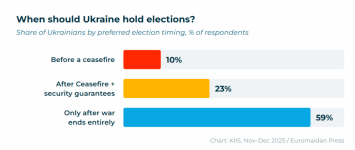
Recent polling by the Kyiv International Institute of Sociology indicates that only around 10% of Ukrainians support holding elections before a ceasefire. This is not a marginal statistic. It suggests a society acutely aware of the difference between democratic ritual and democratic legitimacy. Ukrainians do not fear elections. They fear sham conditions for them.

The issue is not abstract. It is not merely about clauses in the Constitution. It is about real power and real people.

1771726263747.png

The legal barrier is real—and deliberate

The Constitution of Ukraine provides that parliamentary terms are extended during martial law and that presidential elections cannot meaningfully proceed under such conditions. The Law “On the Legal Regime of Martial Law” expressly prohibits national elections while martial law is in force. This framework was not improvised in 2022. It reflects a long-standing recognition that wartime conditions are incompatible with free and equal political competition.

To hold elections now would require lifting martial law—while Russian missiles continue to strike Ukrainian cities—or amending legislation in ways that could themselves be constitutionally contested. Either path would expose the country to political fragmentation at precisely the moment unity remains a strategic asset.

Ukraine is fighting not only for territory but for constitutional order. Expediency cannot substitute for legality in a state whose legitimacy derives from adherence to law.

The missing voters


But the argument does not end with statutes.

Consider a soldier deployed near Kupiansk. Before the war, he was registered at an apartment in Mariupol that no longer exists. The building was destroyed during the siege. The municipal records office is under Russian occupation. His polling station is rubble. How does he vote? In which constituency? Under what administrative authority?

Or consider a young woman who fled to Germany in March 2022 at the age of 15. She has just turned 18 in Munich. She has never voted in Ukraine. She is formally registered in a city she cannot safely return to. Under pre-war arrangements, overseas voting required attendance at an embassy or consulate.

Those facilities were never designed to process millions. Should Germany host hundreds of improvised polling centers? Who verifies identity documents, particularly where Russian occupation authorities have forcibly imposed alternative passports?

These aren’t thought experiments. These are the lived circumstances of millions of Ukrainians.

An election in which vast categories of citizens are effectively excluded would not prove democratic resilience. It would prove administrative fiction.

Occupation and coerced passports

The most profound dilemma concerns territories under Russian occupation. Crimea, Donetsk, Luhansk, Zaporizhzhia, and Kherson remain, under Ukrainian constitutional law, integral parts of the state. No amendment has altered that status. Yet Ukraine cannot administer elections in areas controlled by Russian forces.

Proceeding without them would create a geographic distortion of representation. Waiting for their liberation may mean waiting years.

Meanwhile, occupation authorities have coerced residents into accepting Russian identity documents. These acts violate international humanitarian law, but they generate evidentiary chaos for any future voter registry.

Does exclusion from a wartime election implicitly concede territorial loss? Or does proceeding signal that effective sovereignty has been reduced to what Kyiv can physically administer? Either course carries constitutional symbolism.

Digital promise—and digital peril

Ukraine’s Diia platform—her ambitious digital public services application—offers a technological solution. In theory, remote voting might enable participation by displaced citizens and soldiers alike.

Yet Ukraine is also the primary target of sustained Russian cyber operations. An online voting system would be an irresistible objective for sabotage or disinformation. Even unproven allegations of interference could delegitimize results.

Moreover, digital exclusion remains real—older citizens, rural communities, and those without secure connectivity cannot be relegated to second-class participation.

Power, not procedure


Elections are never merely administrative events. They redistribute power.

Who benefits from postponement? The incumbent presidency and the existing parliamentary majority, whose mandates are constitutionally extended. Who might benefit from immediate elections? Potential challengers positioning themselves for post-war leadership.

The public disagreement that has recently surfaced between President Zelenskyy and senior military figures—including former Commander-in-Chief Valerii Zaluzhnyi—illustrates that Ukraine’s politics are not frozen. They are simply channeled differently during wartime.

Washington’s interest in Ukrainian elections is likewise not purely procedural. Some American policymakers view elections as reassurance—proof that support is backing a living democracy. Others perceive leverage.

Yet democracy is not a theater for foreign capitals. It is the organized expression of a people’s will under conditions of equality.

If elections are conducted while millions cannot vote, while front-line regions cannot safely host polling stations, while soldiers vote within rigid hierarchies and refugees queue in overstretched consulates, then the result may satisfy formalists abroad while corroding legitimacy at home.

The strategic calculus

President Zelenskyy’s calculus is therefore not simply about retaining office. It is about timing. A premature election could fracture wartime cohesion, embolden adversarial propaganda, and create contested results under conditions of insecurity.

Postponement carries risks too. Democratic mandates cannot be extended indefinitely without political cost. But the polling data are clear: Ukrainian society overwhelmingly prefers elections after a ceasefire.

Ukraine’s war has been fought with artillery, drones, and code—but also with institutions. Courts continue to function. Parliament legislates. Civil society scrutinizes.

Ukraine’s allies may wish to see elections as proof of democracy. Yet holding them under current conditions could demonstrate the opposite—that constitutional safeguards can be bent under pressure.

For an international reader, the lesson is sobering. Democracies at war do not defend themselves by imitating peacetime rituals at any cost. They defend themselves by preserving the integrity of the conditions that make those rituals meaningful.

When Ukrainians next go to the polls, it must be because they can do so freely, safely, and inclusively. Anything less would not be a triumph of democracy under fire. It would be a gamble with the very constitutional order she is fighting to preserve.

https://euromaidanpress.com/2026/02/21/ukraine-wartime-elections-10-percent-support/
 
Back
Top