It is estimated that 40 million people died in the First World War between 1914 and 1918. In that final year of the war the great influenza pandemic took hold and was to cause possibly 50 million fatalities, some estimates claiming a global death toll as high as 100 million.
No pandemic before or since has resulted in deaths on such a scale. Tragically, many soldiers who survived the horrors of trench warfare then fell victim to the influenza scourge.
It is commonly referred to as “the Spanish flu” epidemic but Spain is highly unlikely to have been the source. Wartime censors in the UK, Germany, the United States and France, anxious not to lower morale, played down the numbers of victims. But there were no restrictions on reporting the figures for Spain, which had taken no part in the war. So the belief grew that seemingly badly hit Spain was the epicenter of the disease.
The 1918 pandemic came in three waves. During the first, in the early part of the year, deaths were relatively low. The second wave, which began in August, was much more serious, the virus having mutated to a considerably aggressive form and October was the deadliest month of the whole pandemic.
Those between the ages of 20 and 40 were the most vulnerable, the virus so savage that a victim might show no symptoms in the morning but be dead by nightfall.
The third wave in the spring of 1919 was more lethal than the first but less so than the second.
An unusual characteristic of the virus was the high death rate among healthy young adults. But after the lethal second wave peaked in late 1918 new cases of infection dropped abruptly and the virus eventually burnt itself out.
Many factors contributed to the virulence of the 1918 pandemic. The world was at war and large numbers of troops stayed in close contact. No diagnostic tests existed; in fact, doctors didn’t know flu viruses existed.
Even if they had known, vaccines did not exist, antibiotics had not been invented and no antiviral drugs were available. On top of that, there was no such thing as intensive care or mechanical ventilation.
Businesses, though, were not slow to offer so-called remedies. Products including Lifebuoy soap, Oxo, Aspirin, quinine, opium, turpentine, iodine, ammonia, cinnamon, cocoa, disinfectant and even cigarettes were all promoted as having properties that could either prevent the flu or ward it off.
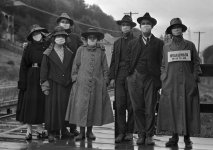
1918: A group of Americans in California with a message for their fellow countrymen.