For Those Who Might Be Wondering Why We Might Be In Ukraine

Reality on Frontline | Ruzzians Bypassed Defence | Pokrovsk is Avdiivka 2.0


Yeah, I’m about done with Denys: He obviously doesn’t understand the idea of delaying the enemy at places like Pokrovsk and continuing the war of attrition until Russia collapses internally.

Yes, it’s tough on the Ukrainian military - but it’s tougher on the Russian military & the Russian oligarchy. Ukraine continues to sanction Russia while Pokrovsk (etc) holds.

👍 🇺🇦

That ^ is the way it was and the way it is going to be: It is a battle of wills and attrition.

And that ^ is why DonOld & the MAGAt republicans should be supplying DIRECT MILITARY AID TO UKRAINE - including the AGM-86 and AGM-158, more long range ATACMS and HIMARS launch systems, and more JDAMs

The Patriot missile batteries from Germany are a great addition to Ukraine’s defense, but more is needed in the advanced offense - defense category of weapons.

The weather seems to be limiting Ukraine’s drone capabilities in recent days / weeks, so more conventional weapons need to fill the gap, imho.

More direct aid from the U.S. would obviously raise Ukrainian morale as well.

But of course DonOld & the MAGAt republicans will continue to betray Ukraine, so…

🤬

We. Told. Them. So.

🌷
 
This Applies to the US Army as much as the Europeans...

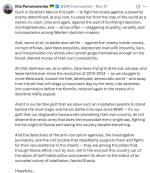
Bohdan Krotevych
@BohdanKrotevych
· Nov 11

A few days ago I was at an event organized by MITS in Kyiv, where the topic was the “drone wall” and whether Russian UAVs could shift Europe’s front line. Ironic question — can you shift what doesn’t exist. I tried to unpack the core problem: Europe’s lack of preparation for the imminent war Russia might start against European countries.

So the title of my thought: Europe is playing at war, not preparing for it.

Europe speaks the language of progress but thinks in the language of comfort. Here war has become a tech show, where every new buzzword — “game-changer”, “AI”, “drone revolution” — creates an opiate sense of control, replacing real preparation for the coming war Russia may begin by invading the Baltic states. Unfortunately, because of a lack of real combat experience, generals, defence ministers, politicians (Ukrainians included, regrettably) have forgotten the main thing — equipment does not fight on its own. A drone, a rifle, a tank, a fighter, a radar station, a truck — these are only tools with specific tasks. An army is not a pile of metal and not merely a crowd of highly trained soldiers.

An army is a structure that moves as one: C4ISR, logistics, infantry, artillery, intelligence, medicine, communications. Everything begins with the principles of war — they are the constant on which the art of war is built; they should be reminded to European generals as insistently as we constantly remind Ukrainian (Soviet-trained) commanders.

Objective — a clearly defined end state.

C4ISR must provide a single picture and clear tasks; without an objective all tools are useless.
Offensive — action must seize the initiative; defense must be active. Infantry and artillery cannot wait for long data collection cycles; they act on targets provided by intelligence and on C4ISR decisions.
Mass — concentrate fire and resources at the decisive point. Logistics and ammunition stocks allow you to “build up” fire where it will matter most.
Economy of Force — allocate resources with priority to what matters.
Battle-testing and right procurement priorities prevent wasting scarce resources on “show projects”.
Maneuver — use movement to create favorable force ratios. Infantry and armor, combined with intelligence and EW, create opportunities to bypass or break the enemy’s defenses.
Unity of Command (C2) — one plan, coordinated action. C2 inside C4ISR guarantees that all elements act to a single intent, not to separate instructions.
Security — protection from enemy reconnaissance and strikes; protect supply chains and comms. EW/cyber and dispersed logistics infrastructure make the system survivable.
Surprise — strike where and when the enemy does not expect it. Quality intelligence plus a fast decision cycle in C4ISR deliver tactical advantage.
Simplicity — plans must be understandable and executable in chaos. Training, NCO skills and standardized SOPs make tactics work even when comms fail.
Sustainability / Perseverance — the ability to endure prolonged pressure and to recover. Strategic stocks, MRO, medicine and mobilization capacity are what give a campaign long legs.

Without this connectivity, everything else is just shards of technical pride. If there is no system, even the best technology does not unite an army — it merely fragments it into pieces, each living in its own illusion of strength. Today Europe pours billions into startups that have no grounding and no realistic chance of success. Their founders are “veterans” of peacekeeping missions, not modern high-intensity war. They build pretty prototypes that fail field tests.

Stark Defence failed all strikes; Watchkeeper fell on its own wings. This is not merely technical malfunction — it is a diagnosis of a system where money has replaced experience. Stark raised over $100 million in venture capital, including investment tied to Peter Thiel, and none of its four test strikes hit their targets. Watchkeeper cost British taxpayers more than £1 billion, and after years of development became a symbol of expensive impotence: drones crashed before they could fight. Money creates the illusion of understanding war, but it cannot substitute for those who have seen it up close. When technology is born without front-line experience, it becomes a fine concept that dies on first contact with reality.

Finland is the exception.

It has over 900,000 reservists, of whom 280,000 can be mobilized immediately. Under the Comprehensive Defence 2035 plan the state is deploying new ammunition and fuel stocks and modernizing shelters along the eastern border, while updating its system of field fortifications.

The purchase of 64 F-35A fighters, joint production of Patria 6×6APCs and over 2,000 exercises a year — this is not a show, it is practical preparation for war.

Finland does not build “drone walls” for the news — it builds real territorial defence plans: stocks, roads, reserves, mobilization lists. For them war is not a concept, it is an engineering task already calculated by the hour.
And Europe, even if in theory it were to receive the best weapons and the best army, would still lack the most important thing — officers who know how to fight this war. Not a museum war, not a simulation — but a modern, chaotic, dynamic war.

That experience exists — among Ukrainian officers. And Europe is now losing the chance not merely to learn from them, but to save itself from future defeat. Investment should go not into yet another prototype, but into people who know what real war looks like. That is the most profitable investment — and the only one that makes sense.

Europe is turning its attention to Ukrainian officers — chiefly those bearing high ranks: generals, advisors, former chiefs of staff. It is convenient: they speak a familiar language — about strategy, plans, funding. But most of them met the war away from the frontline, in offices. In 2014 many were colonels who had not seen the real front line. Their experience is administrative, not combat. And this paradox creates the false impression that experience is being taken into account. While Europe listens to generals instead of those who actually fought, it repeats the old mistake: learning from theorists when living practitioners are right next to it.

Concepts like a “drone wall” will not save you if they are not backed by a system that can see, think and act. Any wall without experience of use, without protection and countermeasures, is just decoration. Any innovation without war is just noise.

Victory will not go to the side with the most technology, but to the side that remembers the army is not a set of devices, but a way of thinking that turns chaos into order. Whoever first stops playing at war — and starts preparing for it — will win. It is a pity that the mistakes of the foolish and the show-loving will bring additional suffering and the deaths of innocent civilians.
 
Ok… let’s talk about corruption in Ukraine

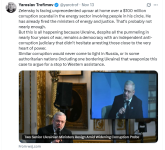
The biggest story in Ukraine right now and in much of the international press is a developing corruption scandal linked to the energy sector. Russian propaganda is heavily shaping the narrative, and many people are taking it as proof that Ukraine is “corrupt as a country.” I wanted to speak to a local Ukrainian and offer a different perspective on what’s actually happening: this is about accountability, and about Ukrainians demanding it from their own government.

We currently don't have a war going on here in the U.S., but we have much more corruption going on in our government, so I'm not feeling too critical of Ukraine for discovering some in their government. And Ukraine is actually doing smething concrete about it.


Top Ukrainian Ministers Resign as $100 Million Corruption Scandal Explodes​


https://static.westernjournal.com/wp-content/uploads/2018/04/Joe-S.-biomug-II-Joe-Saunders-150x150.jpg
By Joe Saunders November 14, 2025 at 6:23am

A corruption probe in Ukraine has cost two cabinet ministers their jobs — and could cost the government a lot more in terms of credibility.

According to the Associated Press, a scandal involving up to $100 million in kickbacks, including deals around the state-owned nuclear energy company, has sparked the forced resignations of the country’s justice minister and energy minister.

And a close business associate of President Volodymyr Zelenskyy could be implicated, according to the outlet.

The allegations — even in a system with a reputation for endemic corruption — are shocking in a nation that’s at war for its survival against a Russian invasion that started in 2022.

According to the Associated Press, a 15-month investigation by Ukraine’s National Anti-Corruption Bureau found that the suspects — who were unidentified — had cooked up schemes to use the energy company Energoatem as a source of kickback money, even to the point of exposing its assets to the Russian military.

Much more here: https://www.westernjournal.com/top-...sign-100-million-corruption-scandal-explodes/
 
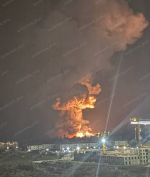
Russian port in Novorossiysk right now.


View attachment 2577544

That was huge.

And Ukraine apparently took out multiple S-400 air defense systems in the same strike.

The first strike shown in the video I’m providing shows the S-400s getting blown up:


😳

With those S-400s offline, I would expect further strikes on that port in coming days. There is a window of opportunity to do even more catastrophic damage.

👍

Slava Ukraini!!!

🇺🇦
 
Last edited:

Battle of Pokrovsk: How Russia broke into the city and what's next - Kyiv Independent


Pokrovsk, a city that held back some of Russia’s fiercest assaults for over a year, is now on the verge of falling. Despite Kremlin claims of encirclement, Russian forces have advanced through infiltration tactics, overwhelming infantry pressure, and relentless drone attacks — leaving Ukrainian defenders in an increasingly untenable position. The Kyiv Independent’s Francis Farrell explains how the battle reached this point and what Pokrovsk’s fall could mean for the wider defense of Donetsk Oblast.


Russian Ports Devastated As Ukraine Unveils Neptune Missiles


Ukraine has just taken out three Russian ports in one of the most devastating precision campaigns of the war — including Russia’s second-largest oil-exporting port. A combined Neptune missile + drone attack shattered key facilities and has sent Moscow scrambling to contain the damage.

As Ukraine dismantles Russia’s war economy, Moscow launched another massive missile strike on Kyiv overnight — a predictable act of retaliation that only underscores how desperate the Kremlin has become.

Meanwhile, extraordinary scenes are unfolding across Russia:
• North Koreans pouring into Russia to replace the lost workforce
• A collapsing oil market that the Kremlin can’t stabilize
• A global oil glut that makes Russia’s crude unsellable
• Bank runs spreading as ordinary Russians panic over the regime’s financial lies


Putin is isolating himself from basically everyone, presumably out of fear of assassination. Someone should really feed that paranoia and remind him that Caligula was killed by his own Praetorian guard.
 
Putin is isolating himself from basically everyone, presumably out of fear of assassination. Someone should really feed that paranoia and remind him that Caligula was killed by his own Praetorian guard.
LOL He has a lot of Russian history to remind him of that
 

Pokrovsk Still Holds — How Russia Got In and Why They’re Stuck


Ukrainian attack halfs oil exports from Russia's Novo, affecting 2% of global supply
Ryazan refinery hit yet again
A quarter of Russias generating capacity has been crippled
Ukraine is operating a two-later strategy - missiles for destruction, drones for disruption

Russia managed to push into the Pokrovsk sector — but the story didn’t end there. In this breakdown, I walk through how they got in, what caught Ukraine off guard, and the key factors that stopped the Russian advance cold. You’ll see the tactical choices, drone shifts, terrain features, and logistical chokepoints that shaped the outcome… and why the situation is far more complex than the headlines suggest.


NOVOROSSIYSK BLOWN UP, VORONEZH, SARATOV ON FIRE


During the strike on the Russian naval base in the port of Novorossiysk, in Russia’s Krasnodar region, Ukraine used Neptune missiles. Valuable port infrastructure and the Sheskharis oil terminal were hit, as well as an S‑400 launcher and a missile storage site, followed by detonation and fire. The Sheskharis terminal is one of the largest oil transshipment complexes in southern Russia. It is involved in supplying the armed forces of the aggressor state that are conducting combat operations in Ukraine.


The Armed Forces of Ukraine are using weapons of the future!


Need to use auto-translate for this one


Ukraine Is BREAKING Russia... Why Does PUTIN Still Reject PEACE?


Putin’s war in Ukraine has dragged on despite catastrophic losses, economic strain, and growing internal instability. Experts point to a mix of ambition, misinformation, political survival, and foreign pressure driving his refusal to negotiate. As Russia becomes increasingly dependent on militarization and external allies, the conflict persists with profound consequences for the nation’s future and global security.


Why Russia’s Gains Won’t Last


Russia has managed to push forward in several areas — but the story isn’t as simple as it looks. In this breakdown, I show how Russia made these gains, the vulnerabilities Ukraine faced, and the structural weaknesses inside the Russian advance that almost guarantee these moves won’t hold. From terrain realities to drone pressure to logistics collapsing under their own weight, you’ll see exactly why these gains may be short-lived — and what the next phase of the fight really depends on.

 
Back
Top