For Those Who Might Be Wondering Why We Might Be In Ukraine

The good thing is that any American business with a competent Board and/or C-Suite would not bother to re-invest in Russia as they face major risks of nationalization or sanctions from the next Admin. It's also likely Congress will flip in 2026 which will make business even harder. And Witkoff and Kushner in jail.

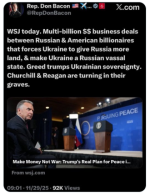
Make Money Not War: Trump’s Real Plan for Peace in Ukraine

Three powerful businessmen—two Americans and a Russian—hunched over a laptop in Miami Beach last month, ostensibly to draw up a plan to end Russia’s long and deadly war with Ukraine. But the full scope of their project went much further, according to people familiar with the talks. They were privately charting a path to bring Russia’s $2 trillion economy in from the cold—with American businesses first in line to beat European competitors to the dividends. At his waterfront estate, billionaire developer-turned-special envoy Steve Witkoff was hosting Kirill Dmitriev, head of Russia’s sovereign-wealth fund and Vladimir Putin’s handpicked negotiator, who had largely shaped the document they were revising on the screen. Jared Kushner, the president’s son-in-law, had arrived from his nearby home on an island known as the “Billionaire Bunker.”

Dmitriev was pushing a plan for U.S. companies to tap the roughly $300 billion of Russian central bank assets, frozen in Europe, for U.S.-Russian investment projects and a U.S.-led reconstruction of Ukraine. U.S. and Russian companies could join to exploit the vast mineral wealth in the Arctic. There were no limits to what two longtime adversaries could achieve, Dmitriev had argued for months: Their rival space industries, which raced one another during the Cold War, could even pursue a joint mission to Mars with Elon Musk’s SpaceX. For the Kremlin, the Miami talks were the culmination of a strategy, hatched before Trump’s inauguration, to bypass the traditional U.S. national security apparatus and convince the administration to view Russia not as a military threat but as a land of bountiful opportunity, according to Western security officials. By dangling multibillion-dollar rare-earth and energy deals, Moscow could reshape the economic map of Europe—while driving a wedge between America and its traditional allies. Dmitriev, a Goldman Sachs alumnus, had found receptive partners in Witkoff—Trump’s longtime golfing partner—and Kushner, whose investment fund, Affinity Partners, drew billion-dollar investments from the Arab monarchies whose conflict with Israel he had helped mediate.

The two businessmen shared President Trump’s long-held approach to geopolitics. If generations of diplomats viewed the post-Soviet challenges of Eastern Europe as a Gordian knot to be painstakingly unraveled, the president envisioned an easy fix: The borders matter less than the business. In the 1980s, he had offered to personally negotiate a swift end to the Cold War while building what he told Soviet diplomats would be a Trump Tower across the treet from the Kremlin, with their Communist regime as a business partner. "Russia has so many vast resources, vast expanses of land,” Witkoff told The Wall Street Journal, describing at length his hopes that Russia, Ukraine and America would all become business partners. “If we do all that, and everybody’s prospering and they’re all a part of it, and there’s upside for everybody, that’s going to naturally be a bulwark against future conflicts there. Because everybody’s thriving.”

When a version of the 28-point plan leaked earlier this month, it drew immediate protests. Leaders in Europe and Ukraine complained it reflected mostly Russian talking points and bulldozed through nearly all of Kyiv’s red lines. They weren’t assuaged even after administration officials assured them that the plan wasn’t set in stone, worried that Russia—after violently redrawing European borders—was being rewarded with commercial opportunities. As Western leaders convened this week to digest the plan, Poland’s prime minister Donald Tusk offered a pithy summary: “We know this is not about peace. It’s about business.” For many in the Trump White House, that blurring of business and geopolitics is a feature, not a bug. Key presidential advisers see an opportunity for American investors to snap up lucrative deals in a new postwar Russia and become the commercial guarantors of peace. In conversations with Witkoff and Kushner, Russia has been clear it would prefer U.S. businesses to step in, not rivals from European states whose leaders have “talked a lot of trash” about the peace effforts, one of these people said: “It’s Trump’s ‘Art of the Deal’ to say, ‘Look, I’m settling this thing and there’s huge economic benefits for doing that for America, right?’”

A question for history will be whether Putin entertained this approach in the interest of ending the war, or as a ploy to pacify the U.S. while prolonging a conflict he believes is his place in history to slowly, ineluctably win.

One sign that he may be serious is that some of his most-trusted friends, sanctioned billionaires from his St. Petersburg hometown—Gennady Timchenko, Yuri Kovalchuk and the Rotenberg brothers, Boris and Arkady—have sent representatives to quietly meet American companies to explore rare-earth mining and energy deals, according to people familiar with the meetings and European security officials. That includes reviving the giant Nord Stream pipeline, sabotaged by Ukrainian tactical divers, and under European Union sanctions.

Earlier this year, Exxon Mobil met with Russia’s biggest state energy company, Rosneft, to discuss returning to the massive Sakhalin gas project if Moscow and Washington gave the green light. Elsewhere, a cast of businessmen close to the Trump administration have been looking to position themselves as new economic links between the U.S. and Russia. Gentry Beach, a college friend of Donald Trump Jr. and campaign donor to his father, has been in talks to acquire a stake in a Russian Arctic gas project if it is released from sanctions. Another Trump donor, Stephen P. Lynch, paid $600,000 this year to a lobbyist close to Trump Jr. who is helping him seek a Treasury Department license to buy the Nord Stream 2 pipeline from a Russian state-owned company. There is no evidence that Witkoff, the White House or Kushner are briefed on these efforts or coordinating them. A person familiar with Witkoff’s thinking said the envoy is confident that any settlement with Russia would benefit America broadly, not just a handful of investors.

Witkoff, who hasn’t traveled to Ukraine this year, is set to visit Russia for the sixth time next week and will again meet Putin. He insisted he isn’t playing favorites. “Ukrainians have fought heroically for their independence,” said Witkoff, who has tried to inspire Ukrainian officials with the idea of soldiers disarming to earn Silicon Valley-scale salaries operating American built AI data centers. “It is now time to consolidate what they have achieved through diplomacy,” he said. “The Trump administration has gathered input from both the Ukrainians and Russians to formulate a peace deal that can stop the killing and bring this war to a close,” said White House spokesperson Anna Kelly. “As the President said, his national security team has made great progress over the past week, and the agreement will continue to be fine-tuned following conversations with officials from both sides.”

An administration official said that Kushner and Witkoff also met with Ukraine’s national security adviser, Rustem Umerov, in Miami and spoke with Ukrainian President Volodymyr Zelensky. The official said that while Trump has “done a lot of new, important things regarding economic incentives,” he and his team have also been focused on “geopolitical and military realities.” As Witkoff pursued talks with Dmitriev over nine months, some agencies inside the Trump administration had a limited view of his dealings with Moscow. In the lead-up to an August summit in Alaska between Trump and Putin, Witkoff and Dmitriev discussed a prisoner exchange that would have been the largest bilateral swap in their countries’ history. The Central Intelligence Agency, which traditionally manages prisoner trades with Russia, wasn’t fully briefed on that proposed exchange. Nor was the State Department’s office for unjustly imprisoned Americans. The CIA didn’t return requests for comment. The State Department referred questions to the White House. Career officials in the office overseeing sanctions at the Treasury Department have at times learned details of Witkoff’s meetings with Moscow from their British counterparts.

In the days after Alaska, a European intelligence agency distributed a hard-copy report in a manila envelope to some of the continent’s most senior national security officials, who were shocked by the contents: Inside were details of the commercial and economic plans the Trump administration had been pursuing with Russia, including jointly mining rare earths in the Arctic. Witkoff has worked closely with Vice President JD Vance and Secretary of State Marco Rubio. But Trump’s special envoy for Ukraine, former Lt. Gen. Keith Kellogg, has been all but frozen out of serious talks, and last week said he is leaving the government. To understand the story behind the administration’s Russia negotiations, The Wall Street Journal spoke to dozens of officials, diplomats, and former and current intelligence officers from the U.S., Russia and Europe, and American lobbyists and investors close to the administration. The picture that emerges is a remarkable story of business leaders working outside the traditional lines of diplomacy to cement a peace agreement with business deals.

https://www.wsj.com/world/russia/ru...0?st=zSGL71&reflink=desktopwebshare_permalink
 
Massive Drone Strike on Ruzzia | Frontline Situation | Yermak Dismissed

Lots of kabooms in Russia. Grozny hit!

 
Kremlin wants to erase Ukraine from the map - Putin reveals his true plan!

Putin wants Ukraine to hand over land BEFORE Peace Talks LOL

Putin demands the impossible again — handing over Ukrainian territories in exchange for "talks." In a new scandalous speech in Bishkek, he repeats ultimatums, threatens the world, and tries to redraw Europe's borders. But the true nature of the Kremlin's "peace initiatives" has been called out by everyone this time: BBC, CNN, The Guardian, EU, and allies.

While the dictator threatens, the Ukrainian army takes real action: destruction of the Saratov oil refinery, strike on the drone base in Saky, halting the Russian offensive near Huliaipole, and blocking the enemy near Kupyansk. Partners launch new armaments programs: drone coalition, license for producing Ukrainian interceptors in Britain, NATO support, and massive expansion of Ukraine's defense industry.

0:00 – Intro
0:34 – Putin's absurd statements in Bishkek: ultimatums, manipulations, and blackmail
4:36 – World media reaction: BBC, CNN, The Guardian expose Kremlin lies
7:10 – Orbán with Putin: cheap gas in exchange for silence on aggression?
9:02 – Massive UAV strikes on Saratov, Engels, and Saky
10:16 – On the front: Ukrainian army halts Russian offensive near Huliaipole and cuts logistics near Kupyansk
11:37 – ISW: Russia suffers huge losses, positional battles, and offensive failure
12:19 – Partners ramp up aid: drone coalition, contract with Britain, $5B from allies
14:28 – Ukraine scales up weapons production: air defense, drones, and ammo — record defense growth


Putin’s War in Ukraine Backfires HARD


Russia’s four-year war in Ukraine is grinding its economy to the brink. Skyrocketing prices, collapsing industries, and relentless Ukrainian drone strikes are exposing a nation stretched past its limits. As winter approaches, Russia’s finances, infrastructure, and public patience are wearing thin. Behind closed doors, quiet peace talks are underway—but Putin is running out of time, options, and money. One question now hangs over the Kremlin.

 
Two Russian Oil Tankers Attacked By Marine Drones: On Fire in the Black Sea

Ukrainian marine drones attack two Russian oil tankers who are part of the shadow fleet. The Virat and Kairos were attacked on their way to Novorossysk. Five marine drones hit one. An unknown amount the other.


Putin Can’t Sign the Peace Deal — His Hardliners Won’t Let Him


Most analysts look at peace proposals by asking what Zelensky can or cannot accept. But almost nobody asks the opposite question: Can Putin even sign one? In this video, we flip the lens to examine the internal forces constraining Putin — the nationalist hardliners, the “Angry Patriots,” and Igor Girkin himself, who just published a blistering critique showing why any peace deal would cost Putin his legitimacy, territory, and even his alliance with China.

Putin isn’t an absolute dictator; he’s trapped between competing factions, political fears, and a military he cannot afford to demoralize. This breakdown reveals the internal pressures that make any peace settlement nearly impossible for the Kremlin.


Trump is ‘no friend’ to Ukraine as Europe ‘steps up’ to take down Putin | Sir Bill Browder


Sir Bill Browder joins Times Radio’s Maddie Hale to discuss the latest developments on Ukrainian land concession discussions, why the progression of the war puts Vladimir Putin’s life at stake and The New York Times details the timeline of European officials finding out the United States had left them out of a peace plan proposal.


RUSSIA LOST ACCESS TO SPACE


Damage of the launch platform on Russia`s Baikonur space field cancels their manned space programs for the first time since 1961. During another unsuccessful test launch, Avangard intercontinental ballistic missile explodes in the air. Russia`s shadow fleet tanker on fire in the Black Sea, as Yelabuga military construction site is destroyed by Ukrainian drones too.

 
Listen to what she's saying - shes saying that the tale that the USSR and China WON WW2 is fiction, and she's right. China mostly fought a civil war while the Americans defeated Japan - and as for the USSR, without American lend lease they would have been toast.

Just like Kaja, you are trying to rewrite history..... The Chinese fought a civil war before and shortly after WW2, but during the war Mao and Chiang Kai-shek joined forces and fought Japan. As to lend-lease. It was Great Britain who benefitted by about 30 billion, USSR got about 3 billion. Yes, a significant help to USSR with food and war material, but majority of it did not start arriving until 1943. By then, USSR was already pushing Germans back to Germany. At worst the war would have taken maybe a year longer and The D-day would have been pushed also.

I am NOT denying that USA and Britain ( you forgot) greatly helped to defeat Germany, but NOBODY in the right mind can say that at, and after 1943 USSR would have lost a war. As I have said it is rewriting history. But hey...... NOBODY in Ukraine is building statues to Bandera :D and Estonian Herberts Cukurs was a great aviator.:D

 
Trump Suffers Polling Blow Over Ukraine Peace Plan

U.S. President Donald Trump has been hit with a negative poll about his plan to end the war between Russia and Ukraine. According to polling by YouGov, the majority of Americans disapprove of Trump's handling of the conflict, as the U.S. continues its latest push to try to broker a lasting peace deal between the two countries. Newsweek contacted the White House for comment via email outside normal business hours. One of Trump's pledges during the 2024 presidential campaign was to end the war in Ukraine within 24 hours of taking office, but efforts to do so have thus far failed. Last week, details of the U.S.'s 28-point plan to end the war were disclosed, but some lawmakers raised concerns that it was too conciliatory to Russia, leading to alterations.

Meanwhile, a leaked call from October showed Trump's special envoy Steve Witkoff coaching top Kremlin officials on how to pitch a Russian plan for ending the war to the U.S. president, which drew further scrutiny.

YouGov's survey of 4,058 U.S. adults, conducted on November 26, found that 46 percent of Americans disapproved of Trump's handling of the conflict, while 36 percent approved. Of those who disapproved, 36 percent strongly disapproved. The polling division fell on party lines, with 72 percent of Republicans approving of Trump's handling of the war and 79 percent of Democrats disapproving.

https://www.newsweek.com/donald-trump-ukraine-russia-peace-plan-polling-11123799
In today's political climate does a survey that falls within party lines actual tell you anything about policy or is it more about TDS.
 
Trump Suffers Polling Blow Over Ukraine Peace Plan

U.S. President Donald Trump has been hit with a negative poll about his plan to end the war between Russia and Ukraine. According to polling by YouGov, the majority of Americans disapprove of Trump's handling of the conflict, as the U.S. continues its latest push to try to broker a lasting peace deal between the two countries. Newsweek contacted the White House for comment via email outside normal business hours. One of Trump's pledges during the 2024 presidential campaign was to end the war in Ukraine within 24 hours of taking office, but efforts to do so have thus far failed. Last week, details of the U.S.'s 28-point plan to end the war were disclosed, but some lawmakers raised concerns that it was too conciliatory to Russia, leading to alterations.

Meanwhile, a leaked call from October showed Trump's special envoy Steve Witkoff coaching top Kremlin officials on how to pitch a Russian plan for ending the war to the U.S. president, which drew further scrutiny.

YouGov's survey of 4,058 U.S. adults, conducted on November 26, found that 46 percent of Americans disapproved of Trump's handling of the conflict, while 36 percent approved. Of those who disapproved, 36 percent strongly disapproved. The polling division fell on party lines, with 72 percent of Republicans approving of Trump's handling of the war and 79 percent of Democrats disapproving.

https://www.newsweek.com/donald-trump-ukraine-russia-peace-plan-polling-11123799
Sorry to (appear to) nit pick, but it was not "his" plan. Major swaths lifted straight from Kremlin

Never, Never in US history has a president ceded decision-making (or policy) to an adversary
AMAZING

You bet textbooks will review these times, each in search of explanation of "WTF wrong with those people?"
 

Kadyrov SECRETLY BUILDS Huge Private Army. REBELLION Preparation?


The fragile alliance between Vladimir Putin and Ramzan Kadyrov is cracking, and the consequences are enormous for Russia, Chechnya, and the war in Ukraine. For twenty years the Kremlin funded Kadyrov’s rule, armed his militias, and allowed him to build a state within a state in exchange for one thing: silence in the North Caucasus. But the war in Ukraine shattered that balance. As soon as the invasion began, Kadyrov sent fighters and propaganda crews to boost his influence — then abruptly pulled back, claiming Chechnya had “sacrificed too many men.” Instead of punishing him, Moscow kept paying billions to keep the region quiet. That money is no longer going into the war. It’s being used to expand the Kadyrovtsy, a massive private army loyal not to Russia, but to Kadyrov personally.

This is the nightmare scenario the Kremlin never wanted: a heavily funded, well-equipped, fully independent military force operating inside Russia’s borders, answering only to a warlord whose health is declining and whose focus has shifted from loyalty to legacy. As Kadyrov consolidates power, trains elite units, and prepares his successors, Putin is left financing an army he may not be able to control. Analysts warn that Kadyrov’s private forces could secure the republic after his death — or destabilize it. They could enforce loyalty to Moscow — or challenge it. They could protect Russian interests — or trigger the very separatism Putin spent his entire career crushing.

What was once a marriage of convenience is now a dangerous imbalance. Kadyrov’s autonomy grows as Russia weakens. His private army expands while the Russian military suffers losses and shortages. And Putin, already overwhelmed by the war, fears confronting the one man whose rebellion could ignite the Caucasus. The Kremlin publicly pretends everything is stable, but behind the scenes, they know the truth: by funding the Kadyrovtsy, they may have armed the very force that could one day turn against them. The private army Putin created to secure Russia has become the biggest threat to his own power.

 
If Trump Gives Away Ukrainian Territory, America’s Global Security System Collapses

If the United States recognises Russia’s occupation of Ukrainian territory, the consequences will spread far beyond Europe. It will trigger a chain reaction that collapses the entire security architecture America has relied on for decades.

Europe will respond with force.
  • Recognising Russian land grabs destroys the principle that borders cannot be changed by conquest. Europe will move militarily into eastern Ukraine to stop further Russian expansion. NATO unity will fracture because the United States would be the one who broke the foundation it created.

China will act in the Pacific.
  • Beijing will see the collapse of US resolve as the moment to break American containment. China will push into the First Island Chain and challenge US positions near Japan, Taiwan and the Philippines. The Pacific will no longer be a buffer. It becomes a direct strategic route toward the US mainland.

North Korea will exploit the weakness.
  • Pyongyang will immediately pressure or attack South Korea, knowing the United States cannot project strength on two fronts at once. America will either be drawn into a major Asian conflict or forced into withdrawal, ending its credibility in the region.

Japan and South Korea will lose faith in the US.
  • Both nations rely on American protection. If Washington abandons Ukraine under pressure from a political faction, they will no longer consider the US a stable ally. This would shift the balance of power in East Asia overnight.

Taiwan becomes indefensible.
  • With credibility broken, deterrence collapses. China will move on Taiwan, and the US will face a choice between an enormous war or abandoning another democratic partner.

The Middle East will shift away from the US.
  • All states dependent on American stability Saudi Arabia, Israel, Jordan, the Gulf states will reassess their alliances. They will turn toward China and Russia because they will no longer trust US guarantees.

All of this begins with a single decision: legitimising Russia’s territorial conquest.

And it is driven by a tiny group around Trump.
  • A small circle with strong pro Russia sympathies and personal interests tied to Russian energy assets. They are not the Republican Party. They are not normal America. But they have the president’s ear and they do not understand the global chain reaction their actions would ignite.

This is not about ideology.
It is about the destruction of US credibility.

Giving away Ukrainian territory does not end a war. It starts a global one.

Trump is now a threat to gobal peace and security. He has no idea what he doesn't know and he can't be bothered finding out.

1764447120207.png
 
This is not about ideology.
It is about the destruction of US credibility.

Sounds like a plan that Putin & Xi would cook up… with help from a puppet…

🤬

Giving away Ukrainian territory does not end a war. It starts a global one.

Sounds like something that benefits Putin & Xi (Russia & China) …and it helps that their puppet is preemptively ceding territory…

🤬

Trump is now a threat to gobal peace and security. He has no idea what he doesn't know

Trump doesn’t need to know anything… That is what Putin & Xi are for…

🤬

We. Told. Them. So.

🌷
 
Here, John Mearsheimer breaks down the Trump-led Ukraine peace deal currently being negotiated with Russia. He delivers a deep, unsparing, and scholarly assessment of its moral costs, its political realities, and the power dynamic it reflects. You’ll be well served to hear every word of his explanation of why, and how from it's beginning in 2008 we’ve arrived at this historic turning point today. It's worth the time.


🙄

Russiaguide just can’t stop pushing Russian propaganda laundered through western mouthpieces…

👎

Meanwhile:

Putin’s War in Ukraine Backfires HARD


Russia’s four-year war in Ukraine is grinding its economy to the brink. Skyrocketing prices, collapsing industries, and relentless Ukrainian drone strikes are exposing a nation stretched past its limits. As winter approaches, Russia’s finances, infrastructure, and public patience are wearing thin. Behind closed doors, quiet peace talks are underway—but Putin is running out of time, options, and money. One question now hangs over the Kremlin.


And that ^ crippling of Russia by Ukraine is despite DonOld & the MAGAt republicans sabotaging the support of Ukraine FOR TWO FUCKING YEARS.

😳

Slava Ukraini!!!

👍

🇺🇦

We. Told. Them. So.

🌷
 
Back
Top