For Those Who Might Be Wondering Why We Might Be In Ukraine

Putin's Oil Empire Falls Into Chaos


For the first time, Ukrainian forces struck directly at Russia’s shadow tanker fleet in the Black Sea, disabling two vessels that sustain Moscow’s sanctions-busting oil trade. The implication is enormous: a de-facto blockade of Russian maritime oil exports is now becoming possible. The Black Sea is no longer safe for Russia’s logistics, and the regime’s ability to finance the war through offshore smuggling is under direct threat.

This comes as Russia’s largest oil producer — responsible for roughly 40% of national output — reports earnings down nearly 70% year over year, catastrophic numbers that expose the collapse behind Kremlin propaganda. China is now demanding even deeper discounts on Russian crude, forcing Moscow to sell below Brent just to keep shipments moving.

At the same time, Russia launches another large-scale missile and drone attack on Ukrainian cities, while boasting about weapons that increasingly fail to function. A test launch of the Sarmat intercontinental missile ends in spectacular malfunction — an embarrassing symbol of Russia’s deteriorating military industry.

Despite record budget deficits and plunging revenues, Putin responds by increasing war spending yet again, doubling down on a conflict the economy can no longer sustain.

Meanwhile, the information battlefield continues to decay. Elon Musk’s platform X has become saturated with Russian propaganda, while more British MPs are caught accepting Moscow-linked money. Viktor Orbán returns to Moscow as well, exploiting carve-outs created by Trump to keep Russian oil flowing into Europe — another reminder of how political weakness sustains an increasingly isolated regime.

Russia is losing control — at sea, in energy markets, financially, and diplomatically — but it continues to sacrifice everything to keep its failing war machine alive.

 
Wolfpack - Ukraine changes naval warfare

Poland and Norway’s Kongsberg are teaming up to mass-produce Ukraine’s Seawolf unmanned naval drones, turning Eastern Europe into the world’s newest factory for robot warships. If Russia’s admirals were sleeping well before, they definitely are not now. In today’s video, I break down why this deal is a tectonic shift in European defense, how the Seawolf system actually works, and why the new Polish production line is a strategic nightmare for Moscow.

Seawolf is a modular family of naval drones, designed by Ukraine’s Nordex to adapt faster than Russia can update a map. I go through the two main variants:

The 7.5-meter Seawolf – the stealthy scout
Ultra-low profile that hides in sea clutter

The 9.5-meter Seawolf – the naval sledgehammer
4,000 kg payload capacity

And here’s where it gets spicy: Nordex says they can produce 25 heavy Seawolfs per month. Put that production inside Poland, safe from Russian missile strikes, and suddenly Europe has a swarm-capable fleet factory operating on NATO soil.

Poland wants to be the arsenal of Europe, and this deal moves them one major step closer.

This production deal is about shaping the naval battlefield of the 2030s, where unmanned surface vessels dominate sea lanes, threaten ports, and make billion-dollar legacy fleets think twice before leaving harbor.

If Russia thought the Moskva sinking was a fluke, they are about to learn what happens when Ukraine gets an industrial-scale drone navy.

This video explores the collaboration between Poland, Ukraine, and Norway in manufacturing Seawolf naval drones, a significant development in military technology. This partnership combines Ukrainian battlefield innovation with Norwegian funding and Polish industrial capabilities, creating a powerful force in naval engineering. The mass production of these unmanned vessels marks a substantial shift in Europe's defense posture, with considerable implications for drone warfare and overall defense innovation.
 

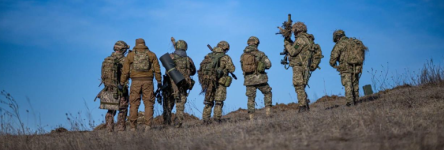
Ukrainian Ground Drone SOLOS Russian Infantry for Over a MONTH!


Ukrainia drone holds infantry position lone for 45 days....Crazy and scary how cheap and effective this is. The drone is not fully independent - it was regularly withdrawn for some time for repairs and reload by operators in a safe location behind the frontline. Basically an automated mobile pillbox if they wanted to be. They could also use drones to re-supply it's ammo with an auto loading cartridge system. Same with battery, a drone could fly in a new battery and collect the old battery for recharging. Otherwise it could utilise a small solar panel also. Add IR detection and AI target acquisition and you have a 24/7 smart sentry anti infantry weapon system. Probably has night vision and obviouslyy motion detection as well.


Zelensky BREAKS IN with URGENT NEWS on the NEGOTIATIONS! DETAILS of the meeting in the US


The Ukrainian delegation will meet in the United States on November 29 with Donald Trump’s special envoy, Steve Witkoff. Led by National Security and Defense Council Secretary Rustem Umerov, the Ukrainian representatives are expected to promptly and substantively discuss the next steps toward ending the war. President Volodymyr Zelensky announced this during his daily address to Ukrainians.

 
Putin Orders Draft as Recruitment PLUMMETS!

Governor of Yakutia declares there is no money to pay for soldiers sign on fees and burials. It's not just Yakutia. most regions are heading towards bankrupcy and have asked Moscow for emergency fundings...

Russia has called up all reservists in Luhansk and Donetsk. Kind of surprised there are anyone left. Every able-bodied male is a member of the reserves - they were told they would be guarding infrastructure but are now being given cursory combat training for assault operations. Sounds like Russia is hardup for people and they're draftimg the ones they want to get rid of - the seperatists in luhansk and Donetsk are going to find out they are expendable - unfortunately along with everyone else. Lets hope they can figire out how to desert quickly.


Russian Milblogger Explodes Kremlin’s Biggest Battlefield Lies


Russian milbloggers are rather more truthful that the Russian govt.

A major rupture has opened inside Russia’s information war. One of Moscow’s most influential milbloggers just exploded the Kremlin’s biggest battlefield lies — openly contradicting the Ministry of Defense and exposing the real situation on the front.

Why would a pro-Kremlin voice risk everything now? After all, nationalists want Russia to win. And what does this internal revolt reveal about Russia’s collapsing grip on the war narrative?

Today we break down the blogger’s claims, what he revealed, and why this moment is far more dangerous for Moscow than the Kremlin wants to admit.
- Ukrainian frontline is NOT collapsing
- Russia is far from victory
- Russian forces have become optimized to fight positional warefare with low quality personnel, insufficient armor and poor command and control

 
Putin’s broken promises: Former negotiator explains why Russia’s history dooms any peace talks

Putin’s track record of breaking written assurances makes any pledge to respect Ukraine’s sovereignty essentially meaningless while he holds power, says former Ukraine-Russia negotiator Jeffrey Price.

 
BEN HODGES: Putin’s WAR plans RUINED! Russia WILL NOT sustain the fight in 2026.

TV Host Daniel Tkiie and Ben Hodges, a retired United States Army officer who served as commanding general, United States Army Europe, discussed the latest news surrounding the war in Ukraine. U.S. Army Secretary Dan Driscoll warned Ukraine of imminent defeat and urged officials in Kyiv to accept U.S. peace proposal. His message was that Ukraine could lose the war. Is he right?

 
Russia Accidently Break Their Only Launch Pad To Space Station

Oh dear

The Launch of Soyuz MS-28 was successful, but the launch pad in Baikonur lost a critical piece of hardware which will require a lot of work to replace. Until this is done there's no way for Russia to launch Cargo or Crew to the International Space Station

 
The Military Equipment Cost Problem - Why (some) Nations Struggle to Build Affordable Weapons

Many countries have gotten pretty good at producing cutting edge military equipment - but cheap equipment is often a different matter.

With the war in Ukraine demonstrating that quantity and affordability can sometimes matter as much as raw capability, today (by patron vote), I want to unpack some of the reasons countries can sometimes struggle to build equipment for less than eye-watering prices - and what options might be available to try and narrow the cost gap with more economical competitors.

 
Kremlin’s Secret Nuclear Missile Test Just FAILED

The November 28 purple plume incident at the Yasny missile complex (Orenburg region) indicates a critical oxidizer-rich exhaust failure within Russia's Strategic Missile Forces. This analysis identifies the specific nitrogen tetroxide leak signature and correlates it with supply chain disruptions in the Russian defense industrial base. We map the connection between this hypergolic anomaly and the broader reliability crisis facing the RS-28 Sarmat and Avangard programs.

Defense procurement data and the 2026 Federal Budget reveal how technical corrosion is increasing sovereign financial risk. By examining the cost of sanctioned alloys and precision tooling, we model the fiscal deficit impact of failed test schedules. This segment targets the intersection of aerospace engineering failures, global energy market volatility, and defense insurance liquidity.

Historical launch data from Plesetsk confirms the toxicology risks of hydrazine handling under deadline pressure. As Western intelligence monitors airspace closures and rail movements east of the Ural Mountains, this report determines if the Yasny event represents a temporary handling error or a systemic collapse in nuclear deterrence capability.

CHAPTERS:

00:00 Nuclear Disaster at Yasny Base
01:15 Kremlin Losing Control
02:10 Why This Moment Matters
03:00 Support Ukraine Message
03:40 Inside Russia's Nuclear Weakness
05:10 Strategic Failures Across Russia
06:15 Ukraine Strikes Deep Into Russia
07:20 Russia's High Tech Weapons Collapse
08:20 Russia's War Machine Cut in Half
09:20 Sea Routes and Oil Under Attack
10:15 Russia's Economy Breaking Down
11:20 Kremlin Power Struggles
12:15 Putin Misreads the Crisis
13:10 Regime Near Breaking Point

 
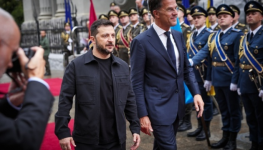
President Volodymyr Zelensky emphasized that many things may change in the coming days. He reported this on Telegram following a conversation with NATO Secretary General Mark Rutte, Ukrinform notes.

“I spoke with Mark Rutte, NATO Secretary General, and we will continue our conversation in the coming days. These are important days, and much can change,” Zelensky said.

1764535767523.png
 

It was a lie, as are so many others by the government and the media to justify the war in Ukraine.

🙄

These ^ fucking MAGAt imbeciles don’t seem to understand that Russia invaded Ukraine in FEBRUARY of 2022, and the pipeline was blown up in SEPTEMBER of 2022 (so who really cares that Ukraine sabotaged a potential source of income for Russia’s war economy???).

😑

Also:

There WERE various narratives going around at the time, and it was perfectly prudent for President Biden to remain skeptical of all of them and not publicly make a determination. It also would have hurt the Ukrainians at a time when they needed all the support they could get (but that is what traitors like HDH & Russiaguide would have wanted).

😑

We. Told. Them. So.

🌷
 
Last edited:
No, and this is why much of your concept of this war is flawed. Take the time and watch that last video I posted.
Yes, they invaded Georgia in 2008.
You are flawed because Putin's cock is glued to your mouth
 

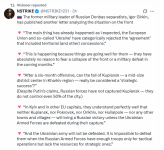
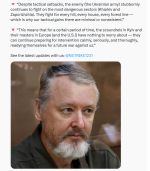
He makes some accurate statements, and then undermines his credibility by suggesting that the U.S. and Europe were / are preparing to go to war with (attack) Russia…

😑

If he would have said: “The Ukrainians and the Europeans (including the U.S. under Trump is laughable) are readying themselves to counter-attack and drive the Russian invaders out of Ukraine”, he would have been more credible.

👍

Slava Ukraini!!!

🇺🇦
 
He makes some accurate statements, and then undermines his credibility by suggesting that the U.S. and Europe were / are preparing to go to war with (attack) Russia…

If he would have said: “The Ukrainians and the Europeans (including the U.S. under Trump is laughable) are readying themselves to counter-attack and drive the Russian invaders out of Ukraine”, he would have been more credible.

When alls said and done, Girkin's a straight out Russian nationalist and he was instrumental in taking those first chunks of Ukraine. It's not that he opposes it, he just thinks Putin cant win this one
 
Ukrainian soldiers reject Trump peace plan as “real capitulation”

“It is not the state leadership sitting in the trenches. It is our boys in the trenches. They have the right to decide,”
says Sgt. Volodymyr Rzhavskyi, rejecting a peace plan that would recognize the Donbas as de facto Russian.

Despite their sincere desire to return to peaceful life, Ukrainian servicemen reject the peace plan announced by the Americans to end the war, as it involves significant concessions to Russia, NBC News reported. Senior Sergeant Volodymyr Rzhavskyi, who is defending the city of Pokrovsk, considers Trump's plan completely unacceptable for Ukraine. "It's not a plan. It's a real capitulation. There is nothing to discuss here," Rzhavskyi told NBC News. The 28-point proposal would recognize the Donbas—comprising fiercely contested Donetsk and Russia-controlled Luhansk—as de facto Russian territory. For Rzhavskyi, 44, who commands a drone unit in his native Donetsk oblast, this is personal. "Of course, for me this is a painful issue, because all of this is happening in my homeland," he said.

Four years on the front lines have destroyed his health, Rzhavskyi said. He wants to focus on recovery and his two sons, ages 5 and 14. But he demands accountability from leadership before any withdrawal. "If it comes without an explanation, it will not be carried out. It is not the state leadership sitting in the trenches. It is our boys in the trenches. They have the right to decide."

Oleksandr, a 43-year-old lieutenant with Ukraine's special forces fighting in the south, rejected another key provision—the proposed 600,000-strong cap on Ukraine's military. "Nobody will make concessions on the size of the military, because it's our security guarantee," he told NBC News. "Nobody will make concessions on the territories, because it's our land and we stand here." Before the war, Oleksandr ran a cocktail bar in central Kyiv. Now he's focused on one thing: "If we don't stop them now, then our children will have to do this, and we can't let this happen."

Lt. Dmytro Melnyk, a drone operator in Dnipropetrovsk oblast, described the daily reality of fighting with inferior equipment against superior Russian numbers. "The Russians are not better warriors than us. There are just so few of us," said Melnyk, 46, a Paralympic athlete who competed in Paris last summer on battlefield leave. Despite years of combat, Melnyk harbors hope for peace—but not on these terms. "At the beginning of the war, we were like 'Go, go, go,' and it's not the case anymore. Obviously, I won't stop until the war is done, but my soul is torn," Melnyk said. "I won't hide it. There is a constant fear of dying."

Military analyst Mykola Bielieskov of the National Institute for Strategic Studies questioned the logic that Ukraine should accept unfavorable terms before losing more territory. "It's much worse when we make unilateral concessions and withdraw from the Donetsk region, but Russia retains potential and can now threaten neighboring regions," he said. Asking soldiers "who risked their lives and lost their comrades to slow down the Russian offensive" to abandon positions they still hold "won't be taken positively," Bielieskov added. Junior Lt. Oleh Zontov, 58, who served in Donetsk before moving to a civilian-focused role, acknowledged abandoning Ukrainian-controlled territories would be "a very controversial decision" causing "outrage and negativity within the military." Still, Zontov welcomed that "some" peace plan exists. His definition of victory has shifted with battlefield realities: "Today, victory would probably mean stopping the enemy where it is now and holding it at these positions."

What Trump and Witkoff seem to be completely unaware of is that there is no possible world in which Ukraine will make major concessions and capitulate. The Ukrainian military is made up of those who largely are intent on fighting the Russians and many of the best units are strongly Ukrainian nationalist. There would be another Maidan if the agreement concedes too much - and a big chunk of the military have been fighting since 2014 and see no real reason to stop short of bringing down Russia. Trump seems to think of this as a real estate transaction. It's not. It's peoples hearts and souls and lives.
https://euromaidanpress.com/2025/11...reject-trump-peace-plan-as-real-capitulation/
1764547057265.png
 
Beyond Trump’s “Russian Plan”: There Will Be No Peace Agreement With Moscow - Part I

This Is Not Actually Bad News


Much has been written and said since Trump’s “Russian plan” was leaked. An uncompromising analysis has been made by excellent authors, notably Timothy Snyder, Lawrence Freedman, and Michael Weiss, of its 28 points, all of which are obviously unacceptable to Ukraine, but also to Europe. The links between Trump’s special envoy, Steve Witkoff, and his complacency—which remains an understatement—towards Russia and the profits that some close to the Trump regime hope to make have been widely demonstrated. One could undoubtedly call it a corruption pact. We have seen attempts by US Secretary of State Marco Rubio to make it vaguely more presentable, but his submission to the US president has not been contradicted, as he even went so far as to request the signing of the so-called peace plan before any security guarantees had been announced. As for the Republican US lawmakers who have shown, sometimes forcefully, their opposition to the Dmitriev plan dictated to Witkoff, we now wait to see if this will translate into a vote in Congress.

On the other side, President Zelenskyy is forced to accept diplomatic contortions in order to avoid a brutal confrontation with Trump. He knows full well that the so-called negotiations are a shadow theater from which nothing serious can emerge. He is also buying time to avoid a suspension of aid from US military intelligence. He has long since learned to put up with the humiliating actions of Trump and sometimes others. For the time being, he is playing along because he believes that not doing so would be even worse for Ukraine. One can only imagine what his thoughts are, as they have been for a long time.

As for the Europeans, they have proposed a 19-point plan, the exact wording of which is unknown and which, incidentally, one wonders whether it has been taken into account at all by the US administration. It is certainly more presentable, despite what appears to be a great deal of vagueness. The Europeans were right to clearly oppose the “Russian plan,” while sparing Trump, but they were probably wrong to start from the document presented by the Americans, when it would have been more sensible to present their own version beforehand. This would have allowed them to be seen as the ones setting the agenda, rather than appearing as followers sitting on the sidelines. They are also well aware that, if they want to be taken seriously, only military action will provide concrete proof of their commitment.

Unsurprisingly, Moscow has denounced the European plan and said it is prepared to start from the one officially proposed by Washington, without however accepting it. It hardly needs repeating: Russia does not want to stop the war, but on the contrary to pursue it to the end, which for it means the submission of Kyiv, then to take it to European soil. The evidence of Moscow’s refusal to accept any form of peace was also pointed out by the French president. No one can pretend that this reality does not exist, let alone act as if it does not. In any case, neither Trump’s so-called peace plan nor the European plan will see the light of day. Peace is not coming anytime soon—and neither plan would bring it about. The predictable failure of any peace plan with Russia, as paradoxical as it may seem—of course, everyone wants peace, especially the Ukrainians—is ultimately not such bad news; in fact, quite the opposite. That is what I will endeavor to demonstrate.

What the “Russian plan” tells us about Trump’s United States

The plan supported by Washington should serve as a revelation of what the United States has become—and it cannot be ruled out that it will remain so for a long time to come. It has often been pointed out, and I have echoed this here, that the concern to “resolve” what some considered to be a “Ukrainian problem”—when in fact it was a global Russian problem—was already present before, beyond any overt support. This temptation to “move on” still animated some Western European leaders at the start of Russia’s all-out war against Ukraine. The radical change, however, comes from the fact that they have completely switched sides to the enemy, even though they still insisted that it would be possible to envisage peace with Russia—and this illusion has had devastating consequences for the Ukrainian nation and the security of Europe as a whole. However, the current plan reveals an even more fundamental shift: a worldview ideologically aligned with that espoused by Moscow, but also by Beijing.

The first element of this vision is not only indifference to international law, but also to the mass crimes perpetrated by the Russians. Many elements of the plan attest to this. The first is the abandonment of the territories occupied by Russia—and even beyond—as if border rights no longer mattered and as if the summary executions, torture, deportations of children, and mass rapes committed there on an almost daily basis did not in themselves constitute a decisive obstacle to any cession. The second is undoubtedly the clause providing immunity for Russian criminals, a clause which is in any case unenforceable because only the International Criminal Court can rule on these crimes and cannot be bound by an agreement between states. Let us remember that international criminal law cannot be the subject of any mediation or negotiation. The third highly problematic point is the prospect of Russia’s reintegration into a process of regular consultation and discussion at the international level, particularly the G8, as if aggression and crimes did not preclude any reintegration. Finally, the absence of any mention of the reparations that Russia owes Ukraine and the lifting of sanctions complete the establishment of a “new order” based on lawlessness.

Undoubtedly, two different paths are leading the current US leaders to this scuttling of the law.

The first is the lure of profit that characterizes Steve Witkoff, Jared Kushner, who appears to be involved in discussions with the Russians, and Trump himself, even though the latter, who has no deep understanding of the issues at stake, is also willing to sign any document that includes the word “peace” in the foolish hope of being rewarded for doing so. At a certain point, the most blatant immorality can have terrible consequences on a global scale. These people have no consideration for the victims and no outrage at the crimes because it does not fit into their mental categories. In their world, there are no guilty parties and no victims, no murderers and no innocents: their moral relativism is that of a Putin.

Another path, perfectly convergent, is the one championed by J. D. Vance. He is no different in moral terms, but it is ideological and, it must be said, ideologically radical. The destruction of the law in the former cases can be explained by indifference; in Vance’s case, it is the nature of an elaborate and constructed project. He knows full well that the “Russian plan” not only directly threatens the security of Europe, but is also a major offensive against his own principles—in this, too, he is entirely aligned with Putin. Impunity is his goal not only for himself and his clan, but also because, if it were enacted, the very legacy of Nuremberg would collapse. Impunity is also an ideological goal. Vance has, on numerous occasions, made no secret of his intention to destroy the European doctrinal legacy—while at the same time favoring the European far right, whose allegiance to Russia is well known, with few exceptions. All of this is in line with his “post-liberalism,” which is in reality illiberalism. He would thus kill two birds with one stone. For him, Ukraine is not a subject and a nation; it is an instrument in the service of a higher purpose. Here too, the convergence with Moscow is almost total.

The second element of radical change that this plan reveals is the total indifference to Europe’s security—which seems to confirm this. This is certainly nothing new: previous US administrations had already expressed their desire to distance themselves from Europe, albeit in a less abrupt and more polite manner. The all-out war in Ukraine had been, particularly for Joe Biden, a brake on this trend, because, even though his aid to Ukraine was far too meager—with the United States, Europe could and should have repelled Russian forces as early as 2022, and we would not be where we are today—his administration was at least aware that a collapse of Kyiv would have been a direct threat to Washington. Now, the basic elements are changing in nature: not only is it clear that the US military would not intervene to defend a NATO country, particularly in Central and Eastern Europe, attacked by Moscow, but the US “plan” for Ukraine, as we shall see, constitutes a direct threat to Europe’s security. Reading the statements of certain Trump administration officials, one might even conclude that weakening Europe’s security is a quasi-objective. Vance’s already noted hostility toward what Europe represents is not a momentary lapse, but an assumed doctrine with concrete consequences. It is therefore a deliberate policy.
 
Beyond Trump’s “Russian Plan”: There Will Be No Peace Agreement With Moscow - Part II

Finally, the third element is that, beyond the law itself, there is the spread of global disorder, which strengthens revisionist powers, among which Trump’s United States must necessarily be included. The US has repeatedly shown its contempt for what it considers to be secondary nations. They have no concern for legality in their relations with these nations, excluding neither annexation nor aggression. In the case of Ukraine, openly despised by Trump and his acolytes, it appears to be considered a non-nation, with the only concern of the so-called negotiators being to return to business as usual with Moscow. Trump has not hidden a certain admiration for Putin as a supposed “strong man,” as he does for Xi Jinping, as president for life and a man who “controls his 1.4 billion citizens with an iron fist.” It is no coincidence that he applauded the Kremlin leader on the tarmac at Anchorage airport on August 15, 2025. The hundreds of civilian victims in Russia are of no concern to him.

Trump would therefore welcome the advent of a world in which three great powers, or Russia as a supposed great power, would share the world and where the others, including the European nations, would no longer have a say. From this perspective, Europe, not just Ukraine, is an obstacle and a kind of “mistake” in his vision of international relations. It is not only with his tariffs that Trump is accelerating global disorder, but also with his conception of a world where small and medium-sized states are relegated to the status of vassals. Trump and Xi think no differently.

A plan that jeopardizes the security of all of Europe

The current plan, even if it were to be slightly amended to be less unilaterally pro-Russian, would pose a vital threat to Ukraine. It would be amputated of part of its territory, once again under threat from Russian fire and subject to all possible attempts at destabilization by Moscow. Massacres, torture, deportations of children, and summary executions would continue in the territories controlled by Moscow. No one can trust the supposed security guarantees offered by Washington. Even those that Europe could provide would be potentially shaky due to its current divisions and could be called into question if far-right governments were to come to power in certain key European countries, which no one can seriously rule out.

But this plan would also be devastating for Europe. It would herald and accelerate Russia’s next war on European soil, for which Ukraine has so far been the line of defense.

First, Russia would emerge stronger diplomatically, ideologically, and militarily.

Diplomatically, faced with what would be perceived, not without reason, as a weakness on the part of Western democracies, many countries outside Europe would prefer to try, albeit illusory, to save the day by turning to Moscow and even more so to Beijing. Countries under Russian rule, such as Georgia and Belarus, would have no hope of liberation. Others would be weakened, such as Moldova and Armenia, which are currently trying to resist the domination of Moscow and Russian networks. Russia could also more easily retain its allies in Europe, such as Hungary, Slovakia, and Serbia, and they would have no qualms about further strengthening their ties with the Kremlin.

Ideologically, the Russian Weltanschauung, particularly the dismantling of international law and justice, would gain prominence. Already widely disregarded, international law would be considered by even more states as a non-binding norm. Pro-Russian political parties, often aligned with the MAGA worldview, would see this as a kind of free advertisement for their ideas. Nor should we underestimate another risk that has not been sufficiently highlighted: believing that peace has returned and the risk of war has been averted, a large section of European public opinion would be inclined to demobilize. Warnings from several governments about the future risks of war would be dismissed. Parliamentarians in these countries, as well as MEPs, would also be less inclined to vote for increased military budgets.

It could also be added that, even though Ukraine has not yet recovered Crimea, which has been occupied since 2014, the combination of a lasting occupation, Ukraine’s military weakening, and the lifting of sanctions would spell the end of one of Kyiv’s greatest achievements: clearing the Black Sea, at least its western part, of Russian ships, notably by forcing them to leave the Sevastopol base. These ships would then return in force and threaten not only the rest of Ukraine, but also all the countries bordering the sea. Many people still do not understand that the Ukrainians were the guardians of our own security.

Finally, militarily, Russia, which is currently struggling, could strengthen itself militarily, particularly if sanctions were to be lifted. It would replenish its coffers, which are now virtually empty. Able to withdraw some of its troops from the Ukrainian theater of operations, it could use them much more easily against a country in Central and Eastern Europe. Finally, Russia, as it is already beginning to do, could mobilize young Ukrainians from the territories it continues to occupy as cannon fodder and one day turn these new forces against Ukraine and Europe, thus compensating for its massive losses, undoubtedly more than a million men, during its nearly four years of total war against Kyiv.

Russia would then have succeeded in permanently cutting Europe off from the United States, with the latter’s benevolent complicity. Of course, it has long been clear that Europe must rearm and prepare to defend itself on its own. But the subjugation of Ukraine would weaken it militarily, especially since Ukraine now has the best army in Europe, the most trained, mobile, and intelligent, and the only one to have experienced high-intensity warfare. A NATO without Ukraine, and tomorrow, de jure or de facto, without the United States, would be much weaker. Europe would then find itself in a much less favorable position to wage the next war against Russia than it is today, especially if public opinion, as has been indicated, is reluctant to accept a massive arms build-up.

In short, what some pompously call “the security architecture in Europe” would be marked by greater weakness and greater insecurity, especially if Washington reestablishes direct ties with Moscow at the expense of the Europeans.
 
Beyond Trump’s “Russian Plan”: There Will Be No Peace Agreement With Moscow - Part III

The supposed peace now or the rescue of Russia

Another element of collusion is generally insufficiently pointed out: the supposed peace plan, which is in reality a plan heralding war, would also help save Moscow from collapse. This would have been the case, had they been less catastrophic and indecent, with the peace plans previously hinted at under the previous US administration. Any peace plan with Russia is a contradiction in terms, and one wonders why the Europeans have fallen into such a trap. It can hardly be ruled out that this is also the intention of some in Washington, particularly those whose primary concern is to resume business with Russia.

I will not repeat here the analysis, carried out almost a year ago, of Russia’s economic, financial, and military situation. Since then, it has worsened, as evidenced in particular by Moscow’s obligation to sell part of its gold reserves, even though the strengthening of its war economy, to the detriment of the majority of the Russian population, has been effective. It also wants to continue the war because the war economy is one of its paradoxical fuels, providing a livelihood for hundreds of thousands, even millions, of Russians. Above all, the decisive factor has been the increased capacity of the Ukrainian armed forces and intelligence services to carry out decisive strikes against air bases and ammunition depots, oil depots and refineries, and ships in the Russian ghost fleet used to transport its oil in circumvention of sanctions. It has also significantly increased its production of the most advanced drones, anti-drone systems, and, now, long-range missiles. So, contrary to Trump’s claims, Ukraine has many cards to play, and more and more of them. Its lines of defense, although under increasingly difficult and deadly conditions, continue to hold. Ukraine is less defeated than ever. It may even win if its European allies show less reluctance to supply the decisive weapons in sufficient numbers to enable Kyiv to strike far and hard on Russian territory, which would allow it to envisage the reconquest of its territories.

This certainly does not mean that Russia will collapse economically and militarily tomorrow, but this prospect cannot be ruled out, even if no one can say whether it will happen in one, two, or three years. Now is therefore the worst possible time to force Ukraine into a peace that would place it completely under Moscow’s yoke. On the contrary, action must be taken to hasten Russia’s collapse. This is the absolute duty of the Allies.

If this so-called Russian-American peace plan, even amended, must be totally rejected, it is also for this reason: we must finish the job, already well underway by the Ukrainians, because Russia’s defeat is more within our reach than ever before—the fault of the Allied countries in the eyes of history is not having undertaken it in 2022 and 2023, because it would have been less costly for Ukraine and for us. We must imagine what a world rid of Russia’s evil power would be like: it would certainly not be perfect, but it would be safer, more dignified, more humane, and would no longer hold the threatening sword of crime over the heads of millions of people.

Everything seems to indicate so far that there will be no peace agreement with Russia, if only because Moscow intends to continue its war of extermination to the end. Neither the Ukrainians nor other Europeans can accept a so-called peace agreement that would herald even more terrible and widespread wars. But let us not think that this is bad news—on the contrary. Certainly, Ukrainians, like all martyred and murdered peoples, long for peace. But polls show that they cannot accept a plan that would mean submission, the abandonment of millions of people living on Ukrainian soil, the loss of all sovereignty, including military sovereignty, and the absence of any future security. They know that the “Russian plan” would ultimately mean even more death and suffering.

If European leaders still have a modicum of dignity, but above all a sense of responsibility, they must show that they know how to say “no.” Otherwise, they will lose all their life insurance and enter dark ages in which, this time, they could lose for good.

https://tenzerstrategics.substack.com/p/beyond-trumps-russian-plan-there
 
When alls said and done, Girkin's a straight out Russian nationalist and he was instrumental in taking those first chunks of Ukraine. It's not that he opposes it, he just thinks Putin cant win this one

He’s an idiot who contributed to Putin’s grip on power (and the invasion of Ukraine) and is NOW acting like some geopolitical savant who is smarter than the genuinely smart kids.

Sound familiar???

🤔

We. Told. Them. So.

🌷
 
He’s an idiot who contributed to Putin’s grip on power (and the invasion of Ukraine) and is NOW acting like some geopolitical savant who is smarter than the genuinely smart kids.
He's no idiot, Laz. He's a smart guy, but ALWAYS from a Russian nationalist perespective. He's jailed, but that he remains alive is a good indicator that he is protected. There's a strong faction in the FSB that looks after him. I always wonder what's going to happen to him,
 
'Washington sees Europe as inconsequential,' former US commanding general in Europe tells Euronews

In an interview with Euronews’ flagship morning show Europe Today, General Ben Hodges, former commanding general of US Army Europe, warned that the continent is “slowly waking to the realisation” that it cannot count on Washington as a fair partner. “The United States really sees Europe as inconsequential except maybe for some business purposes,” Hodges told Euronews.

In his view, the US administration’s approach to the conflict was “doomed from the start” because they treated the war like “a massive real estate deal”. Hodges pointed to recent revelations involving Steve Witkoff, US President Donald Trump's special envoy to the Middle East and Jared Kushner, Trump's son-in-law, as evidence that Washington’s primary interest is “business with Russia after this is all concluded”. “If it goes the way that Mr Witkoff and Jared Kushner wanted to go with the Russians, (it) is going to be a massive problem for Europe”, he said, warning of millions of more refugees if Ukraine is forced into an unsatisfactory deal.

This shift in priorities was laid bare this week as US Secretary of State Marco Rubio is set to skip a key NATO meeting in Brussels. “It is unusual but that’s part of the problem,” Hodges noted, adding that under the current administration’s list of priorities, “Europe is number four” behind the western hemisphere, the Indo-Pacific and the Middle East.

Despite the grim outlook, the general insisted that the situation is not hopeless. He rejected the premise that Ukraine is losing, noting that after 11 years of war, Russia occupies only 20% of the country and parts of its economy are “in deep trouble”. According to Hodges, “Ukraine and Europe together” have the industry, wealth and population to stop Russia. “There’s no reason that Europe, including Ukraine, cannot stop Russia,” he said. “What they lack is the self-confidence and the political will.”

https://www.euronews.com/my-europe/...mer-us-commanding-general-in-europe-tells-eur

1764587001471.png
 
Back
Top