For Those Who Might Be Wondering Why We Might Be In Ukraine

Yes.
And you have no interest in Russian desertions and somehow have an interest in Ukranian.

Wonder why


You always want to talk about the war from Russian dominating perspective.

And yes, I have a broader view than that.
They are dominating the war, that is the point you refuse to face.
 
Meanwhile:

Apparently, the Witkoff and Jared Kushner meeting with Putin was all smiles…

Let. That. Sink. In.

😳 😑 🤬

WE. TOLD. THEM. SO.

🌷
 
Of course the Witkoff and Jared Kushner meeting with Putin was all smiles…they're doing their best to hand Ukraine to Putin on a plate.

Kushner and Witkoff would sell their own mothers if their was a buck in it.


1764720426120.png
 
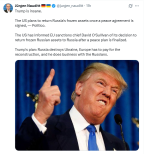
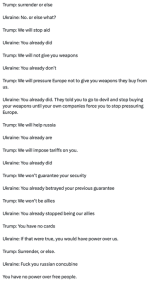
Trump Has Effectively Declared the United States an Ally of Russia in the War Against Ukraine

Let’s break down the exact phrases he used today, because every word matters.

Trump: “The United States is no longer involved in the war in Ukraine.”
Really?

At a Cabinet meeting today he said:
“We’re trying to get it settled. I settled eight wars. This will be number nine. […] This is a war that would never have happened if I were president.”

And the key line: the US is “no longer financially involved.”

But that’s a lie. Here’s why.

1994. Budapest Memorandum. Ukraine gives up the world’s 3rd largest nuclear arsenal (1,700+ warheads) for security guarantees from the US, UK, and Russia.

Ukraine built it. Ukraone serviced it. Ukraone even shipped warheads to Russia for repairs until 2014 because they had no experts left.

The US forced Ukraine not only to give up nukes, but also 44 Tu-95 & Tu-160 bombers.
Those exact planes are bombing Ukrainian cities right now.

Now Trump calls it the “Ukrainian crisis” — the same term used by:
→ Putin
→ Kim Jong-un
→ Xi Jinping
→ Iran’s ayatollahs

When America parrots the Kremlin–Pyongyang–Tehran–Beijing dictionary, it’s not a slip of the tongue. It’s alignment.

His “peace plan” demands:
— total Ukrainian capitulation
— reward Russia for aggression
— legalize occupation
— destroy global order (exactly what Russia + China want)
— zero punishment for war criminals
— no reparations
— unfreeze Russian assets

Only a fool would say Trump isn’t a Russian asset.

The only open question: money or kompromat?

If the US sells out Ukraine, the consequences:
— full or partial occupation of Ukraine
— next wave of Russian attacks on NATO (Moldova, Baltics)
— global nuclear blackmail explosion — Iran, NK, everyone will go nuclear
— end of America as a trusted ally (Taiwan, Korea, Japan already see it)

This is not “ending the war.”
This is how new world wars begin. Same script as 1938–1939.

Trump: “This war wouldn’t have happened under me.”
It literally started in 2014 and never stopped during his first term.

When the US says it’s “not involved” while Russia kills us with planes America made us hand over — that’s not neutrality. That’s complicity.

What a sick world.

History will list Trump among the weakest, most cowardly, most compromized, Kremlin-controlled idiots ever to sit in the Oval Office. That and settimg the stage for WW will be his legacy.
 
Ukraine Strikes 4th Ghost Fleet Tanker… Then Refineries Burn

Ukraine struck a fourth Ghost Fleet tanker, part of Russia’s sanctions-evading oil network used to quietly fund the war. Hours later, multiple Russian refineries were hit overnight, creating fires, shutdowns, and major disruptions across key energy facilities.

124 kms of the Turkisg coast - 4th tanker hit by aerial drone. Ukraine sending a message.


So Many Attacks in Russia That Even the Kremlin Lost Track


A stunning wave of numerous, small-scale but relentless partisan and Ukrainian-linked attacks is now hitting Russia from the inside — rail lines, refineries, military depots, communications infrastructure, and even remote fuel nodes. What matters isn’t the size of any single blast but the sheer volume of them.

I break down why Moscow can’t fully count or cover up the incidents, what this means for Russia’s internal stability, and how the ripple effects may alter both battlefield logistics and political pressure inside the Kremlin.

 
Russia Facing Shortage of Currency, Oil Revenue tanking, moving to Barter for imports


Here, Russia is facing a rapidly worsening shortage of currency as falling oil revenues and severe pressure on its export system cut deeply into its reserves. In response, Moscow is reintroducing foreign-trade barter, reviving stone age economic practices and tactics from the post-soviet economic collapse in a desperate effort to keep imports flowing in.

In recent weeks, major international outlets, including Reuters, El País, and the Kyiv Independent, have confirmed that Russia has reintroduced barter for international trade. The reported deals involve swapping commodities such as wheat and flax for Chinese cars, construction materials, and home appliances, with at least eight transactions documented so far. These arrangements are detailed and formal rather than improvised. They are supported by a 14-page guide issued by the Russian Economy Ministry that instructs companies on how to structure goods-for-goods contracts, bypass banking channels, and settle value through physical shipments instead of money.

The reason Russia is doing this now lies in the oil-money crisis reshaping the country’s economic landscape, because falling oil revenues directly translate into a shortage of the hard currencies that Russia depends on to pay for imports. Over the past several months, seaborne crude shipments through key ports such as Primorsk and Ust-Luga have fallen sharply, with Primorsk dropping from its usual nine to ten tankers per week to just three, and Ust-Luga falling from about twelve to thirteen tankers to seven or eight. US restrictions on Russia’s shadow fleet have reduced the number of available tankers and further constrained export capacity. Urals crude is also trading at steep discounts of more than twenty dollars below Brent, widening Russia’s revenue gap even further.

With global oil prices sliding to around sixty-three dollars per barrel for Brent and roughly fifty-eight dollars for WTI as markets price in the possibility of a Ukraine ceasefire, Russia’s net earnings per barrel have fallen even further. This decline, combined with lower export volumes and wider Urals discounts, has left the government with oil and gas revenues down about thirty-five percent year-on-year in November and more than twenty percent lower over the first eleven months of the year. As these revenues fall, banks inside and outside Russia grow more hesitant to process Russian-linked payments, and many foreign partners refuse to accept rubles because of currency-convertibility limits and the risk that holding Russian assets could expose them to sanctions or future financial scrutiny.

This combination of weak oil income and limited access to global financial infrastructure creates a situation in which Russia struggles to pay for imports even when it wants to, because the currencies it needs are scarcer, harder to transfer, and more heavily scrutinized. Cross-border monetary payments are increasingly routed through channels that involve higher compliance risk for foreign banks, and swift restrictions, partially frozen reserves, and growing caution among Asian banks make it difficult to move large sums without delay or danger. Under these conditions, barter becomes the simplest practical alternative, because trading commodities directly for cars, machinery or industrial supplies avoids the monetary flows that sanctions target and relies on assets Russia still controls. Barter also helps Russia preserve trade relationships it would likely lose under normal payment conditions, because partners can accept commodities without handling rubles or navigating high-risk currency transfers. By relying on goods-for-goods exchanges as a last resort, Russian firms can keep critical imports moving even as the financial system around them becomes too constrained for conventional transactions to function.

Overall, Russia’s return to barter is best seen as a response to a tightening squeeze on its core source of hard-currency income rather than an innovative form of economic resilience. As oil revenues fall and usable dollars and euros become harder to obtain, the country is being pushed to settle trade through commodities instead of cash, even though barter is slower, less efficient, and leaves Russia more exposed to stronger partners. This shift reflects a broader withdrawal from the global financial system and a turn toward abstract, low-productivity exchanges that...

 
Putin Pushes "Surrender"—Ukraine HITS Russia's Capital with Surprising STRIKE

Rest of Russia left virtually defenseless as Moscow is ringed with air defenses

- but somehow Ukrainian drones keep making big ka-booms within the Moscow area.

 
Find YOUR Ukraine YouTuber:

Not all Ukraine YouTubers are the same.

Some are analytical, some emotional, some lightning-fast with updates, some deeper with context. In this video, we compare the major Ukraine-focused creators side-by-side so you can finally understand who delivers what, how they differ, and which voice best fits the way you prefer to learn.

Found this quite fascinating, especially as I follow every single one he talks about here plus a few more. He pinned down exactly what I watch Denys too. If anybody wants the other UA Tubers and Twitter sources I follow, just ask and I'll post a list here with links.

 
Kremlin’s MASSIVE Korean Ammo Disaster - 50% Failure Rate in North Korean Ammo

The Russian military is undergoing a humiliating devolution. Elite heavy tanks are being replaced by unarmored "golf carts" that soldiers call coffins on wheels. This video exposes why Moscow is sending troops into battle in recreational vehicles and what this reveals about their strategic failure.

The crisis deepens with ammunition. The Kremlin is begging North Korea for artillery shells, but reports describe a massive dud rate. These defective rounds are destroying Russian barrels and killing their own crews. This battlefield collapse is mirrored by a domestic economic disaster. Inflation has forced supermarkets to lock basic butter in anti-theft security cases to prevent mass shoplifting.

We also analyze the financial ruin of Gazprom. The energy giant has posted historic losses after failing to blackmail Europe. Now, Russia is a distressed asset to Beijing, paying a massive war tax on Chinese imports. This is the reality of a superpower becoming a vassal state, trapped in an irreversible spiral of inflation and dependency.

CHAPTERS:
00:00 - Intro
01:00 - The Real Cost of Pokrovsk: Russia's Insane Troop Loss Ratio
05:09 - The $17,000 Coffin: Russia's Desperate Armored Vehicle Shortage
06:06 - Putin's Shell Hunger: 50% Failure Rate in North Korean Ammo
07:43 - Russia's Guns vs. Butter Crisis: Luxury Anti-Theft Butter Cases
09:04 - Gazprom's Historic $7 Billion Loss: China Dictates Terms
09:56 - The End of an Empire: Collapse on the Front, Rot in the Economy
13:03 - Outro

 
Ukraine Strikes Putin’s Warlord Bunker

Russia’s war machine is currently suffering a catastrophic system-wide failure that threatens to dismantle both its high-value military assets and its long-term economic stability. In this urgent update reporting directly from the Donbas and Kharkiv, we analyze how a massive and precision-guided Ukrainian drone offensive is successfully blinding Moscow’s air defense grid. By destroying advanced S-300V and Niobij radar systems worth hundreds of millions in United States dollars, Ukraine has created a critical tactical opening for upcoming F-16 fighter jet strikes and long-range missile operations. A blind air defense grid means Ukrainian drones can now freely target supply depots and critical energy infrastructure deep behind the front lines without detection.

The systemic instability is now spreading far beyond the trenches to threaten the regime itself. Drones have struck Ramzan Kadyrov’s stronghold in Chechnya to prove that no territory is safe and expose the fragility of the North Caucasus. Simultaneously, the Kremlin faces a severe fiscal crisis as Turkey quietly cuts imports of Russian crude oil and replaces those barrels with supplies from Kazakhstan and Iraq. This geopolitical shift threatens billions in export revenue for the Russian Central Bank and the federal budget while putting immense pressure on the Russian Ruble and depleting foreign currency reserves.

We also investigate how Shadow Fleet tankers are being hit near Turkish waters to expose the collapse of Moscow’s sanctions evasion routes. Finally, we expose the fake victory maps of Pokrovsk that Putin is using to deceive Western diplomats. This video connects the destruction of expensive military tech with the fracture of global energy markets to show how the war is collapsing Russia’s economy.

CHAPTERS:

00:00 Blinding Russia’s Air Defenses
00:48 Radar Stations Destroyed
01:30 Why Blinding the Enemy Matters
02:00 Returning From Donbass
02:42 Soldiers on the Frontline Speak
03:20 Drone Warfare Dominates the Battlefield
04:05 Russia’s Failing Strategy
04:42 Dismantling Russian Power in the East
05:20 Shaping the Future Air War
06:00 Message From Ukrainian Soldiers
06:42 Launching the Christmas Support Drive
07:20 Financial Shock for the Kremlin
08:05 Drone Strike Inside Chechnya
08:55 Kadyrov’s Weakness Exposed
09:40 Fires Across Russia’s Energy Network
10:20 Turkey Cuts Russian Oil Imports
11:00 The Shadow Fleet Exposed
11:45 Putin’s Information Warfare
12:30 Fake Victories for Trump Meeting
13:05 Why the U.S. Must Take a Hard Line

 
NATO Left In The Cold As Trump Embraces Moscow

The US appears to be increasingly stepping back from its leadership role in Europe, leaving European nations to face Russia largely on their own while Washington deepens its own contacts with Moscow. This geopolitical shift comes as pressure continues to mount across Russia’s collapsing economy and expanding war effort.

Another of Russia’s top bankers has now publicly called for a ruble devaluation, confirming what markets have been signaling for months: the financial system is under unsustainable strain. At the same time, Ukraine’s long-range drone campaign against Russian oil refineries continues to intensify, steadily degrading the infrastructure that fuels the Kremlin’s war machine.

Russia has also suffered fresh losses abroad, with reports that nearly $12 billion in oil and financial reserves tied to Iraq have effectively been written off. Inside Russia, scientists warn the country’s HIV crisis is worsening dramatically, estimating that nearly one in every 25 Russian men is now infected — a public health catastrophe unfolding amid state censorship and international isolation.

On the battlefield, Vladimir Putin has announced another expansion of the war while Ukrainian forces struck a major Chechen military base, further demonstrating Kyiv’s ability to reach deep into Russian and proxy territory. Meanwhile, the Kremlin tightens information control at home by blocking WhatsApp, accelerating the digital isolation of its own population.

This video connects the dots between Washington’s shifting posture toward Europe, Russia’s accelerating economic decay, Ukraine’s expanding strike campaign, and the Kremlin’s tightening grip as the consequences of the war continue to spiral beyond the battlefield.

 
Kremlin 'frightened' after Witkoff talks flop as Putin's worst fears realised in Ukraine war

The Kremlin is 'frightened' that Putin's failure to end support for Ukraine and ease oil sanctions has left Russia headed for crisis, says Robert Fox, Defence editor at The Standard.

This one is really interesting and worth listening too.

 
Sir Bill Browder: Putin fears he’ll be killed if his war in Ukraine ends

“What motivates Putin right now is staying alive. To stay alive, he needs to stay in power. And to stay in power, he needs to be at war.”

Putin needs the Russian people to be angry at a foreign enemy so they don’t turn their wrath on him, says Sir Bill Browder.

 
Putin is Losing Control... Secret WAR Erupts in Russia

When Putin launched the invasion, he never imagined that the greatest threat to his war would rise from the shadows. Across occupied Ukraine and deep inside Russia, resistance networks sabotage supply lines, strike key targets, and feed Ukrainian intelligence with real-time data. Their coordinated operations are eroding Moscow’s control and exposing cracks the Kremlin can no longer hide. This is the secret war Putin can’t contain—one that’s only growing stronger… But the next strike hasn’t even begun.

Russia has a major problem with incipient resistance movements that are spreading acoss Russia and seem to be coordinated.

 
Putin GETS SHOCK OF HIS LIFE as Ukraine HUNTS Down FSB Agents in Russia

Ukraine delivering some political messages too.

 
Putin’s Economy Is Showing Desperation — Here’s the Tell

Russia’s wartime economy just flashed signs that insiders have feared: a visible, undeniable indicator of financial strain. In this video, I walk through the specific moves Moscow made, why they matter, and what they reveal about the pressure building behind the scenes.

From budget gaps to forced capital controls to mounting industrial losses, the patterns are becoming harder to hide. Today we break down the latest numbers, the strategic missteps, and what these signals mean for the battlefield and the political landscape around Putin himself.

 
Russian General Admits the Big Lie: ‘We Thought 70% Backed Us

A former commander of Russia’s Ground Forces has publicly admitted the catastrophic intelligence failure that shaped the Kremlin’s invasion plan. Vladimir Chirkin now acknowledges that Russian intelligence assured the Kremlin that 70% of Ukrainians would support Russia. In reality, the opposite was true — a misread that helped doom the “three-day blitzkrieg” before it even began.

In this video, we break down Chirkin’s admission, what it reveals about Russia’s intelligence failures, how it shaped the failures around Kyiv, and why Shoigu tried to spin it as a “gesture of goodwill” even after the retreat. This moment of honesty from inside the Russian command gives us a rare window into the mindset that led to one of Moscow’s biggest strategic blunders.

 
Returned Russian POWs hunt down and kill everyone on their former base!

Here, a disturbing new trend is emerging inside Russia, one that offers a chilling preview of what the country could face if the war were to end. As returning soldiers from the front carry out new mass shootings and vengeance sprees that decapitate their own military units, the Kremlin grows increasingly afraid that ending the war could trigger chaos it can no longer control.

In the latest case, Russian authorities are searching for a serviceman who, shortly after returning from Ukrainian captivity, murdered seven of his own comrades in what investigators describe as a planned act of revenge. The suspect had been released during a prisoner exchange and immediately signed a new military contract upon his return. His motive was to regain access to the same circle of men who had previously abused him. He was assigned to the 69th Division in Kamyanka, where he opened fire on fellow servicemen before fleeing. Security services have issued a wanted notice, warning that he is armed and believed to be hiding in the Belgorod region. This incident is shocking, as it reflects a deep moral rot inside Russia’s armed forces and the growing phenomenon of returning prisoners of war seeking vengeance against those who tormented them.

The backdrop to this violence is a military culture defined by internal brutality, with Russian soldiers often tormented, humiliated, or even executed by their own commanders for minor insubordination like complaining about conditions, or simply hesitating. An investigation in October 2025 documented 101 verified cases of Russian troops killing or assaulting their comrades. Leaked videos show beatings, electrocutions, and even forced gladiatorial fights to the death between punished soldiers, staged by officers as penance or entertainment. These practices revive the worst Soviet-era penal traditions, and despite Russian denials, the evidence is overwhelming and continuous: nearly every week, new cases emerge of troops being abused by their own chain of command. This systematic brutality, intended to enforce discipline amid staggering casualties, has instead fostered chaos, mistrust, and paranoia inside the ranks. Soldiers now fear their commanders as much as Ukrainian fire, sometimes far more.

This environment of abuse has made surrender a rational choice for thousands of Russians. In captivity, they discover a reality that contradicts every piece of Russian misinformation. Ukraine’s “I Want to Live” hotline receives around 3,000 calls a month from Russian soldiers who want to defect or surrender. Those who do are often surprised by humane treatment, which includes medical care, the ability to contact families, proper food, and compliance with the Geneva Conventions. UN monitors confirm that Ukrainian treatment of POW’s meets international norms, starkly contrasting the torture chambers Russia runs in occupied territories. Many Russian prisoners of war openly describe a psychological shock, abused by their own commanders, they find safety among those they were taught to see as enemies and Russophobes.

Yet, Russian prisoners of war do not stay forever in Ukraine, and many are sent back in prisoner exchanges, returning to the very system that once mishandled them. For some, the return provokes rage, and they re-enter the Russian army looking for revenge, angry, and with nothing to lose. Historically, returning veterans in Russia have destabilized the system before, and after World War II, waves of traumatized Soviet soldiers contributed to spikes in domestic violence and crime. After the Soviet war in Afghanistan, embittered veterans helped fuel unrest that contributed to the collapse of the regime. The parallels are ominous: hundreds of thousands of Russian soldiers will eventually return home with psychological scars, grievances, and violent conditioning.

The stark contrast between Ukrainians and Russians underscores the division, as Ukrainian prisoners are seen crying with relief, phoning relatives, singing the national anthem, and embracing freedom after being exchanges. Russian prisoners, by comparison, appear stiff, anxious, and performatively enthusiastic. Video sequences often reveal inconsistencies: in one frame, a prisoner quickly removes the Russian flag the moment he boards the bus; in the next, the flag is reattached, and soldiers are told to cheer for the camera.

Overall, the rising number of surrenders and...

 
Ukraine has BROKEN Russia at Pokrovsk… CATASTROPHIC Losses for Putin’s Troops

Russian President Putin claims Pokrovsk has fallen—but the reality on the ground tells a very different story. Ukraine continues to resist fiercely, inflicting catastrophic losses on Russian forces even as the city remains under siege. Putin’s propaganda aims to project strength ahead of U.S. peace talks, but the truth is clear: Russia is bleeding heavily, and Ukraine is turning Pokrovsk into a deadly trap. What will happen next in this high-stakes battle?

 
Back
Top