For Those Who Might Be Wondering Why We Might Be In Ukraine

Show me that part of article 157 of the Ukrainian Constitution that permits amendments during martial law. Experts argue that the Constitution does not explicitly authorize an extension of the 5-year term even under martial law, and that Article 103 doesn’t provide for term prolongation without elections. You should probably research those points as well. I don't think his claims are as clean as you think. But, it is what it is. He is the leader until he decides to take his loot and bug out for somewhere safe.
The Constitution requires Parliament to approach and extend martial law declaration every 90 days, which they have.

It also stipulates that elections cannot be held under martial law.

If citizens demanded a new election, Parliament can initiate one.

Earlier, you mentioned Poland. Have you heard there may have been as many as 10,000 dead Polish mercenaries on the field in Ukraine? I wonder how many Americans and European mercenaries are being employed there. You know they are not protected by the laws of War and most likely will be imprisoned or executed upon capture.
That sounds like a Russian rumor mill.....quite on par with your normal schtick.
 
Show me that part of article 157 of the Ukrainian Constitution that permits amendments during martial law. Experts argue that the Constitution does not explicitly authorize an extension of the 5-year term even under martial law, and that Article 103 doesn’t provide for term prolongation without elections. You should probably research those points as well. I don't think his claims are as clean as you think. But, it is what it is. He is the leader until he decides to take his loot and bug out for somewhere safe.
If there were anything to those arguments, wouldn't Zelenskyy's domestic political opponents be making them? (It's much safer to be an outspoken opponent in Ukraine than in Russia.)
 
But these are not mercenaries. They're only foreign soldiers in Ukrainian uniform. There are many foreigners in the U.S. Army -- they ain't mercs, and it is no war crime to employ them.
Except Russia has a vote. They have already announced the presence of foreign fighters and have designated many of them as mercenaries. They are holding thousands of prisoners. Just a couple of days ago announced they had killed A British soldier on the field of battle. There were many volunteers fighting along the line of contact in Ukraine. You may want to examine the following article from the Lieber Institute at West Point:

Status of Foreign Fighters in the Ukrainian Legion​

by Petra Ditrichová, Veronika Bílková | Mar 15, 2022

Among other new resistance groups, Ukraine has formed an International Legion for the Defense of Ukraine (UKR Legion). There are reports that its members come from all over the world, including Canada, Japan, the United Kingdom, the United States and the European Union. Some of the volunteers are former military personnel; others have no previous combat experience. At the time of publication of this post, the General Staff of the Armed Forces of Ukraine has reported that 20,000 foreigners from 52 different countries have already volunteered to fight in the UKR Legion against the Russian invasion.

In reaction to this development, the spokesman of the Russian Ministry of Defense, Igor Konashenkov, warned that “none of the mercenaries the West is sending to Ukraine to fight for the nationalist regime in Kyiv can be considered as combatants in accordance with international humanitarian law or enjoy the status of prisoners of war…. [A]t best, they can expect to be prosecuted as criminals.”

This begs the question as to whether the classification of personnel status discussed previously in this symposium applies to foreign fighters enlisted in the UKR Legion under the law of armed conflict (LOAC). Could they, as Russia suggests, be considered mercenaries without legal protection as prisoners of war (POW) when captured and can they be treated as “unlawful combatants” or “criminals”? This post addresses these issues of personnel status regarding foreign fighters enlisted in the UKR Legion.

Much more here: https://lieber.westpoint.edu/status...members of the UKR,entitled to the POW status.
 
If they want to keep what they still have, they should sue for peace. If they don't, it's only going to get worse. I told you this would be solved in the battlefield, and the solution is becoming apparent. They are being attrited.
It will make no difference. Putin has said again and again and again that his conditions remain the same - what amounts to a complete Ukrainian capitulation. He wants Ukraine back in the Russian empire and he will not an cannot back down. No amount of wishful thinking on Trump's part can obfuscate this simple fact, which Putin has stated again and again.

He plays Trumo like a violin, and Trump consistently falls for it for whatever reason. But the end result is that nothing less than complete surrender will satisfy Putin, he has said so again and again - and the end result of that will be another Holodomor. You can alrewady see it taking place in te occupied territories. It doesn't matter if Ukraine sues for peace - Putin will simply see that as weakness and kee attacking.

The only way out of this war s the collapse of Russia and the death of Putin. It's that simple.
 
Putin’s Frontline is COLLAPSING… Russia’s Army Is Breaking From Within

For months, Putin has pushed a carefully crafted story: Russia advancing everywhere, Ukraine on the brink, peace inevitable on Moscow’s terms. This video breaks down why that narrative is collapsing. From false city capture claims to exhausted Russian units, shattered logistics, and growing Ukrainian counterattacks, the reality looks very different from Kremlin talking points. The battlefield truth is catching up fast—and it threatens everything Putin is betting on next.

 
Ukraine’s Trap at POKROVSK… Russians CHARGED Straight Into Hell

Russia claimed Pokrovsk fell in early December. Two weeks later, its troops are still dying outside the city. In this video, we break down how a supposed Russian “surprise” assault using motorcycles and buggies drove straight into a Ukrainian drone trap near Hryshyne, losing dozens of soldiers in minutes. Pokrovsk still stands, the Kremlin’s narrative doesn’t—and the next phase of this battle may surprise Moscow even more. What happens next could reshape the entire front.

 
Ukraine Reveals SHOCKING Russian Troop Losses… Putin’s Army Is BLEEDING OUT

When Russia invaded Ukraine in February 2022, the Kremlin expected a swift victory. Instead, Vladimir Putin’s army is paying a staggering price. Ukrainian President Volodymyr Zelenskyy now claims Russia is losing up to 30,000 soldiers every month, a rate few militaries can sustain. As Ukraine refines deadly new tactics and Russia clings to attrition, the true cost of Putin’s strategy is coming into focus. But what happens when the losses become impossible to hide?

Putin's army is bleeding out.....30,000 Russians a month are being KILLED. Not wounded. Dead. That death toll may be higher as not all Russian kills are recorded and counted.

 
Diesel and Oil Everywhere! Massive Fuel Train Derailment in Russia

Love Artur's updates. Forget the facts - watch for the entertainment. LOL

00:00 Intro
00:43 Sub-Sea babies sunk a Submarine
03:58 Russians published a video claiming the submarine has not sunk
04:42 Penza train derailed
07:07 Kupyansk thread
10:20 How RUS are doing in Kupyansk
12:504 Ukrainian fighters are in Pokrovsk
17:47 AN-22 crash video
19:54 Illegal immigrant arrives in russia
20:47 1 FPV-6 RUS KIA
22:04 Restaurant patio has an AA cannon - people dining

 
Kremlin is EXTREMELY CONCERNED About Putin's Future War Plans

Russia’s war in Ukraine has entered a dangerous new phase, and behind closed doors the Kremlin is increasingly alarmed about Vladimir Putin’s future war plans. After nearly four years of invasion, sanctions, massive casualties, and economic damage, the original justifications for the war — NATO expansion, protecting Russian speakers, denazification — have completely collapsed. This video breaks down why the Kremlin knows these narratives no longer work, why Putin showed no real reaction when Finland and Sweden actually joined NATO, and why the war is no longer about geopolitics, but about Putin’s personal political survival.
We explore how ending the war without a clear victory would trigger a wave of anger inside Russia, as veterans return home, families demand answers, and millions of citizens face the reality of economic devastation and human loss.

The Kremlin understands that peace would mean accountability, and accountability is fatal for authoritarian regimes. This is why Putin cannot stop the war, even though he cannot win it.

The video also dives deep into Russia’s militarized economy, explaining how the country has become dependent on wartime production, inflated military salaries, and artificial growth tied directly to the front lines. Factories, workers, and entire regions now rely on the war to survive financially, making a return to normal life nearly impossible without mass unemployment, inflation, and social unrest that could rival or exceed the chaos of the 1990s.

Finally, we examine the central paradox trapping Putin today: he cannot achieve a real victory in Ukraine, but he also cannot end the war without exposing the collapse of the system he built. Every additional day of fighting delays the reckoning, while simultaneously deepening Russia’s economic, social, and political crisis. The Kremlin’s greatest fear is not NATO, sanctions, or Ukrainian counteroffensives — it is the moment Russians openly ask whether this war was all for nothing.

 
Putin’s Inner Circle Is Being ELIMINATED

The Russian Federation is currently undergoing a systemic transformation that effectively ends the era of post-Soviet oligarchy and introduces a new model of state-directed asset liquidation. Facing critical liquidity shortages and the exhaustion of sovereign wealth funds, the Federal Security Service (FSB) has initiated a hostile takeover of the nation's most profitable commercial sectors. This is not random political violence; it is a calculated "receivership" of the entire economy, where the security apparatus is seizing direct control of energy export terminals, maritime logistics, and banking infrastructure to secure hard currency flows.

This internal redistribution of capital signals that the Kremlin is prioritizing immediate regime survival over long-term market stability. By dismantling the private wealth of the business elite through forced transfers and a wave of suspicious "executive fatalities," the state is cannibalizing its own tax base. For global energy markets and international investors, this shift represents a catastrophic elevation in sovereign risk. The freezing of exit routes for high-net-worth individuals and the seizure of corporate assets indicate that Russia has ceased to function as a market economy and has devolved into a command system focused solely on resource extraction for military funding.

The implications extend far beyond Moscow. As the shadow fleet and export mechanisms fall under direct security service control, the predictability of global oil and gas supply chains will further deteriorate. We are witnessing the final closure of the Russian market to the global financial system, a move that traps domestic capital in a closing cage and accelerates the timeline for a potential systemic collapse similar to the 1998 financial crisis, but with far more violent internal dynamics.

CHAPTERS:
00:00 - Intro: Kremlin Panic as the War Hits Moscow
02:11 - Russian Purge: Why Putin's Elites Are Dying
04:24 - Russia's Decline: A Return to 90s Mafia Rule
05:21 - Putin's Revenge: Navalny & Assassinations in the US
07:51 - Putin's Secret: False Flags & The 1999 Bombings
09:37 - FSB Takeover: Seizing Russia's Oil Wealth
11:56 - Regime Collapse: The End of Putin's Stability
13:07 - Outro


TOTAL CHAOS Breaks Loose as Veterans IMPLODE Russian Cities


This has been forecast for a while, but now it's happening as Ukraine war veterans return "home"

 
Kremlin CONFESSES! Russia Will Seize ALL of Ukraine.

In a moment that cuts through years of denial and doublespeak, the Kremlin has effectively admitted what Ukraine and its allies have long argued: this war was never about NATO “defense” or Donbas autonomy—it was always about total domination. Whatever Trump offers them, they won't compromise and will continue the war.

Today we look at what was said, why it matters, and how this confession reframes the war politically, militarily, and diplomatically. Once the quiet part is said out loud, there’s no going back.

 
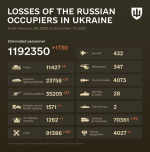
Meanwhile - Highest Russian Losses in 264 Days: 1,730 Down in a Single Day

On December 17, 2025, the General Staff of the Armed Forces of Ukraine confirmed that Russian military personnel losses reached 1,730 in a single day. This staggering total marks the highest daily casualty count in 264 days, a peak not seen since the intense combat of early spring. The surge is driven by high-intensity "meat wave" assaults in the Pokrovsk-Myrnohrad sector, where Ukraine repelled over 80 attacks in 24 hours. Data indicates that Russia is sustaining roughly 83 casualties for every square kilometer captured during this winter offensive. Alongside the massive human toll, Ukrainian forces destroyed 33 artillery systems, 179 vehicles, and 6 tanks, severely crippling the logistics of Putin’s 710,000-strong invasion force.

 
Ukraine's Patient Counteroffensive

Kupiansk is just about liberated, Pokrovsk remains an orc trap, and something may be brewing in the ***** area. Far from exhausted, Ukrainian forces are punching back where opportunity allows.

Andrew Tanner, Dec 17


With Western media’s annual consumer-powered silly season in full swing, there’s little to no airtime for good news out of Ukraine. After all, as everyone knows, the Ukrainians are doomed to either a bitter peace or war unending, right? So the talking heads say. They say a lot of things. As their income depends on producing cozy factoids for the well-informed to repeat, the charade allegedly constituting civic discourse, quality of information is usually subordinated to developing plot points in some astroturf narrative.

That’s pretty much been the story of mainstream (I dislike this term, but what else is there?) Ukraine war coverage and analysis since 2022. First Ukraine was doomed, then the orcs were comic villains doomed to fall as soon as a few overhyped American weapons entered the fray, and after that didn’t produce a swift, cathartic resolution to the conflict, slowly but surely portrayal of the affair settled into today’s pattern of asking when the Ukrainians will finally give up.

Media interests being what they are, the steady decline in the number of exciting new stories to tell about Ukraine that also cast a good light on foreign partners was guaranteed to eventually make covering Ukraine an irritating chore for the average journalist. So the media conventional wisdom is happy to hold that the war is soon to be put on pause by some deal worked out by all-powerful leaders. It’s just the way any American style media profit-seeking ecosystem works. People are willing to pay for bias-conforming content that lets them feel more informed than their peers. It breaks the fourth wall to point out that industry standards are constructed not to ensure the publication of fact or truth, but a simulation thereof. Most consumers of media don’t like being made aware of how the game functions, so a lot of bullshit stands.

An additional challenge is created by an education system which teaches students to go along with the charade, even though the evidence of its true nature is right there for anyone to observe. Systems logic emphasizes connections between objects and the uncertainty associated with their behavior. It is a world of stocks and flows, rates and ratios, better and worse case scenarios - but also critical points and thresholds.

At certain moments, systems are prone to a massive, irreversible trajectory shift. Welcome to the world system in the 202s. The status quo in political, economic, and social systems across the planet is collapsing at an unprecedented rate. The mainstream is now dangerously behind the curve. The end of one regime, in a systemic sense, is not the end of the system itself. This is a phase shift involving the reorganization of key elements. Nobody and nothing is in control: organisms are simply adapting based on the particular incentives and expectations that motivate them. Those which tend to survive and even thrive are the ones that better preserve their capacity to adapt. This is produced by efficient and above all else patient application of scarce vital resources to double down on connections and technology that prove reliable and shed those which do not.

This is why I’m not at all concerned about the future of Ukraine and Europe without US support, as appears inevitable, peace deal or no. It’s better to have fewer, closer allies than depend in any way on an unreliable partner. The US federal government isn’t even that: it’s a scavenger willing to prey on allies and citizens alike. A switch has been flipped in the minds of a certain class of Americans on both sides of the partisan divide, and for them the world is now split into domestic and foreign domains, with the latter serving the former. You simply will not get the true story of what’s happening to the USA and wider world from US and US-adjacent media. Censorship isn’t to blame; there simply isn’t much of a market for truths that contradict certain sacred assumptions made by educated folks in any postmodern society. It’s failure to practice the universal morals it preaches is what causes it to descent into nihilism, and after that, a return to premodern tribalism. The next epoch of science triumphant should begin around mid-century, though the mid-2030s is still possible.

...cont
 
II Continued

The gap in the public knowledge base the mainstream media system leaves is basically why blogs exist. Although most these days wind up playing the same game, conforming to a conventional wisdom that amounts to the sum total of any idea that becomes popular. Still, a few still hold true to the original dream of the internet, which was quickly sharing information with whoever could use it, not shopping or hosting ads tied to that end.

Olena Kryzhanivska’s Ukraine’s Arms Monitor and the staff at Center for Defence Strategies are two I especially appreciate for summarizing Ukrainian language sources in English. There are many others, of course.

When you combine the meticulous documentation of events bloggers like these put together with patterns in geolocated event data from the battlefield, you’ve got the necessary foundation for developing true understanding of Ukraine’s fight. Having even a conscript’s level of military training - actual combat experience is, obviously, even more powerful - adds another important element, because it is what gives an analyst the intuitive sense of what data and variables matter.

I harp on the media a lot, I know, but in reality a tremendous amount of lazy, frankly shitty quantitative work is floating around out there in any number of soft science fields. It nearly always rides on abusing the actual significance of variables by making their use in a model look better than it is to an untrained observer, and is at the heart of the inability to replicate most studies in the social sciences.

My personal favorite example has long been a widely cited study by a couple Harvard political scientists which claimed to “prove” that the average length of a dynasty being longer in the Islamic World “explains” why Christian Europe developed liberal democracy and the Islamic World has lots of dictatorships and theocracies. I found it while working through a required doctoral reading list from one of the Ivy Leagues that I was using to guide my own studies. Department that I was in being what it was, pretty much all my doctoral work was self-directed like that. Anyway, what killed me about this highly-acclaimed piece was that it actively pandered to Western prejudices about Islam to effect a backhanded celebration of why European culture is special.

Any competent scholar from one of dozens of adjacent fields could have spotted the flaw, but publishing in a prestigious journal in the right field basically makes one immune to professional critique. Academia is riddled with half-science crap like that - so no surprise that journalists, who derive most of what they know about science from their own studies, are chronically ignorant of basic science in any field they didn’t happen to encounter.

If you think the study of military history or science is in any way better, I’m so very sorry for the loss of innocence you’re bound to experience if and when your professional training is put to the test, or your country fights a war. So much analysis of the fighting in Ukraine is dangerously biased by the palpable need to make it conform to what Western professionals expect from warfare thanks to their education and training. Which these days has become so colonized by a counterinsurgency logic which can’t comprehend anything but a battlefield defined by carefully scripted actions with the good guys having full control over nearly every aspect of the fight.

American obsession with lethality and dominance is tacit evidence of a military as reliant on outdated doctrine and tactics as the orcs proved in 2022. Against even a badly deteriorated Muscovite army that literally has to rely on horses and quad bikes to make marginal advances, any American or NATO force would struggle to avoid losing ground a square kilometer at a time.

Nobody ever planned to fight in a gigantic dynamic minefield against scattered groups of soldiers who hide in their positions but don’t surrender so long as radio contact is maintained and a supply drop arrives now and then. Not when they can’t mass large forces together for fear of getting pummeled by a barrage of glide bombs or rockets fired from a hundred kilometers away.

Neither civilian or military professionals working in national security from the mid-level on up have any incentive to admit the truth about the dangers friendly forces now face. Nor do the vast majority of journalists or scientists who rely on cooperation with defense professionals. This is the best explanation I have for the aggressive refusal to aggressively relay the full, honest truth about what’s happening in Ukraine. Both on the military and diplomatic fronts. It is irresponsible and misleading to portray the potential outcomes as either Ukraine is forced to accept a poison deal by the US or Putin slowly grinds to victory anyway. This argument depends on a total misread of the actual state of Ukraine’s fight.

The actual possible outcomes are, and have always been: Ukraine’s forces collapse, Moscow’s collapse, or the fighting in Ukraine becomes one theater in a global conflict that won’t end until pretty much everyone loses, with Ukraine likely winning out in the long run because the Ukrainians have what takes to survive in this world. Terror of what this all means is the driving force behind so many senior leaders burying their heads in sand. The intensity of the response required to avoid a massive global conflict now demands that politicians take what most experts would presently portray as serious risks. That’s toxic to most.

A Ukrainian collapse is the least likely scenario by a long shot. Even the failure of an entire Ukrainian corps wouldn’t be fatal, with the Muscovites unable to rapidly take advantage. The Ukrainians will always adapt a solution and plug the gap.

Putin’s single biggest strategic win across the decades he’s been in power has been to make his fall almost impossible for Western minds to conceive. This was no accident, but part of a deliberate and relentless campaign that targets the inherent vulnerabilities of the Western mentality. All talk of peace deals is really a bid to undermine support for Ukraine abroad and mobilization at home.

Putin knows that historians and journalists in the West are bent on portraying history as a linear progression, a march from barbarism to civilization, tradition to modernity, or some other similar construction. So he threatens nuclear apocalypse to play on fears of the project ending, while also making the conventional conflict so bloody and repetitive that after a time the endless string of atrocities comes to feel normal, not worth reporting save to point out how horrible war is and ask when it will end.

The presumption that war is awful so must be ended as soon as possible is noble and correct, but also open to exploitation. Those of us who know the right science are fully aware of the stakes and how the future will be shaped by the outcome of the fight for Ukraine. But thanks to Putin’s ongoing mindfuck of the Western mindset, the default assumption is that the fight is about territory most people can’t find on a map, so any end to the bloodshed must be good.

You’ve also got the unfortunate tendency of policy wonks to go against their training and misapply cost-benefit analysis in situations where true apples-to-apples comparisons are impossible to make. For example, it would never work to offer Ukraine financial incentives to stop fighting, because the cost of any deal going wrong must be assumed to be Ukraine dies. Can’t enjoy money if you cease to exist, y’know?

Bottom line: right now, the message is being spread by people who ought to know better that the Ukrainians will have to accept a bad deal, but not because the facts bear this out. It’s just that there are more lucrative crises to cover and a chance that the next phase of the conflict will come on someone else’s watch. Or at the least can be covered as a sequel, not another new season.

....cont
 
III Continued

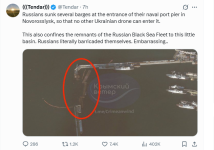
In the actual war, Ukrainian successes continue to mount, and Moscow’s grinding advances remain prone to being thrown back, months of seeming progress reversed overnight. The near-complete liberation of Kupiansk, Ukraine’s historic use of a submersible drone to whack an orc submarine in Novorossiysk, record numbers of Ukrainian drones hitting targets across the empire, combat deployment of indigenous tactical ballistic missiles, and the fact that the Ukrainians are still pinning the enemy in Pokrovsk a month after Putin’s last deadline to secure the place fully passed - all a big meh to most of the media.

Nah, every day the emphasis must be on the latest false step in the endless peace talks tango, no one able to reconcile the territorial and security guarantees problems that have always been the heard of the entire issue. Ukraine can’t and won’t give up Donbas without a fight, because there is a very good chance that Putin will never be able to take it and will destroy himself trying. Then Ukraine takes everything back - and maybe even a bit more. Rostov-on-Don as reparations for obliterating Mariupol sounds about right.

The territorial issue also conveniently obviates the serious problem with trusting any security guarantees offered by D.C.

D.C. thinks it can gain leverage by offering an Article 5-like pact to Ukraine, but come on: it’s intrinsic to the America First brand to not accept the rights of foreigners, and Team Trump has already talked about not respecting Article 5 if he thinks a target country doesn’t deserve it. What serious person can sincerely believe that D.C. won’t find an excuse to skip out on its end of any deal if there’s a real risk of war with Moscow? After all that has happened - or really, not happened - since 2022, if not 2014? Riiiiiight.

Unless US troops are sitting in eastern Ukraine in numbers that Congress will never approve, equipped with weapons capable of decimating Muscovite forces without reinforcement if a single American hair gets singed or nose bloodied, nothing the US promises is worth a damn. This includes NATO’s precious Article 5, which has never actually legally compelled any member country to do more than exactly what most NATO members have for Ukraine.

Everyone pretends otherwise because it’s easier - for now - than calling Trump an idiot to his face. They all just think it, and place their bets accordingly. Article 5 remains a useful fiction, despite having zero chance of working as billed, because in the event of a Muscovite invasion of a member it would form the legal foundation for any joint intervention by members. If you need proof that this is all the thing was ever intended to do, consider that the Turks and Greeks are both NATO members and have actually fought a number of brief wars since joining up.

The Ukrainians have, according to polls, largely lost faith in NATO for a reason. So has everyone else - it’s just impolitic to admit it. But that doesn’t mean everyone isn’t now quietly planning out a successor. One which can and should include Japan, South Korea, Australia, New Zealand, and even much of Southeast Asia. Let D.C. try to build Oceania without Air Bases One and Two and enjoy the impending quagmire in Central and South America.

In reality, the current peace talks are just a sop to Trump’s ego - and a way for European leaders to demonstrate that they have no choice but to spend big to ensure Putin is contained. They want it to be Putin who says no to peace first to minimize the risk of Trump throwing another tantrum, and that’s all.

Big picture stuff handled, on to the fronts, where it’s getting chilly, if the snowfall in recent drone feeds is an indication. I’m still not sure whether Ukrainian fighters would prefer a bitter winter to make orc logistics struggles and entrenchment even harder, or a milder one, because they face the same challenges.
 
Ukraine’s Trap at POKROVSK… Russians CHARGED Straight Into Hell

Russia claimed Pokrovsk fell in early December. Two weeks later, its troops are still dying outside the city. In this video, we break down how a supposed Russian “surprise” assault using motorcycles and buggies drove straight into a Ukrainian drone trap near Hryshyne, losing dozens of soldiers in minutes. Pokrovsk still stands, the Kremlin’s narrative doesn’t—and the next phase of this battle may surprise Moscow even more. What happens next could reshape the entire front.


👍

Putin, DonOld, Russiaguide, etc, might also want to consider the FACT that the Ukrainians have adapted their defense strategy at warp speed, and any future Russian advances WILL face INCREASED…difficulty:


😳

I would NOT want to be a Russian meat sacrifice going forward. I would shoot my commanding officer and anyone else who tried to send me into the hell trap(s) that the Ukrainians have prepared.

😳

Slava Ukraini!!!

👍

🇺🇦
 
The Putin Paradox

by Benjamin Cook
Dec 17

The central paradox of the Ukraine war is this: Russia desperately needs the war to end, while Vladimir Putin is increasingly dependent on its continuation. These interests are no longer aligned—and the gap between them is widening.

For Russia as a state, the war has become an economic, demographic, and institutional drain. For Putin as a ruler, however, the war has become a political trap. Ending it now would force him to explain sacrifices that can no longer be credibly justified, while continuing it deepens the very damage Russia cannot sustain indefinitely.

Putin Needs the War to Continue

For Putin, the war is no longer about victory. It is about narrative control and personal survival. A negotiated end—especially one short of clear victory—would raise unavoidable questions: Why the casualties? Why the economic hardship? Why the defacto-mobilization? Why the lies? These questions are manageable during war. They are much less so in peace. Contrary to earlier assumptions, the war does not unify Russia’s elites. Elites are looking for the door. Whether that door leads to a fall from their penthouse apartment remains to be seen. Sanctions, asset seizures, travel restrictions, and shrinking margins have taxed loyalty.

Even more threatening is the issue of the army itself. Putin and the elites are scared to bring home a war-torn, abused, and lied-to army. This is not an abstract concern. Returning soldiers would carry lived experience that directly contradicts state propaganda. Any army vet can tell the truth better than Putin can. The Russian military—despite catastrophic losses—is lionized by Russian society. Soldiers are portrayed as heroes defending the nation against the West. When they return, those “heroes” will command moral authority. They will have trust—equal to or greater than Putin’s—precisely because they paid the price. It makes me wonder, will the gulags in Siberia be full of returning fighters, just like during and after WWII? A demobilized force with shared grievances, informal networks, and public legitimacy is a classic destabilizing factor in authoritarian systems. Ending the war would mean reabsorbing hundreds of thousands of men trained in violence, aware of corruption, and conscious of being misled. Continuing the war postpones that reckoning. Possibly giving Putin enough time to find another conflict to dump these men into. Africa, Syria, Venezuela? N. Korea?

Finally, war provides procedural cover. Repression, censorship, budget secrecy, emergency powers, and elite discipline are all justified by ongoing conflict. Peace would remove the rationale for extraordinary measures. From Putin’s perspective, that is the worst possible outcome.

Russia Needs the War to End

For Russia as a country, the calculus is far more straightforward. Economically, the strain is mounting. Energy revenues—the backbone of the Russian budget—have declined significantly under western sanctions as well as Ukraine’s Long Range Sanctions. Wartime spending has distorted growth, crowding out civilian investment resulting in masked structural weakness. What looks like resilience is increasingly forced mobilization of resources. Consumer behavior reflects this reality. Wartime stimulus initially supported consumption, but household confidence is weakening as prices rise, savings fall, and expectations deteriorate. Regions are hollowed out as labor is pulled into the military or defense industry, exacerbating demographic decline that predated the war.

Strategically, Russia is becoming more isolated and less secure. Dependence on China has deepened, access to markets has narrowed, and long-term competitiveness has eroded. Even a frozen conflict would ease some pressure; a prolonged high-intensity war compounds it.

Socially, the costs are corrosive. Casualties are unevenly distributed, hitting poorer and peripheral regions hardest. This strains the implicit social contract: political passivity in exchange for stability. As stability erodes, repression must increase—an expensive and brittle substitute concentrated in the areas most likely to produce rebellion.

From a state perspective, ending the war—even inconclusively—would reduce economic bleed, slow demographic damage, and open limited pathways to normalization. It would not solve Russia’s problems, but it would stop making them worse.

The Paradox

Putin cannot easily end the war because peace threatens him personally. Russia cannot afford to continue the war because it threatens the state itself.

This is the Putin Paradox: the longer the war goes on, the safer Putin may be in the short term—and the weaker Russia becomes in the long term. The interests of ruler and country have diverged so sharply that policy has become a hostage to regime survival.

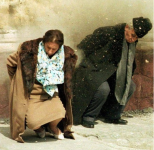
History suggests such gaps do not close gently. And Christmas 1989 stays on Putin’s mind.

1766018739793.png
 
The Putin Paradox

by Benjamin Cook
Dec 17


The central paradox of the Ukraine war is this: Russia desperately needs the war to end, while Vladimir Putin is increasingly dependent on its continuation. These interests are no longer aligned—and the gap between them is widening.

For Russia as a state, the war has become an economic, demographic, and institutional drain. For Putin as a ruler, however, the war has become a political trap. Ending it now would force him to explain sacrifices that can no longer be credibly justified, while continuing it deepens the very damage Russia cannot sustain indefinitely.

Putin Needs the War to Continue

For Putin, the war is no longer about victory. It is about narrative control and personal survival. A negotiated end—especially one short of clear victory—would raise unavoidable questions: Why the casualties? Why the economic hardship? Why the defacto-mobilization? Why the lies? These questions are manageable during war. They are much less so in peace. Contrary to earlier assumptions, the war does not unify Russia’s elites. Elites are looking for the door. Whether that door leads to a fall from their penthouse apartment remains to be seen. Sanctions, asset seizures, travel restrictions, and shrinking margins have taxed loyalty.

Even more threatening is the issue of the army itself. Putin and the elites are scared to bring home a war-torn, abused, and lied-to army. This is not an abstract concern. Returning soldiers would carry lived experience that directly contradicts state propaganda. Any army vet can tell the truth better than Putin can. The Russian military—despite catastrophic losses—is lionized by Russian society. Soldiers are portrayed as heroes defending the nation against the West. When they return, those “heroes” will command moral authority. They will have trust—equal to or greater than Putin’s—precisely because they paid the price. It makes me wonder, will the gulags in Siberia be full of returning fighters, just like during and after WWII? A demobilized force with shared grievances, informal networks, and public legitimacy is a classic destabilizing factor in authoritarian systems. Ending the war would mean reabsorbing hundreds of thousands of men trained in violence, aware of corruption, and conscious of being misled. Continuing the war postpones that reckoning. Possibly giving Putin enough time to find another conflict to dump these men into. Africa, Syria, Venezuela? N. Korea?

Finally, war provides procedural cover. Repression, censorship, budget secrecy, emergency powers, and elite discipline are all justified by ongoing conflict. Peace would remove the rationale for extraordinary measures. From Putin’s perspective, that is the worst possible outcome.

Russia Needs the War to End

For Russia as a country, the calculus is far more straightforward. Economically, the strain is mounting. Energy revenues—the backbone of the Russian budget—have declined significantly under western sanctions as well as Ukraine’s Long Range Sanctions. Wartime spending has distorted growth, crowding out civilian investment resulting in masked structural weakness. What looks like resilience is increasingly forced mobilization of resources. Consumer behavior reflects this reality. Wartime stimulus initially supported consumption, but household confidence is weakening as prices rise, savings fall, and expectations deteriorate. Regions are hollowed out as labor is pulled into the military or defense industry, exacerbating demographic decline that predated the war.

Strategically, Russia is becoming more isolated and less secure. Dependence on China has deepened, access to markets has narrowed, and long-term competitiveness has eroded. Even a frozen conflict would ease some pressure; a prolonged high-intensity war compounds it.

Socially, the costs are corrosive. Casualties are unevenly distributed, hitting poorer and peripheral regions hardest. This strains the implicit social contract: political passivity in exchange for stability. As stability erodes, repression must increase—an expensive and brittle substitute concentrated in the areas most likely to produce rebellion.

From a state perspective, ending the war—even inconclusively—would reduce economic bleed, slow demographic damage, and open limited pathways to normalization. It would not solve Russia’s problems, but it would stop making them worse.

The Paradox

Putin cannot easily end the war because peace threatens him personally. Russia cannot afford to continue the war because it threatens the state itself.

This is the Putin Paradox: the longer the war goes on, the safer Putin may be in the short term—and the weaker Russia becomes in the long term. The interests of ruler and country have diverged so sharply that policy has become a hostage to regime survival.

History suggests such gaps do not close gently. And Christmas 1989 stays on Putin’s mind.

View attachment 2584285

Xi and China need the war to continue (to a decisive victory for Russia) as well…

Just sayin’

😑
 
Not sure about that. The collapse of the Russian Federation hands them Siberia and immense amounts of natural resources

Yeah, no.

Russia does still have nukes, and if the wounded bears (hawks) in Russia decided that China was trying to exploit their moment of weakness (and possibly engineered it) to annex parts of "greater Russia”, then who knows what those wounded bears (hawks) would do…

🤔 😳 😑

Also:

China is already benefiting bigly from the current status quo, and they would benefit even more if Ukraine fell due to their alliance with Russia and it resulted in a definitive "New World Order".

It could go a different way, but I just don’t see it happening.

😑
 
Back
Top