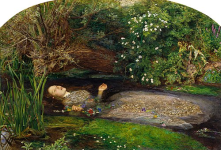
Is the word "Muse" problematic?

sirhugs

Riding to the Rescue
Joined
Jan 25, 2002
Posts
42,217
Many of us use the word "muse" casually on this forum.

I'm reading Zadie Smith's essay collection, Dead and Alive, and just read her essay "The Muse At Her Easel", first published in 2019. In that essay, she asserts that the word "muse" is feminized, thus misogynistic. She does end the essay hoping that "...perhaps now they will less regularly take that wearying, inadvertantly comic form: old man, young girl..."

Being an old man, who appreciates young women more than is healthy, I feel unqualified to judge her assessment, or what progress we might have made.

What do you think- is the term "muse" problematic? If so, have we made progress since 2019?
 
Last edited:
If you go with the traditional Greek mythology, the 3 muses (Literature, Science, the Arts) were female. I don't believe it was patriarchal and/or misogynistic at the time. They also weren't young. It's the current crop of males who decided to reclaim that word (and change the meaning) and re-create the muses in their desired images (i.e. young hot females). IMO, It's no different than the queer umbrella including hetero people. YMMV
 
obligatory Oglaf

I think it can be, depending on how it's used. There's a trope of older male authors (and I guess other artists, but particularly authors) getting inspiration by leching on an attractive young woman.

Usually she doesn't create art herself; she's just there to look pretty and inspire the man. In some interpretations of the Greek myth, art was a matter of courting the Muses, and since the Muses were female this was why only men could be Real Artists...with an exception for Sappho. Sometimes it gets darker; Neil Gaiman and his story "Calliope" turned "courting" into assault.

When she does create art herself, well...this article doesn't use the word "muse", but it illustrates how female artists can end up being trivialised:
1777420563252.png
Or this lady:
1777421241025.png
Elizabeth Siddal was a painter and a poet in her own right, but usually she's just remembered for being a model and Rossetti's "muse".

Basically, describing a woman as somebody's "muse" risks turning them into just some kind of accessory/assistant to a male creator, instead of as a person (and often artist) in their own right, and it often gets used as a euphemism for sketchy relationships where an older guy with a lot of status may be taking advantage of a younger woman.
 
Yeah, what @Bramblethorn said. The original Greek myth muses were no more problematic than most Greek myths, but the word nowadays seems to get used only when it's men treating a woman as an object. Women get inspiration and encouragement, but the word muse with its connotations doesn't get used.

And as Granny Weatherwax reminded everyone, all problems in the world start by treating people as things.
 
Yeah, what @Bramblethorn said. The original Greek myth muses were no more problematic than most Greek myths, but the word nowadays seems to get used only when it's men treating a woman as an object. Women get inspiration and encouragement, but the word muse with its connotations doesn't get used.

And as Granny Weatherwax reminded everyone, all problems in the world start by treating people as things.
So now we are thinking about a story about Granny taking the muses to the loft in the barn for reeducation? ;)
 
Yeah, what @Bramblethorn said. The original Greek myth muses were no more problematic than most Greek myths, but the word nowadays seems to get used only when it's men treating a woman as an object. Women get inspiration and encouragement, but the word muse with its connotations doesn't get used.

And as Granny Weatherwax reminded everyone, all problems in the world start by treating people as things.
Yet @Candy_Kane54 complains about her muse regularly. Excuse me, being a mere male, for feeling confused.
 
Anyone who finds this problematic should take a moment to contemplate what an utterly first world problem it is.

Frankly, if someone referred to me as their muse, I'd take it as a compliment and move on. The common meaning is simply someone who inspires their creativity. That's a good thing.
 
I'm all for the idea of equality and equity, but there are people who take it way too far and focus on absolutely trivial nonsense when there are real, tangible issues that actually deserve focus, attention, and resources. Conversations like this take away from that focus and make it really easy to mock people who are legitimately trying to create a just and fair society that works for as many people as possible. I'm not sure that debating whether the word "muse" is patriarchal is going to close the gender pay gap.
 
I'm all for the idea of equality and equity, but there are people who take it way too far and focus on absolutely trivial nonsense when there are real, tangible issues that actually deserve focus, attention, and resources. Conversations like this take away from that focus and make it really easy to mock people who are legitimately trying to create a just and fair society that works for as many people as possible. I'm not sure that debating whether the word "muse" is patriarchal is going to close the gender pay gap.
I will add that the actual idea of a man leching after a woman and having that be his muse is icksville for me (really, just anybody obsessively focusing on a single individual and having that be their muse is unsettling; Misery's a good example). But the original essay appeared to just be saying that the word "muse" is inherently patriarchal, which it must be nice to have so few actual problems to worry so much about something like that.
 
Anyone who finds this problematic should take a moment to contemplate what an utterly first world problem it is.

Frankly, if someone referred to me as their muse, I'd take it as a compliment and move on. The common meaning is simply someone who inspires their creativity. That's a good thing.
If we try to be "wordsmiths" it must surely be worthwhile to pause once in a while to think about the meaning and consequences of specific words,
 
Frankly, if someone referred to me as their muse, I'd take it as a compliment and move on. The common meaning is simply someone who inspires their creativity. That's a good thing.
I'd be more inclined to question their judgement if I was someone's muse 🤪 But if it's in a non-creepy way, I'm okay with it. If it's obsessive at all, sexual or otherwise, no thanks. I've had a couple of those, not a fan. When they get too effusive it's really, really, really weird.
 
I'm fine with it if the consensus is that it's not problematic. Having read the essay I just wanted to take the temperature of the room.
 
If we try to be "wordsmiths" it must surely be worthwhile to pause once in a while to think about the meaning and consequences of specific words,

What are the "consequences" of the word muse? The problem with trying to eliminate "problematic" words, is that they just get replaced with something else.
 
I will add that the actual idea of a man leching after a woman and having that be his muse is icksville for me (really, just anybody obsessively focusing on a single individual and having that be their muse is unsettling; Misery's a good example). But the original essay appeared to just be saying that the word "muse" is inherently patriarchal, which it must be nice to have so few actual problems to worry so much about something like that.
Wow. Do you think King was deliberately deconstructing modern versions of the Muse in Misery?

That would be really cool.
 
If we try to be "wordsmiths" it must surely be worthwhile to pause once in a while to think about the meaning and consequences of specific words,
Sure, if the words have historical precedent for being used in a disparaging way, or are close enough to problematic words that it's not worth the hassle, then it's definitely worth a think. A good example is the synonym for miserly that is very, very close to the n-word. Technically, the word itself isn't problematic on its own, but it's so close to something that is, and there are many other synonyms for miserly, why put yourself through the controversy? Things like that, where there is potential for actual harm, those are worthwhile conversations.

But proclaiming the word "muse" itself is patriarchal (not that there are cases where people take the idea of a muse too far) isn't really something worth any amount of hang-wringing.
 
Wow. Do you think King was deliberately deconstructing modern versions of the Muse in Misery?

That would be really cool.
It would be, I don't think it was that, though. I think it was more straight-forward commentary about how obsession can warp in the horror trappings that King is so great at. I think it was actually based on a real-life experience he had, if I remember correctly.
 
There's nothing inherently problematic about it. But of course, there can be problematic aspects of a relationship between an older man/artist and a younger woman/muse.

I would disagree with Zadie Smith that the feminization of the word "muse" necessarily makes it misogynistic. I think we have to allow for complexity in human relationships. People can look at one another in many different ways, and that's OK, and they can be inspired by others to create art in many ways, and that's OK. That's not to say that every artist-muse relationship is healthy. Obviously, that's not always the case.

Men like to look at women. Throughout human history, men have been inspired to create art by looking at women. This is not wrong. If that's the sum total of the way men deal with women, then yes, that's a problem. But it's not a problem if we accept this as one strand of how people deal with one another.
 
I will add that the actual idea of a man leching after a woman and having that be his muse is icksville for me (really, just anybody obsessively focusing on a single individual and having that be their muse is unsettling; Misery's a good example).
I don't think that's quite right for Misery; the obsessive character in that story is the muse, and it's still a male author/female muse situation, albeit a rather different dynamic to most.
 
I don't think that's quite right for Misery; the obsessive character in that story is the muse, and it's still a male author/female muse situation, albeit a rather different dynamic to most.

I'm curious about this. How is Annie a muse? She's a fan of the author, but is she a muse? She doesn't inspire the author's work, except in the limited sense that, under duress, he keeps writing at her urging.
 
I don't think that's quite right for Misery; the obsessive character in that story is the muse, and it's still a male author/female muse situation, albeit a rather different dynamic to most.
I was kinda getting more at the overly obsessive type more generally, but you're right that he wasn't her muse. Unless you wanna go the route he was the muse to her going off the deep end and having him write the sequel to Misery. It's not really a very "muse" relationship in either direction, honestly.
 
Back
Top