$20 Words

Who enjoys using big words that are written so damn well that it makes the reader rush to a dictionary to see what it means?

Example... music and memory are ubiquitous.

Unique and interesting words should roll off the tongue, and while it's meaning can be complex it should likely be self evident. But you don't want to overwhelm the user. Unique words being from another language may also work very well, I'm reminded reading in the Anita Blake series where french words were emphasized/italicized, having specific meanings from his language when putting it to meaning. Ardeur for example, which in the context is basically a heated lust or passion (as well as being a curse; If not fed it would grow and eventually overwhelm him forcing him to feed it, a central plot explaining his owning brothels and strip clubs).
 
My goodness, such a furor! Well, I do love English - and good discussions.

I will not claim this is an unimpeachable source, but the word exists. Maybe it’s a $25 word?IMG_1903.jpeg
 
The OP asked:

Who enjoys using big words that are written so damn well that it makes the reader rush to a dictionary to see what it means?

It seems that anyone using a S20 dictionary to look up what 'eructorial' means will be disappointed. Perhaps it needs a $50 dictionary.
By the time they've typed in "eruct" (or skimmed down to it in the dead-tree version) they should be close enough to "eructation" to figure it out.
 
I feel I should apologize for having unintentionally set off a firestorm. Still, this is a lovely topic (thanks @mejau71 ) and I wouldn't like to feel that I'd been responsible for its demise.

So, another word from a WIP: livery. Guaranteed to be in even $5 dictionaries.

tp
 
By the by, where those valuations even come from? Why do you “price” words as a proxy for how obscure or sophisticated they are?
 
No it doesn't. It means the average blue collar, maybe high school drop out, maybe community college, warehouse worker, fast food/steak house worker, not very cultured or well read, average Joe Blow type person. And you know that. Not to say that you and yours aren't regular folks, but the average person is always defined as like the guy who changes your motor oil, or the chick taking your order at Waffle House–not folks that could have a deep convo with Fraiser Crane or Sheldon Cooper.
Amazing how you say "no it doesn't" and then continue to repeat "actually yeah"

Yes: We know the expression and we know what people mean to imply when they use it, That does not mean that it doesn't also imply the other ... implication. You proved it.
 
Not to say that you and yours aren't regular folks, but the average person is always defined as like the guy who changes your motor oil, or the chick taking your order at Waffle House–not folks that could have a deep convo with Fraiser Crane or Sheldon Cooper.
Seems unwise to make assumptions about anybody's inability to have a deep conversation merely because of what they do for a living. You'd be surprised by some of the people who serve you.
 
By the by, where those valuations even come from? Why do you “price” words as a proxy for how obscure or sophisticated they are?
I'm not sure who originated it but the idea of using a dollar value to indicate that a particular word is fancy or plain goes back a long way in English, to at least the 1890s. One popular version is "never use a five-dollar word when a fifty-cent word will do"; that one often gets attributed to Mark Twain but people will attribute just about anything to Twain regardless of whether he actually said it.

https://english.stackexchange.com/questions/45683/value-in-cents-of-big-words

The monetary value of a fancy word seems to have shifted with inflation. In the 1890s example the "half-dollar word" is implied to be fancy; in the 1930 example, a "fifty-cent word" is one that everybody knows. In the fake-Twain version, a "five-dollar" word is obscure, but now we're talking twenty-dollar words.
 
By the by, where those valuations even come from? Why do you “price” words as a proxy for how obscure or sophisticated they are?
I can’t believe you of all people are asking about where valuations come from. Every restaurant I go to that serves lobster has it at market price, and I’m pretty sure they pull those numbers out of their ass…🤣
 
Seems unwise to make assumptions about anybody's inability to have a deep conversation merely because of what they do for a living. You'd be surprised by some of the people who serve you.

Completely agree.

Many years ago I witnessed a woman turn to her daughter in a shop, and say (right in front of the girl who worked there) "This is why you should study harder in school, otherwise you'll be stuck working in a shop like she is." The worker hadn't done anything stupid at all, the mother and daughter had just been waiting and hadn't been served yet.

Only thing is, the girl who worked there had just recently graduated not just top of her class, but top ten in the whole entire country. She was from a poor family and had got there without fancy schooling or private tutors, beating other students whose parents had forked out $$$$$ on tuition etc all while working to help her family afloat.

I also have a close friend who is a "high school drop out"* who works a low-skill job and speaks English as a third language, and he knows a lot of words in this thread billed as "$20 words" and could hold his own in intelligent conversation with anyone mentioned... (Yes, In English.) His official schooling and work choices have nothing to do with his intelligence.

*in quotations as I'm translating there to American English.

---

But, that aside, when I consider an "average person" in the context of this thread, I'd consider the "average reader," meaning what is average for my readers. Which, I get I can't *know* but there are things I can guess at.

The other thing about "big words" is you don't necessarily need to know the word to get the meaning. I've never been educated in the US, but I assume there you had reading comprehension? There's an exercise where you read a passage which contains a few big words that the teacher is pretty sure you don't know. You then need to answer the meaning of those words based on the context.

This is how you might not know what a "glorp" is, but in context of "Her blouse blossomed with a pair of glorps so sweet they'd make you drop to your knees and beg for milk" you might have an inkling ;)

If an author is using a big word for the reason of making themselves look smart, or to make the reader have to stop and look it up, chances are you're not going to have the context. (Or, as in the case of "bangs," if the author has no idea their word is a $20 one lol :LOL: )


From. WIP: eructatorial. The MFC has just guzzled a beer and describes her reaction as an ‘eructatorial performance’.
From what I've gathered, your meaning of "eructatorial" is something that could be gleaned from context, and it's not so much the meaning of the word which is important, but more about learning that the character is the sort of person who'd use such a word to make a burp joke. Meaning, you've chosen the word for a good reason, it's not the situation where I'd need to stop reading and go look it up to be able to continue. Which seems fine to me. :)
 
Seems unwise to make assumptions about anybody's inability to have a deep conversation merely because of what they do for a living. You'd be surprised by some of the people who serve you.
It's not an assumption, they're just examples of the "average Joe/Joan". Yall.making this deeper than it needs to be.
 
I actually, when I was I think 15, asked for Christmas to get an unabridged dictionary. Then if I ever came across a word I wasn't 100% sure of, I'd look it up - screw context, sometimes context can allow for multiple, even opposing, potential meanings. Any word I looked up I marked. If I looked up a word and it was already marked? That 2nd time I would do something like write it in 5 sentence, something active but fast, so I would comply - then I would highlight it. If I ever looked at word and it was highlighted? That's when the cutting started.

In a corporate role I held, actually the best employer I had, I got "in trouble" (in the form of minor roasting) for using the term "attenuate" instead of "reduce". I thought the former described the data just a little bit better. So I announced to the group that I was sincerely very sorry for being "well read". [This was all-male group. In these groups, insults are currency.]
 
I don't know if I use $20 words when I write. Not consciously, but someone has recently observed that my writing style reminded him either of a grandmother, a high school English teacher, or a person for whom English is not the primary language... or a Nigerian English speaker.

Anyway, hubby and I tend to use $20 words sometimes. One morning one of us said, "You'll need to explicate that." And then we simultaneously said, "What's the difference between explain and explicate????"

I made a note to find out, and, a couple of weeks later I found the note and acted upon it. Here's what ChatGPT had to say. (Note, @ElectricBlue, I have not spent one second double checking the results. :) )

Explain and explicate are closely related, but they differ in formality, depth, and typical usage.

Explain​

Meaning:
To make something clear or easy to understand by describing how or why it happens.
Tone:
  • Common
  • Neutral
  • Everyday and professional use
Typical use cases:
  • Teaching
  • Giving instructions
  • Answering questions
  • General writing and speech
Example:
  • Can you explain how a pull request works?
  • The teacher explained the concept clearly.

Explicate​

Meaning:
To explain something in great detail, often by carefully analyzing text, ideas, or meaning.
Tone:
  • Formal
  • Academic
  • Analytical
Typical use cases:
  • Literary analysis
  • Philosophy
  • Law
  • Scholarly writing
Example:
  • The professor explicated the symbolism in the poem.
  • The article explicates the legal implications of the ruling.

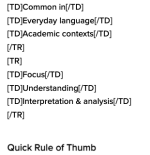
Key Differences at a Glance​


[TR]
[TH]Aspect[/TH]
[TH]Explain[/TH]
[TH]Explicate[/TH]
[/TR]
[TR]
[TD]Formality[/TD]
[TD]Neutral[/TD]
[TD]Formal[/TD]
[/TR]
[TR]
[TD]Depth[/TD]
[TD]General clarity[/TD]
[TD]Detailed, thorough[/TD]
[/TR]
[TR]
[TD]Common in[/TD]
[TD]Everyday language[/TD]
[TD]Academic contexts[/TD]
[/TR]
[TR]
[TD]Focus[/TD]
[TD]Understanding[/TD]
[TD]Interpretation & analysis[/TD]
[/TR]

Quick Rule of Thumb​

  • Use explain in almost all situations.
  • Use explicate when you mean carefully unpacking complex meaning, especially in scholarly contexts.
If you’d like, I can give examples where using explicate would sound awkward—or where explain would sound too weak.
 
Screenshot 2025-12-20 at 18.38.32.png
omg you broke my browser !!

Big words are fine but one's audience should moderate grandiloquence. I'm currently reading a Robert MacFarlane book ( Oxford professor, author, explorer ) who clearly feels compelled to use $20 words to placate his old college chums. Opening a random page where he's wandering the hills of Scotland, I see 'noctambulism' 'sensorium' 'gryke' and describing the sky as a 'generalised photonic haze' which marks him out to be a pompous ass. I am persevering because he described a 'snowflake melting on his jacket like a ghost slipping through a wall' and at that moment I wanted his babies.
 
View attachment 2584941
omg you broke my browser !!

Big words are fine but one's audience should moderate grandiloquence. I'm currently reading a Robert MacFarlane book ( Oxford professor, author, explorer ) who clearly feels compelled to use $20 words to placate his old college chums. Opening a random page where he's wandering the hills of Scotland, I see 'noctambulism' 'sensorium' 'gryke' and describing the sky as a 'generalised photonic haze' which marks him out to be a pompous ass. I am persevering because he described a 'snowflake melting on his jacket like a ghost slipping through a wall' and at that moment I wanted his babies.
<pedant> He's actually a Cambridge guy, which matters more to some than others. </pedant>

His writing can be an extraordinarily immersive experience, but yes, you need a high tolerance for hefty words. I can read him, happily, about once a year before saturation sets in. He's worth it.
 
<pedant> He's actually a Cambridge guy, which matters more to some than others. </pedant>

His writing can be an extraordinarily immersive experience, but yes, you need a high tolerance for hefty words. I can read him, happily, about once a year before saturation sets in. He's worth it.
Bugger. His MPhil is from Magdalen Oxford, though he is now a Fellow at Cambridge :p

Oh good - someone else familiar with him. His first chapters of Wild Places are gorgeous, but I did write in pencil at the end of chapter where is decided to sleep the night on Ben Hope
"TWAT. It's only Scotland, not the fucking Himalayas"
 
He's actually a Cambridge guy, which matters more to some than others.
It's very important to Oxfordians.

A Cambridgite and an Oxfordian had met over dinner with mutual friends, and needed to go use the urinals at the same time, by pure coincidence. The Oxfirdian left without washing up.

The Cambridgite pounced, gleefully announcing, "At Oxford don't they teach you to wash after micturating?"

Whereupon the Oxfordite asked, "At Cambridge don't they teach you not to mickey bliss on your hands?"
 
Never been to Cambridge, but they do a nice Xmas Carol service each year on the telly. Kings College

It's said you can walk from Oxford to Cambridge universities without ever leaving their land. Not sure how much of a myth that is/was.
 
I was reading Master and Commander to get back in a normal mood after writing a fairly emotionally intense lesdom scene, and hit these two sentences with both $20 words and $20 construction:
Two bells in the morning watch found the Sophie sailing steadily eastward along the thirty-ninth parallel with the wind just abaft her beam; she was heeling no more than two strakes under her topgallantsails, and she could have set her royals, if the amorphous heap of merchantmen under her lee had not determined to travel very slowly until full daylight, no doubt for fear of tripping over the lines of longitude.

The sky was still grey and it was impossible to say whether it was clear or covered with a very high cloud; but the sea itself already had a nacreous light that belonged more to the day than the darkness, and this light was reflected in the great convexities of the topsails, giving them the lustre of grey pearls.
Nacreous is a great word.
 
Back
Top