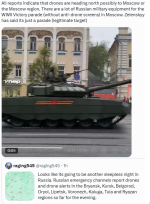
For Those Who Might Be Wondering Why We Might Be In Ukraine

Australia delays handover of decommissioned Abrams tanks to Ukraine due to US opposition – ABC

Australia has been delaying delivery of M1A1 Abrams tanks promised to Ukraine as part of a US$245 million military aid package due to resistance from the United States, which has not granted permission to send the armoured vehicles.

It seems the Trump Administration is doing everything they can to betray and handicap Ukraine.

https://www.pravda.com.ua/eng/news/2025/04/29/7509634/

You know that the delay was because of Biden and not Trump, yes?
 
You know that the delay was because of Biden and not Trump, yes?
If you don't read the article, then yes.

If you read it to understand the current situation, then no.

ABC reported that the first complications with the tank handover had arisen last month when US President Donald Trump temporarily froze military aid to Ukraine.


Defence officials familiar with the situation now say the process is further complicated by the fact that the formal authorisation which must be granted by the US before the tanks can be transferred to another country has not yet been received.

 
All the Russian war criminals (which is pretty mich every Russian) has gotta be sweating. The SBU is gonna make Mossad and Munich look like amateur hour.

Skabeeva is slowly realizing she may end up just like General Moskalik, because Ukrainians won’t rest until every single Russian war criminal is held to account.

Not gonna lie, watching them start to sweat is wonderful. I'm going to enjoy seeing Skabeeva explode. They may just be realizing the personal implications here.


1745938017983.png
 
You watch, Russia will cancel the parade this year citing terrorist threats from Ukrainian Nazi's against the Russian people.
It's going to be either
(a) so humiliatimg for Putin to cancel it, or
(b) so humiliating for Putin to hold the parade and watch it rain drones....

I'm good either way
 
Now THIS is the President for a country in the war to end all wars! Not only is he a soldiers leader, not only does he call JD Vance a bitch to his face, not only does he stand up to Putin AND Trump....

He can also PLAY THE PIANO WITH HIS DICK

Frigging awesome!!!!!!!!


1746052112104.png
 
Now THIS is the President for a country in the war to end all wars! Not only is he a soldiers leader, not only does he call JD Vance a bitch to his face, not only does he stand up to Putin AND Trump....

He can also PLAY THE PIANO WITH HIS DICK

Frigging awesome!!!!!!!!


View attachment 2534141
Zelenskyy was a comic actor before he went into politics -- nothing should surprise us.
 
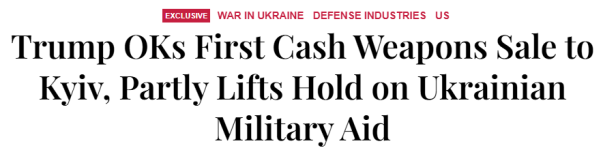
As peace talks slow, the Trump White House approved its first $50M arms exports to Ukraine through direct commercial sales to Kyiv. On Wednesday, the Trump administration informed Congress of its intention to green-light the export of defense-related products to Ukraine through direct commercial sales (DCS) of $50 million or more.

https://www.kyivpost.com/post/51800
1746111996130.png
 

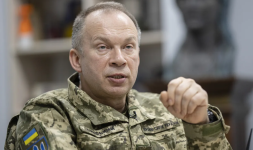
Ukrainian army retook 115 positions in April, Syrskyi says

The Ukrainian army retook 115 positions from Russian forces during April, Commander-in-Chief Oleksandr Syrskyi reported on May 1. "We use active defence tactics: thanks to these actions, our soldiers regained a total of 115 positions over a month," Syrskyi wrote on Facebook.

The main task of the Ukrainian army now is to deter Russian troops in the "threatened areas," primarily Sumy, Kursk, Pokrovsk, and Novopavlivsk, he added.

Syrskyi highlighted the continued success of artillery, aviation, and UAVs. "In April, DeepStrike (long-range drones) hit 62 targets in Russia, destroying military facilities and undermining the aggressor's (Russian) military-industrial complex," he said. The main task of the Ukrainian army now is to deter Russian troops in the "threatened areas," primarily Sumy, Kursk, Pokrovsk, and Novopavlivsk, he added. Syrskyi highlighted the continued success of artillery, aviation, and UAVs. "In April, DeepStrike (long-range drones) hit 62 targets in Russia, destroying military facilities and undermining the aggressor's (Russian) military-industrial complex," he said.

He also noted that the "18-24" mobilization project is progressing, as is the transfer of military from non-combat units to combat ones, with 30,500 soldiers moving to combat roles using the "Army+" application.

1746114989708.png
 
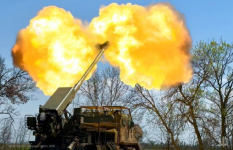
How is France helping Ukraine resist Russian aggression? In this special Kyiv Post “Point of Impact” report, former Navy SEAL and war correspondent Chuck Pfarrer breaks down France’s growing role in Ukraine’s defense – from elite training programs and heavy weapons to air power and NATO coordination.

What’s inside:

– How 10,000 Ukrainian troops trained by France are reshaping the battlefield

– The battlefield impact of CAESAR howitzers, SCALP cruise missiles, Mirage jets & more

– France’s role in strengthening NATO’s eastern flank

– The future of Mirage 2000s in Ukrainian skies – Why France’s support is more than just symbolic

This is one of the most comprehensive looks at a major ally’s role in the war.

 
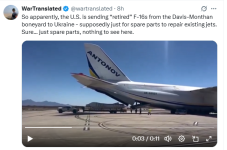
Old F16's from the boneyard off to Ukraine. Now, the question is, are they to be used as decoys, as spare parts, or perhaps....given the aptitude of Ukraine for reassembling "spare parts" into things that work....

The United States has begun pulling F-16 Fighting Falcons from the Davis-Monthan Air Force Base’s “boneyard,” not to restore them to combat glory but to dismantle them for spare parts destined for Ukraine. This move, confirmed by recent reports, marks a creative twist in America’s support for Kyiv’s war effort against Russia, offering a lifeline to Ukraine’s fledgling F-16 fleet without committing new aircraft. Announced in late April 2025, the decision reflects a delicate balance of logistical pragmatism, geopolitical signaling, and resource management at a time when global tensions demand strategic finesse. Why send parts instead of planes? What does this mean for Ukraine’s air force and the broader conflict? The answers lie in the interplay of technology, strategy, and history at one of the world’s most iconic military storage facilities.

The F-16 Fighting Falcon, a single-engine multirole fighter, has been a cornerstone of American airpower since its introduction in 1978. Designed by General Dynamics [now Lockheed Martin], the F-16 is renowned for its agility, versatility, and relatively low cost compared to heavier fighters like the F-15 Eagle. With a length of 49 feet, a wingspan of 32 feet, and a top speed exceeding Mach 2, the jet can carry a wide array of weapons, from air-to-air missiles like the AIM-120 AMRAAM to precision-guided bombs. Its compact design, powered by a Pratt & Whitney F100 or General Electric F110 engine, allows for a thrust-to-weight ratio that makes it a nimble dogfighter. Over 4,500 F-16s have been built, serving not only the U.S. Air Force but also dozens of allies, including recent operators like Ukraine, which began receiving F-16s from European nations in 2024.

The jet’s adaptability has kept it relevant through decades of upgrades, with modern variants featuring advanced radar, electronic warfare systems, and compatibility with cutting-edge munitions. Yet, the F-16s at Davis-Monthan, primarily older Block 25 and Block 30 models, are relics of an earlier era, retired as newer variants and fifth-generation fighters like the F-35 Lightning II took their place. These retired jets, stored under the meticulous care of the 309th Aerospace Maintenance and Regeneration Group (AMARG), are preserved in the desert’s low humidity and minimal rainfall, conditions ideal for preventing corrosion. The boneyard, spanning over 2,600 acres, holds nearly 4,000 aircraft, including 340 F-16s as of recent counts.

The process of “cannibalization,” where airframes are stripped for usable components, is a well-established practice at AMARG. Engines, avionics, landing gear, and even structural elements like wings or fuselage sections can be refurbished and repurposed. For Ukraine, these parts are critical to maintaining its small but growing fleet of F-16s, donated by countries like the Netherlands and Denmark. The transfer, first spotted on April 26, 2025, when a Ukrainian-operated Antonov An-124 airlifter was seen loading F-16 fuselages at Davis-Monthan, underscores the urgency of keeping these jets operational amid intense combat demands. The logistics of this operation are daunting. Transporting heavy aircraft components across the Atlantic, likely via airlifters to hubs like Rzeszów, Poland, requires precise coordination. Once in Ukraine, technicians must integrate parts from older American F-16s with European-donated models, which may differ in configuration. Ukraine’s maintenance infrastructure, already strained by years of conflict, faces the challenge of adapting to these components, some of which may require refurbishment or recalibration. The F-16’s maintenance demands are significant, with each jet requiring hundreds of hours of upkeep for every hour of flight.

Spare parts like turbine blades, radar modules, or hydraulic systems can mean the difference between a jet staying grounded or taking to the skies to counter Russian air defenses or support ground operations. This decision to send parts rather than whole aircraft reveals much about the Biden administration’s approach to supporting Ukraine. With domestic pressures to manage defense budgets and global commitments, particularly in the Indo-Pacific where tensions with China loom, the U.S. is opting for a low-profile but effective form of aid. By drawing from the boneyard, Washington avoids depleting active inventories or escalating the conflict with direct transfers of combat-ready jets, which could provoke sharper Russian retaliation. The move also complements efforts by NATO allies, who have pledged dozens of F-16s to Kyiv.

General Christopher G. Cavoli, head of U.S. European Command, noted in early 2025 that F-16s are already flying daily in Ukraine, conducting bombing runs and intercepting Russian cruise missiles. The spare parts from Arizona will help sustain these operations, potentially extending the service life of Ukraine’s jets by months or even years. Historically, the Davis-Monthan boneyard has played a pivotal role in supporting U.S. allies. During the 1980s, AMARG supplied parts for F-4 Phantoms and A-4 Skyhawks to nations like Israel and South Korea. In the 2000s, refurbished F-16s were provided to Pakistan and Thailand, demonstrating the facility’s value as a strategic reserve. The boneyard’s ability to preserve aircraft in “reclaimable condition” allows for rapid response to global needs, whether for spare parts or reactivated airframes. For instance, in 2024, two B-1 Lancer bombers were pulled from storage and restored to service to meet U.S. Air Force requirements.

The current effort for Ukraine echoes these precedents but is unique in its focus on a partner engaged in active, high-intensity conflict. Unlike past transfers, which often involved formal sales or long-term agreements, this operation is expedited to meet immediate battlefield demands. The strategic implications extend beyond Ukraine’s borders. By bolstering Kyiv’s air capabilities, the U.S. signals unwavering support to NATO allies, particularly those on Russia’s periphery, while avoiding direct confrontation. The decision also reflects a broader trend of resourcefulness in Western aid, as seen in Australia’s criticized 2023 transfer of obsolete M113 armored vehicles to Ukraine, which analysts deemed insufficient for modern warfare. In contrast, the F-16 parts are tailored to a specific, high-impact need, aligning with Ukraine’s integration of Western technology.

However, the move raises questions about sustainability. Ukraine’s F-16s face constant threats from Russian air defenses, including S-400 systems and MiG-31 interceptors armed with long-range R-37M missiles. Attrition rates could outpace the supply of spare parts, especially if European donors struggle to provide additional jets or maintenance support. Comparatively, Russia’s air force relies on a mix of Su-27, Su-30, and Su-35 fighters, which are larger, twin-engine platforms designed for air superiority and long-range strikes. While these jets boast greater payload and range, they lack the F-16’s agility and are less suited for the low-altitude, close-support missions Ukraine often requires. Russia’s maintenance challenges, exacerbated by Western sanctions limiting access to advanced components, mirror Ukraine’s but are compounded by a larger, more diverse fleet. China, another potential adversary, operates the J-10, a single-engine fighter roughly analogous to the F-16, but its newer J-20 stealth fighter represents a leap forward. The U.S. must weigh these global dynamics, ensuring that aid to Ukraine does not compromise readiness elsewhere. For Ukraine, the spare parts offer both opportunity and challenge. The F-16s enhance Kyiv’s ability to contest airspace, protect critical infrastructure, and support ground forces. Yet, integrating older components into newer airframes risks compatibility issues, and Ukraine’s technicians, trained primarily on Soviet-era MiG-29s, face a steep learning curve.

There is also the possibility, though speculative, that Ukraine could innovate with these parts, as it has with Western-supplied drones and missiles. Reports of Ukrainian engineers adapting NATO weapons to Soviet platforms suggest a knack for improvisation that could maximize the boneyard’s contributions. The operation’s success hinges on execution. If the parts are seamlessly integrated, Ukraine’s F-16s could remain operational longer, bolstering morale and battlefield effectiveness. If logistical hurdles or combat losses overwhelm the effort, the impact may be fleeting. The boneyard’s role as a “national-level air power reservoir,” as described by AMARG’s mission statement, underscores its value in such scenarios, but it is not a panacea. Ukraine’s air force, still outnumbered and outgunned, will need sustained Western support to alter the conflict’s trajectory. This move from the Arizona desert to the battlefields of Eastern Europe encapsulates a moment of strategic ingenuity. It leverages a unique American asset—the world’s largest aircraft storage facility—to address an urgent allied need without overextending resources. Yet, it also highlights the limits of such measures.

As Ukraine fights on, the flow of parts from Davis-Monthan will be but one piece of a complex puzzle. Can this resourceful approach sustain Kyiv’s air force against a relentless adversary, or is it merely a stopgap in a war that demands more robust solutions? The answer will shape not only Ukraine’s fate but also the contours of U.S. leadership in an increasingly volatile world.

1746150643593.png1746151201530.png
 
What a Cool Way to Motivate Your Soldiers - and Effective Too

Ukraine's military is turning to incentive schemes used in video games to spur its soldiers to kill more Russian troops and destroy their equipment. Ukraine rewards soldiers with "points for kills" targeting Russians in a gamified system, Digital Minister Fedorov told Politico. The program assigns points for each type of kill: 20 points for damaging and 40 for destroying a tank; up to 50 points for destroying a mobile rocket system, depending on the caliber; and six points for killing an enemy soldier. Soldiers have to download the video footage taken by their drones confirming the kill to the military's Delta communication and situational awareness system.

Points buy drones and gear.

The program — called Army of Drones bonus — rewards soldiers with points if they upload videos proving their drones have hit Russian targets. It will soon be integrated with a new online marketplace called Brave 1 Market for the Ukrainian military, which will allow troops to convert those points into new equipment for their units. “Brave 1 Market will be like Amazon for the military, will allow military units to directly purchase technologies they need on the war front,” said Mykhailo Fedorov, Ukraine’s deputy prime minister and minister for digital transformation, speaking at a weekend military tech conference in Kyiv.

Units will soon be able to use the special digital points they’ve been getting since last year by trading them in for new weapons. A Vampire drone, for example, costs 43 points. The drone, nicknamed Baba Yaga, or witch, is a large multi-rotor drone able to carry a 15-kilogram warhead. The Ukrainian government will pay for the drones that are ordered and will deliver them to the front-line unit within a week. “In short, you destroy, you get the points, you buy a drone using the points,” Fedorov said.

He pointed to the accomplishments of Magyar's Birds, one of Ukraine's elite drone warfare units. It has run up a score of over 16,298 points, enough to buy 500 first-person view drones used in daytime operations, 500 drones for night operations, 100 Vampire drones and 40 reconnaissance drones, Fedorov said. The scheme is aimed at directing more equipment to the most effective units. It will also help to bypass bureaucratic procurement procedures and buy weapons directly from manufacturers. As of today there are more than a thousand different items available to Ukrainian soldiers on the Brave 1 marketplace, ranging from drones to robotic systems, electronic warfare systems, parts, AI systems and other weapons.

Soldiers will be able to leave reviews on the site to guide future purchases.

The ability to get points for killing enemy troops is also spurring competition among units; so far about 90 percent of the army's drone units have scored points. In fact, they are logging so many hits that the government has had to revamp the logistics of drone deliveries to get more of them to points-heavy units. “They started killing so quickly that Ukraine does not have time to deliver new drones,” Fedorov said.

It also helps improve the military's verified data on the destruction of Russian targets in real time — boosting battlefield awareness. The Ukrainian government is continually tweaking the system to make it deadlier. “For example, we have increased the number of points for infantry elimination from two to six, and that has doubled the number of destroyed enemy soldiers in one month,” Fedorov said. “This is not just a system of motivation, this is a mechanism that changes the rules of war.”

https://www.politico.eu/article/ukr...-like-digital-weapons-store-deadly-realistic/
 
Another German military assistance package for Ukraine

Germany has provided Ukraine with a new package of military assistance, including IRIS-T air defense systems and missiles for Patriots, according to an updated list released by the German government on April 17. The latest German shipment includes four additional IRIS-T systems and missiles for them, missiles for Patriot air defense systems, and 120 IGLA man-portable air defense missiles. The package has also provided 66 more Mine Resistant Ambush Protected (MRAP) vehicles, additional Kinetic Defense Vehicles, and 38,000 more rounds of Gepard anti-aircraft ammunition.

In partnership with Denmark and Norway, Germany also delivered three new Zuzana 2 wheeled howitzers. Berlin also sent additional artillery supplies, including 27,000 more rounds of 155 mm shells and 1,000 additional rounds of 122 mm ammunition. Drone support includes 70 more Vector reconnaissance drones, 150 additional HF-1 armed drones, and 10 more surface drones. The package also includes engineering and recovery vehicles, surveillance radars, laser rangefinders, assault rifles, personal and tactical gear, as well as continued medical treatment for wounded Ukrainian soldiers.

The support, drawn from Bundeswehr stockpiles and industrial contracts financed through Berlin’s security capacity-building initiative, brings Germany’s total military aid to Ukraine to approximately 28 billion euros since the start of Russia’s full-scale invasion in 2022.

View attachment 2528654 View attachment 2528655
Roll on Taurus . . . ??? Hmmm!
 
It'll be a courageous foreign leader who attends the May 9th Victory Parade in Moscow. Budanov says "wear earplugs"

 
Back
Top