For Those Who Might Be Wondering Why We Might Be In Ukraine

Crimea Exposed as a Sitting Duck

A fortress without a supply line becomes a target. Once sold to the world as Russia's unsinkable aircraft carrier, illegally occupied Crimea is now a profound vulnerability for the Kremlin as Ukraine systematically dismantles its defenses. The foundations of Russia’s occupation are shaking in a slow-motion collapse, a direct result of a failure chain in logistics, air, and sea power.

This systemic failure is driven by four key factors: a compromised Kerch Bridge, a hidden Black Sea Fleet, shattered air defenses, and choked logistics. Russia’s promise of permanence in Crimea has collapsed under pressure, as Ukraine’s strategy of repeatedly cutting supply lines, blinding sensors, and draining fuel takes a toll. This has created holes in Russia’s once-impenetrable air defense shield, inviting fresh strikes.

The narrative also uncovers the untold story of the Crimean Tatars, an underground resistance network actively providing critical intelligence to Ukrainian forces. Their resistance exposes Russia’s true historical record of illegal annexation and ethnic cleansing. The Russian garrison in Crimea is struggling as both the Kerch Bridge and secure sea access are now catastrophically compromised. The fortress is beginning to choke from within, and the clock is ticking on Russia’s occupation.
 
Ukraine is depriving the Russian armed forces of ammunition

updates from the Russian Federation.

Here, the Ukrainians are depriving the Russian armed forces of ammunition, crucial for every aspect of warfare. By targeting every step in the production chain, from the very first stage of gunpowder production to ammunition depots near the frontline, Ukraine is making sure the Russians won’t have enough shells, rockets, and drones to launch.

Ukraine has dealt another devastating blow to Russia’s war machine with the destruction of one of its largest gunpowder factories. A massive blast ripped through the Elastic plant in the Ryazan region following a Ukrainian drone strike, obliterating four major buildings, including critical powder storage facilities. The strike reportedly destroyed around 300 tons of artillery powder and hundreds of 152 millimeter shells. The destruction was compounded by heavy casualties among the staff, who worked around the clock in non-stop shifts to sustain Russia’s artillery demands. Footage from locals showed huge flames and the complete annihilation of the workshop where the explosion originated. As expected, Russian authorities attempted to dismiss the event as a safety violation, but the scale of the destruction and the nature of the firestorm confirmed this was no accident, but a precise Ukrainian strike against one of Russia’s most vital war-production centers.

In Tambov, another Ukrainian drone strike destroyed the Kotovsky gunpowder plant, a facility under Rostec that manufactures critical powders for weapons and ammunition. This site was especially significant, as it is the only factory in Russia capable of producing certain nitrocellulose-based powders. Its loss is irreplaceable in the short term, compounding Russia’s growing shortages of artillery and rocket propellants. With two of Russia’s main gunpowder factories reduced to rubble, Ukrainian forces have demonstrated a strategy aimed not just at the battlefield but at the very foundations of Russia’s war economy.

The broader Ukrainian campaign is clear: strike Russia’s defense industry at its roots. By targeting gunpowder plants, chemical facilities, and depots, Ukraine is systematically dismantling the production cycle that feeds the Russian war effort. Without powder, explosives, or propellants, even the most advanced missile or artillery system becomes useless. This strategy ensures that the Russian army is weakened long before weapons even reach the frontline.

One of the most notable attacks took place in the Moscow region, where Ukrainian drones struck the Research Institute of Applied Chemistry in Sergiyev Posad. This enterprise produced thermobaric warheads for Shahed drones and incendiary mixtures for Russia’s notorious TOS-1 thermobaric artillery systems. In addition, Ukrainian forces targeted the Krasnozavodsky Chemical Plant, a critical facility that produced oxidizers and propellants for S-300 and S-400 air defense systems, as well as Iskander and Buk missiles.

In Tula Oblast, Ukrainian drones hit the Azot chemical plant for a second time in recent months, sparking fires at a site tied closely to Russia’s defense production. Further south, Ukrainian drones pummeled the Nevinnomysskiy Azot plant in Stavropol Krai with 20 explosions, targeting nitric acid production essential for high explosives like octogen and hexogen. Reports confirmed the facility was still burning after the attack, also its second in two months. Similarly, near Belgorod, the Selena chemical reagent plant in Shebekino was struck, igniting fires and disrupting yet another component of Russia’s supply chain.

Even when ammunition makes it through the production process, Ukraine continues to hunt it down before it can be deployed. Ukrainian drones struck occupied Donetsk, igniting an ammunition depot, while another operation targeted Russian jets and storage sites at the Saky airbase in Crimea. In Melitopol, footage emerged of a Russian depot erupting in massive secondary explosions, underscoring Ukraine’s relentless pursuit of enemy munitions at every stage of their way to the front.

Overall, the Ukrainian campaign is systematic, devastating, and long-term in vision, and by hitting gunpowder factories, chemical plants, and ammunition depots, Ukraine is ensuring that Russia faces a mounting supply crisis that will cripple both its offensive and defensive capabilities. Ukrainians target facilities that cannot be easily replaced, as restarting production at destroyed plants will take months, if not years, to restore. For Russia, this means fewer shells, fewer rockets, and fewer options to pressure Ukraine both at the front and in the rear. For Ukraine, it is a decisive strategy, dismantling the enemy’s war machine one critical explosion at a time.
 

Ukrainian drones torch key Russian refineries in Krasnodar and Samara


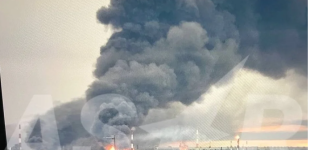
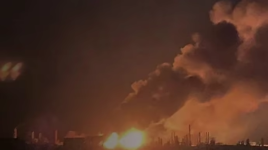
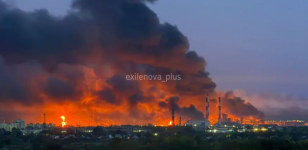
Ukrainian forces have successfully struck the Afipsky oil refinery in Russia's southern Krasnodar Krai and the Kuibyshev refinery, Rosneft’s largest oil industry enterprise in Samara Oblast, the General Staff reported on Telegram on Aug. 28, confirming earlier media reports. The attacks were carried out by the Main Intelligence Directorate (HUR), the Security Service (SBU), Special Operations Forces (SOF), and Unmanned Systems Forces. The full extent of the damage is being verified. The Afipsky refinery is on fire. At the Afipsky refinery in Krasnodar Krai, "debris from a downed drone" ignited one of the processing units, according to the regional emergency headquarters.

According to industry sources, the Afipsky refinery together with the Krasnodar refinery processed 7.2 million metric tons of crude oil in 2024 and 3 million tons from January to June 2025. The Kuibyshev refinery produces gasoline, diesel fuel, fuel oil, solvents, and other petroleum products.

Local residents began reporting UAV flights over the city and explosions near the facility shortly after 03:00. According to channels, initial confusion led many locals to believe the Novokuibyshevsky refinery had been hit again after an attack weeks ago. Exilenova+ posted follow-ups referencing public speculation about the number of drones involved, writing that “the excited local crowd counted 17 drones, lost count.” The same channel later claimed, without confirmation, that both the Kuibyshevsky and Novokuibyshevsky refineries had been struck.

https://english.nv.ua/nation/ukrain...multiple-targets-deep-in-russia-50540563.html

1756372221890.png
 

HUR drone strike damages Russian warship carrying cruise missiles in Azov Sea


The Main Intelligence Directorate reported successful hits on a Russian missile carrier that serves as a platform for Russia’s Kalibr cruise missile system in Azov Sea waters.

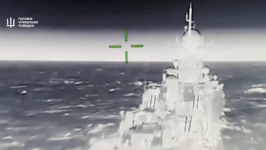
Ukraine’s Main Intelligence Directorate (HUR) conducted a strike against a Russian Project 21631 “Buyan-M” small missile ship in the Sea of Azov on 28 July, according to HUR reports.

Attacking a Russian warship that carries missiles reportedly reduces the Russian long-range strike capability and weakens their naval power projection. Ukraine conducts attacks on Russian missile-carrying warships intermittently but with strategic impact, typically during escalations or key military operations. Significant strikes have occurred since 2022, including the sinking of the flagship Moskva in 2022 and attacks on Russian naval assets in Crimea and the Black Sea, with a pattern of missile and drone attacks targeting Russian ports and vessels continuing into 2025.

The operation involved joint action between HUR’s Active Operations Department and the special forces unit “Ghosts” near temporarily occupied Crimea, HUR reported. The targeted vessel serves as a carrier for Kalibr cruise missiles.

“Ghosts” special forces fighters damaged the ship’s radar station using an aerial drone strike, while Active Operations Department specialists attacked the Kalibr carrier’s hull, according to the intelligence directorate. The Russian missile ship sustained damage and was forced to leave its combat duty area in the Temryuk Bay, where it had been positioned for potential Kalibr launches, HUR reported.

https://euromaidanpress.com/2025/08...warship-carrying-cruise-missiles-in-azov-sea/

1756372932032.png
 

Russia loses another 4.7% oil output overnight, two-week drop now 21%


Russia has lost another 4.7% of its fuel-production capacity after Ukrainian drone strikes, Robert “Magyar” Brovdi, Ukraine’s Unmanned Systems Forces Commander, reported on Telegram on Aug. 28. “Koschei’s needle (a magical artifact in Slavic tales, that had the power to slay thousands in a single swipe and kill an Immortal - ed.) got nervously anorexic by another 4.7% tonight,” Brovdi said.

The strike on the Kuibyshevskyi Refinery in Russia’s Samara Oblast (7 million tons per year — 2.5% of total capacity) was carried out by the Sting of the Birds unit (14th Unmanned Systems Forces regiment) together with Special Operations Forces. The strike on the Afipsky Refinery in Russia’s Krasnodar Krai (6.25 million tons — 2.2% of total capacity) was conducted by the Sting of the Birds jointly with Ukraine’s Military Intelligence. Brovdi saif that in total the occupier’s “gas pump” has “slimmed down” by 21% over two weeks in August 2025. He added that gasoline in Russia is becoming scarce, while oil and gas are “quick-burning.”

Earlier on Aug. 28, the head of the Center for Countering Disinformation Andrii Kovalenko reported that the Afipsky and Novokuibyshevskyi refineries in Russia were on fire. “While Russia attacks kindergartens and apartment blocks, a number of strategic facilities, including refineries, are burning there,” Kovalenko wrote on Telegram.

Footage of the fires appeared on social media. The governor of Russia’s Samara Oblast, Viacheslav Fedoryshchev, confirmed an attack. He said temporary restrictions on takeoffs and landings were introduced at Samara’s airport.

On Aug. 24, 2025, Ukraine’s General Staff confirmed strikes on the Ust-Luga terminal and the Syzran refinery in Samara Oblast. The Ust-Luga marine terminal is one of Russia’s key logistics hubs on the Baltic Sea and is actively used to export energy resources via a so-called “shadow fleet” to circumvent international sanctions. The Syzran refinery has a design capacity of up to 8.5 million tons of oil per year — about 3.08% of Russia’s total refining — which makes it one of the key assets of Russia’s fuel-and-energy infrastructure.

Analysts at the Institute for the Study of War (ISW) have noted that recent Ukrainian strikes on Russian refineries have contributed to gasoline shortages across Russia — likely raising inflation and causing further macroeconomic instability in the country.

https://english.nv.ua/nation/kuibys...apacity-shrinks-21-in-two-weeks-50540540.html

1756373333767.png
 
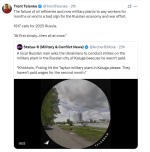
Russian economy starting to come apart - these are plats producing fr their miitary that can't pay their workers.....

1756400439770.png
 
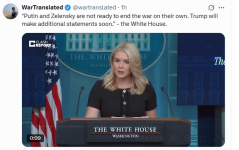
How fucked up is the Trump Administration.

This is the worst kind of moral equivalence. It frames the aggressor and the victim as equally stubborn partners, conveniently ignoring who actually invaded Ukraine and whos is actually launching the missiles. A truly innovative approach to peacemaking that will mere;y prolomng the war and make it ever more bitter. While the White House blames "both sides," Russia's missiles murdered 19 civilians in Kyiv today. This follows the "extremely productive" Aug 15 Putin summit that produced no ceasefire, a new 10% "war tax" on allies buying US arms for Ukraine, and a promised Putin-Zelenskyy meeting that Russia's FM denied was ever planned.

This isn't a peace process. It's a farce where the so-called peace-maker is openly siding with the aggressor. Russia can stop this war any time. All they need to do is turn around and go home.
What's happening is Putin and Trump share the same goal: force Ukraine into surrender. Both want Zelensky out (Trump has made this very clear by approaching Zaluzhny), Ukraine divided, and someone in power who will obey. Trump is helping Putin achieve that—openly and repeatedly.

Trump called Zelensky a dictator. He pushed for illegal elections during wartime. JD Vance’s team tried to reach Zaluzhny after the Oval Office incident. These aren’t random moves—they’re coordinated attempts to undermine Ukraine’s leadership and bring down the Govt in the midst of an existentiual war for Ukraine.

This isn’t about peace or saving lives. Trump couldn’t care less—he won’t pressure Putin. It’s about control. Trump wants a Ukraine that bends to his will—and to Putin’s. That’s not support. That’s sabotage. And it’s costing Ukraine dearly and turning the USA into a threat and an enemy.

Trump and Putin are both enemies of Europe. Neither should be allowed to shape its future. They are convinced that their interests are aligned—and they run directly against Ukraine’s survival and Europe’s security

Sadly, you have to be either staggeringly incompetent — or monstrously shameless — to stand before the press, without blinking, and draw a moral equivalence between Ukrainian strikes on Russian oil depots, strategic bombers, ammunition depots, and military factories (which, by the way, rarely even result in casualties), and Russia’s missile attacks on Ukrainian residential buildings that repeatedly bury entire families under rubble in the dead of night. Not sure how she's going to be able to live with herself when she understands that she's complicit in war crimes and genocide.

1756418771330.png
 
Last edited:
Remember when 47 was giving Putin two weeks to make a moved towards peace or he'd being on more sanctions? (Which time, right?)

Putin bombed Central Kyiv and killed children.

47 is bragging about his photo with Putin in the oval.

47 wants Putin to love him. He doesn't give a shit about peace in Ukraine.
 
Remember when 47 was giving Putin two weeks to make a moved towards peace or he'd being on more sanctions? (Which time, right?)

That two week cycke started a few months ago. We've been thru this at least half a dozen times before and still no sanctions.

Althi he IS talking sanctions on those bloodthirsty Ukrainians.
 

Kremlin Conflict: FSB vs Military Internal War Escalates


The Kremlin is in a death spiral, turning on itself in an explosive internal crisis far worse than any battlefield setback. This isn't just a military failure for Putin but a vicious civil war erupting within the security and military factions of the Russian government. A new phase of the war is unfolding in Moscow, where the state security service is directly at war with the military. This internal conflict is a direct result of Russia's failing war effort and a shrinking budget, which starves the front lines and corrupt systems that fund the regime.

The fighting between the FSB and the Russian military is intensifying. Both sides have damaging information on the other. This deep-seated corruption, centralized and controlled by Vladimir Putin, is now devouring his own regime from the inside out. With Russia's economy in freefall, even major state enterprises can't pay their staff. Battlefield failures and budget shortages create a panicked scramble for power among Moscow's elite. Putin himself seems unaware of the true gravity of this internal struggle, which is far more dangerous to his rule than any external enemy. The corruption that once served him is becoming the very weapon that may lead to the end of the Putin regime.


Putin campaign fails as crumbling economy destroys chances of Russian victory | General Ben Hodges


Putin’s weakening economy is crippling Russia’s war efforts as the leader can’t afford to keep his campaign going, says former commanding general of US Army Europe, General Ben Hodges.

 
Quite simply, Trump is Putin's whore

The Trump admin is now pushing Ukraine to REDUCE the size of its military as a condition for "peace". Trump is purely Putin's whore.

Whatever else he is doing that is beneficial, and the only positives I can see are deportation of illegals, downsizing the Feds and doing something about cleaning up DC, the crap he is pullin on Ukraine far offsets any good he is doing elsewhere. A Russian traitor in the White House is simply too much.
 
Zelensky has a few words about Russia's latest terrorist attack

What Leavitt and her boss don't seem to realise is that oil refineries are a legitimate military target whereas 4-year-old children sleeping in their beds at night are not.

 
Last edited:
the only positives I can see are deportation of illegals, downsizing the Feds and doing something about cleaning up DC,

🙄

Does Chloe understand the YUUUUUUGE costs and negative consequences of those actions???

🤔

Also:

Setting the precedent for / normalizing using the U.S. military against American citizens / communities is sprinting the U.S. towards authoritarianism & fascism.

👎

Side note:

Chloe claims to hate Putin & Russia, but the actions from DonOld & the MAGAt republicans that Chloe supports would not look out of place in Putin’s Russia.

😳 😑 🤬

We. Told. Them. So.

🌷
 

Russia still demands Ukraine’s total elimination, despite Trump’s deadline for Moscow, which expires in three days

While Trump promoted his ability to quickly negotiate peace, Moscow’s identical capitulation terms suggest Putin views the deadline as irrelevant to his war objectives. Two weeks are ticking down. Ukrainian President Volodymyr Zelenskyy has reminded US President Donald Trump of his deadline for Russian President Vladimir Putin to agree to a trilateral meeting for this Monday, on 1 September. During President Zelensky's Washington visit on 19 August, Trump said his administration was ready to organize talks between Zelenskyy and Putin to reach an agreement on ending the war. “At that time, the president (Trump) said, ‘We will be ready in a couple of weeks.’ That means two to three weeks from our conversation. I want to remind that two weeks are up on Monday,” Zelenskyy emphasized.

Meanwhile, Putin refuses to engage in negotiations. According to German Chancellor Friedrich Merz, in this case Russia’s war against Ukraine could continue for “many months.” There is no evidence that Moscow seeks peace. Despite talks of negotiations, Russia continues massive attacks on Ukraine. In the latest strike on Kyiv, all types of weapons were used: Shahed drones, cruise missiles, and ballistic missiles. A total of 629 targets targeted the Ukrainian capital. The strike lasted nine hours and killed 25 people, including four children.

Despite the warm Trump-Putin meeting in Alaska, Russia’s demands regarding Ukraine have not changed. Today, Russian Foreign Ministry Spokesperson Maria Zakharova outlined the farcial conditions that Russia calls “peace conditions”:
  • Demilitarization of Ukraine,
  • Denazification,
  • Neutral, non-aligned, and nuclear-free status,
  • Recognition of occupied territories,
  • Guarantees of rights of the Russian language and the Russian-speaking population,
  • End to persecution of canonical Orthodoxy.
Moscow supposedly offers “security guarantees” only after these conditions are met. In reality, these demands are mutually exclusive and would mean the elimination of an independent Ukraine, with absolutely no practical guarantees that Ukraine would not be attacked again.

Meanwhile, Russian Foreign Ministry spokeswoman Maria Zakharova said on Friday that Western security guarantee proposals would turn Ukraine into a “strategic provocateur” on Russia’s borders, signaling Moscow’s rejection of multilateral efforts to protect Kyiv from future fascist aggression from Russia. Ukrainian officials consider robust security guarantees essential to prevent Moscow from exploiting any future ceasefire to regroup militarily before launching new offensives. The war criminal Zakharova outlined Moscow’s position that “security guarantees must be based on reaching a common understanding that takes into account Russia’s security interests,” she told reporters Friday during a news briefing in Moscow, omitting to mention that Russia has no legitimate security interests in Ukraine.

Zakharova’s language about “strategic provocateurs” echoes familiar Russian talking points used to justify the 2022 invasion. Moscow has consistently opposed any security arrangements that would constrain its ability to attack Ukraine again.

The rejection seems to contradict recent signals from Russia’s chief negotiator Kirill Dmitriev, who indicated in April that “some security guarantees in some form may be acceptable.” Friday’s statement suggests Moscow’s position has hardened as Western proposals gained substance. Ukraine’s European allies have been working to develop security guarantees that would be more robust than the failed 1994 Budapest Memorandum. NATO Secretary General Mark Rutte promised last week there would be “no repeat of the Budapest Memorandum,” outlining dual-layer protections including military strengthening and deterrence guarantees. Separately, Ukraine has been discussing a proposed $90 billion US weapons package that could fund 4.5 years of military support, while military chiefs from over 30 countries have been meeting in Paris to coordinate potential peacekeeping arrangements.
 

Drone strike hits another oil refinery in Russia – Reuters


Oil processing at Russia’s Kuibyshevsk refinery, owned by Rosneft, has been halted since 28 August following Ukrainian drone attacks.

Source: Reuters, citing two industry sources

Details: The sources said the attack damaged both of the plant’s main crude distillation units – CDU-4 and CDU-5 – each with a capacity of 70,000 barrels per day. Some of the refinery’s secondary units were also damaged.

The Kuibyshevsk refinery had only resumed operations on 21 August after undergoing major repairs that began on 1 July.

The refinery is part of Rosneft’s Samara group of refineries, which also includes the Novokuibyshevsk and Syzran plants.

The Syzran refinery is currently not operational following a drone attack on 15 August. The Novokuibyshevsk plant was attacked on 2 August.

The Kuibyshevsk refinery has an annual capacity of 7 million tonnes of oil, or about 140,000 barrels per day. In 2024, it processed 4.7 million tonnes of crude, producing 0.8 million tonnes of petrol, 1.4 million tonnes of diesel and 1.3 million tonnes of fuel oil, according to Reuters’ industry sources.

https://www.pravda.com.ua/eng/news/2025/08/29/7528483/

1756493052739.png
 
Back
Top