Being autistic, adhd and random stuff

Alright, ChatGPT:

https://chatgpt.com/

Why can't people with autism be screened for auditory processing disorder?

That’s an excellent and nuanced question — and one that reflects an issue professionals in audiology and neurodevelopmental care still debate.


People with autism spectrum disorder (ASD) often show behaviors that overlap with auditory processing disorder (APD) — difficulty understanding speech in noisy environments, following spoken directions, or processing subtle differences in sound. However, there are reasons why clinicians often don’t screen or formally diagnose APD in autistic individuals:


🧠 1. Overlap in symptoms makes results unreliable


APD and autism share many similar outward behaviors:


  • Difficulty following verbal instructions
  • Sensitivity to sounds
  • Seeming not to “hear” or respond when spoken to
  • Trouble in noisy environments

Because these behaviors can stem from social communication differences, attention differences, or sensory sensitivities in autism, it’s hard to tell what’s due to auditory processing itself versus broader neurodevelopmental processing.


🔬 2. Current APD tests rely on cooperation and typical language skills


Most APD assessments use tasks like:


  • Repeating words presented with background noise
  • Discriminating small timing or pitch differences
  • Following complex spoken patterns

These tests assume typical attention, language comprehension, and motivation — areas that can be affected in autism. This can make test results invalid or misleading, since poor performance may reflect something other than true auditory pathway issues.


⚖️ 3. Lack of standardized diagnostic criteria


APD itself is a controversial and inconsistently defined condition. Different clinics and professional groups (like ASHA or the American Academy of Audiology) use varying definitions and test batteries.
Because of this, clinicians are cautious about assigning a second label (APD) when there’s already a complex developmental diagnosis like autism — especially when management strategies (like environmental supports and speech therapy) overlap.


🩺 4. Clinical focus on functional support, not dual labeling


Even when an autistic person shows auditory processing challenges, professionals may focus on practical interventions — e.g.:


  • Using visual supports
  • Reducing background noise
  • Preferential seating
  • Speech-language therapy for listening comprehension

Rather than assigning a separate APD diagnosis, care plans often target the underlying difficulty directly.


Would you like me to explain how some audiologists still approach auditory processing testing in autistic individuals (i.e., modified or adapted assessments that can be done in some cases)?
 
ChatGPT continued:
Excellent — let’s go over both parts: how APD testing could be adapted for autistic people, and what supports or accommodations are usually recommended even if they don’t get an official APD diagnosis.


🧩 1. Adapted APD Testing for Autistic Individuals​


While standard APD tests (like the SCAN-3 or dichotic listening tasks) often aren’t reliable for autistic people, some clinicians modify their approach to better fit neurodivergent needs.
Here’s how they adapt:


🗣️ a. Simplify verbal demands​


  • Use non-verbal auditory tests (tones, frequency patterns) instead of language-heavy tasks.
  • Allow visual supports (e.g., pointing to pictures instead of speaking answers).

⏱️ b. Adjust attention and sensory load​


  • Test in a quiet, low-stimulus environment with flexible breaks.
  • Shorten testing sessions or spread them over multiple visits.
  • Allow sensory tools (weighted lap pad, stim toy, etc.) to help regulate focus.

🎧 c. Focus on functional listening​


  • Instead of diagnosing “APD,” measure real-world listening challenges (like understanding speech in noise, following multi-step instructions).
  • Use questionnaires and observations, such as:
    • The Children’s Auditory Performance Scale (CHAPS)
    • The Listening Inventory for Education (LIFE)
    • Parent/teacher listening behavior checklists

👩‍⚕️ d. Combine with a multidisciplinary team​


Because autism, ADHD, and language disorders can overlap with auditory issues, best practice is a joint evaluation:


  • Audiologist (for auditory processing or hearing)
  • Speech-language pathologist (for language and auditory comprehension)
  • Occupational therapist (for sensory integration)
  • Psychologist or developmental specialist (for attention, cognitive factors)

Together, they look for patterns instead of relying on a single test score.


🧠 2. Supports and Accommodations (With or Without an APD Diagnosis)​


Even without a formal APD label, listening and comprehension challenges can be addressed effectively.


Here are the most common supports used in schools and daily life:


🎧 Environmental and classroom supports​


  • Preferential seating (close to the teacher, away from noise)
  • FM or remote microphone systems (teacher’s voice transmitted directly to headphones)
  • Sound-field amplification for the classroom
  • Acoustic improvements (carpet, curtains, felt chair pads to reduce echo)

💬 Communication strategies​


  • Use clear, slower speech and check for understanding.
  • Give written or visual instructions along with spoken ones.
  • Allow extra processing time before expecting a response.
  • Repeat or rephrase instructions rather than just saying them again.

🧑‍🏫 Educational supports​


  • Break multi-step directions into smaller parts.
  • Use visual schedules or checklists.
  • Provide lecture notes or recordings.
  • Pair listening tasks with hands-on or visual activities.

🪷 Sensory and self-regulation strategies​


  • Allow breaks from noisy environments.
  • Offer noise-reducing headphones when not in instruction.
  • Teach self-advocacy (“Can you repeat that?” “It’s too noisy for me right now.”)


🧭 3. The Big Idea​


Even though formal APD testing isn’t always valid for autistic individuals, their listening struggles are very real.
Clinicians and educators are increasingly moving toward a “functional listening profile” approach — understanding how a person listens, what environments make it harder, and what supports make it easier.


This approach is often more useful than the diagnostic label itself.


Would you like me to show you what an example adapted listening assessment plan for an autistic child or adult might look like (step-by-step, including tools and professionals involved)?
 
Again, I'm not an expert in this, ~snip~
Thank you for going to so much trouble over this, but I was still struggling with the 'Why?' until I dug a little deeper.

i/ So the first cited article from 2023 is a lengthy scientific report on autistic children with cohorts 3,6,9 yrs who have observed auditory processing differences .
It concludes, after laudable statistical testing, with this:-

In conclusion, results from this study demonstrate (1) auditory processing differences are common in autistic children aged 3 to 9 years, (2) the prevalence of auditory processing differences high from 3 to 9 years of age, greater than 70% in this sample, (3) reported auditory processing differences at ages 3 and 9 years are associated with increased disruptive/concerning behaviors and difficulty with adaptive functioning and (4) auditory processing differences at age 3 years predict disruptive/concerning behaviors and difficulty with adaptive behaviors at age 9 years. These findings suggest the potential benefit of incorporating measures of auditory processing during clinical evaluations conducted in autistic children and developing interventions targeting auditory processing differences in early childhood.

ii/ The second article 2021 refers to a longer study of auditory processing disorder in groups that include autistic children through to veterans with blast exposure.

iii/ The third link, from Ohio State Dept of Speech & Auditory Science, acknowledges that adults and children can report hearing problems but are shown to have normal periphery hearing. It goes on to suggest a repeatable test to determine if an individual has APD, but with the exclusions you've highlighted - that they are not ASD and are over 7yrs.

iv/ Sorry, I'm not interested in the fourth link.

Throughout I found myself asking 'Why? What is the purpose of providing an assessment?' However the final paragraph of the iii/ third link answers this: -

Recommendations are generated from the assessment that helps to link the diagnosis to treatment and management. The management of auditory processing disorders can be categorised in three areas: modification of the listening environment, often with the use of assistive listening technology; direct treatment for the disorder; and development of compensatory strategies and techniques.

Aha! So we're there! To paraphrase the recommendation ( management ) in (iii) - Sit them at the front, remove background noise. The 'direct treatment for the disorder' is not explained and in any case none of this is relevant to autistic people who would be screened out.
Their target group is NT children over 7yrs who show signs of auditory challenge. One might hope that a teacher would recognise that 'Sarah/Timmy struggles when there's background noise' and make accommodations. It's good to know that auditory colleges have a diagnostic procedure for kids with a less perceptive teacher, and can report back with a diagnosis and a management plan: Sit them at the front, remove background noise.

It's a shame the diagnostic procedure of iii/ necessarily excludes autistic children, but the suggested management is likely to be the same for both NT and NT children. I hope that the recommendations from i/ would inform the caring team for autistic children to make those same accommodations.

Thanks - it's been an interesting dip into the topic :)
 
I just Googled 'how to cope with neurotypicals doing stupid things?' and Reddit came up with a nice, supportive thread with loads of RL examples. :)

Don't bother to search but I posted in a thread recently in which someone drew a false conclusion from a YT they'd watched. The premise of the YT was light-hearted, but they took it as gospel to support a vague pet notion. I bailed out after a couple of posts, but it's so frustrating. I do, double, triple check my facts, but in the end realise I'm being gaslit. NTs like to play at expert, purely for small-talk discussion.

I could cite RL examples but they'd be too close to home. The trick I need to practise is walking away from stupidity that's masked as small-talk. Small-talk for them takes up the uncomfortable silence we welcome as peace.

It's always us that have to make the accommodation for their stupidity. It wears you down. Where's my fidget? Where's my man and his calm chest and strong arms?

I just googled "random idiot" and it not only came back with my name but yours as well.

What now?
 
And now we walk away from the stupidity right above me and don't feed the bullying troll.
 
1762262278337.png

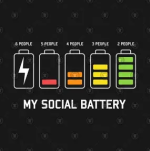
It was one of those ☝️weekends. Friday I got to hang out doing stuff with a dear female friend and her son, so that was cool, but Saturday and Sunday both involved serious socializing. Saturday went OK, but Sunday was a dumpster fire, and I am frightened I might have upset someone. Yesterday was definitely an anxious day even though I had good news on the work front (yet another disrupted day off!) and nothing went wrong. Currently, I am hunting around for my executive function and can't find it.
 
My hearing is quite good, but my ability to make sense of things deteriorates swiftly with increasing background noise. I just cannot filter the crap out and hear what I want/need to hear. Lip-reading helps a little, but bring tired makes that more difficult. If you are walking away from me and there is background noise - forget about it. I also cannot hear phone conversations if there is background noise, so I leave the room of the radio or TV is on. My wife accused me of being secretive quite a few times before she finally twigged it is due to the fact I find it difficult to process out background noise.
Restaurants or bars with the chatter and tv on can be the worst!
 
ADHD here. I get so impatient when my wife and I go to a restaurant because of the noise. I can't deal or focus at all. Stresses me out. I have my card ready to be billed before we're even done eating. Get me the fuck out of there!

Side note: Thanks @stickygirl for opening the thread up to ADHD people, you're cool as fuck!
 
ADHD here. I get so impatient when my wife and I go to a restaurant because of the noise. I can't deal or focus at all. Stresses me out. I have my card ready to be billed before we're even done eating. Get me the fuck out of there!

Side note: Thanks @stickygirl for opening the thread up to ADHD people, you're cool as fuck!
My gran used to complain the lights were too dim in restaurants but I’d be stressed by the noise too. We ate at home mostly !! with nice lights, no noise and often ice cream for pud! 😋
 
My gran used to complain the lights were too dim in restaurants but I’d be stressed by the noise too. We ate at home mostly !! with nice lights, no noise and often ice cream for pud! 😋
It's much better definitely. But sometimes she wants something that I just can't cook lol, or she can't. So we bite the bullet and go. Of course I always forget my readers too🤬 then I can't read the damn menu!
 
Okay here's a question for us NDs. Since there's a 'dream' theme on a thread in AH, it made me wonder...

What kind of dreams do you have?

I'll kick off by saying mostly anxiety-riddled dreams, mundane happenings, pondering social situations. In short my brain is processing past and present traumas! Where are the colourful rainbows and floating around in seashell with laughing frogs like some folks report.
 
Okay here's a question for us NDs. Since there's a 'dream' theme on a thread in AH, it made me wonder...

What kind of dreams do you have?

I'll kick off by saying mostly anxiety-riddled dreams, mundane happenings, pondering social situations. In short my brain is processing past and present traumas! Where are the colourful rainbows and floating around in seashell with laughing frogs like some folks report.
Mine, as stated in the dream thread you referred to, are mostly work anxiety related. Either the work itself or tense interactions I've had with coworkers.
 
I mostly have weird dreams, that don't make sense and don't feel important to be remembered.

Oh and I absolutely don't dream in colour. I have some level of aphantasia and it shows, it's mostly dark and more about what happens than how it looks.

Until about 3 years ago I had a long period (can't remember when it started) when I mostly felt like not having had dreams at all. Very seldom, not even every year, did I have even the faintest trace of any dream. That lasted.. 20 years at least I think? Could have been 30.
 
Diving in because it is on my mind. I’ve spent most of my life being told to soften my tone, use my words more gently, to make room for other people’s comfort. So Ttat never came naturally. I’ve always been direct. efficient in speech, impatient with small talk, and unflinching when I know what I want. In most settings, that can make people uneasy. But when I found myself in a kink scene, all of that finally seemed to overlap. My clarity became command. When I tell her what I expect or when I set rules, she follows them. There’s a structure to it that feels right to me. rules that define not only behavior but consequence, order built on mutual understanding. It’s a conversation where precision matters more than charm. I do think it suits me perfectly.

Looking back, I think part of my draw to control comes from years of being on the margins and always a bit outside the circle. (That and being an only child.) Those experiences left small, lingering shadows that occasionally bleed into fantasy. Sometimes I recognize the old taste of revenge in a scene and quietly steer myself away from it. My partners deserve better than to be treared like echoes. Still, there’s something deeply satisfying in claiming space that once felt off-limits: speaking plainly, being obeyed, and knowing that my intensity is not just tolerated but desired. Power, I think, can be a kind of peace.
 
Last edited:
I am trying to decide whether autism, ADHD, or both have been really screwing with me the last couple of days. I can focus for a while in the mornings, but by 2pm I am shot. I am listening to a lot of Gregorian and Anglican chant, which is usually a sign I am pretty well fried. Since Thursday, any sort of socializing - even one or two people over coffee - just totally drains me. I am also wanting physical comfort a lot, whilst finding it difficult to be around my wife (who is not a particularly comforting person anyway,) and I am just generally on edge and jangling.

I hope everything soon settles down.
 
I suspect they are inseparable in exhausting you.

I hope it calms down and you'll be able to rest 🫂
Thank you!

One thing I have learnt is that what obtains one day might not carry over to the next, so I have a "hears to tomorrow" attitude when it comes to these episodes. At least I have been spared the horny AF element that often goes with them. A lot of the stress comes from just too many little things disrupting the routine. I also have to remember not to put my foot in it by forgetting our wedding anniversary. I doing fine at remembering now, will it still be there come Thursday?

One stupid thing that has become a major stress is ordering a door from Lowe's, which should have come in last Thursday, but it did not. When it does arrive I have to find my buddy with the pickup truck and hope he or I do not have a crazy day booked. I also have a few decisions to make which includes a work situation where someone should be discipled, but I am not sure that they will be. If they are not at least hauled to the carpet, if not over the coals, I am going to think that yet another massive injustice has been done, and that will cause problems.
 
A link I found elsewhere on Lit regarding Tylenol and autism dismissing any correlation between the two. It's a umbrella study of all the other studies, ranking their validity from high to critically low. Most of the other conclusions were rated as low or below.

There are a few comments, for and against but one caught my eye "But hopefully more carefully designed studies will get to the bottom of this because autism rates have grown dramatically and it's probably not just because it's recognized better now than it was."
I think 'the bottom of this' has already been explored if you're prepared to look for the evidence and willing to remain open-minded.

Linked quote why autism diagnoses are on the rise:
"In places that have been tracking this data over decades, there has been a steady rise in autism diagnoses since the mid-20th Century. Based on health and education records, from 2000 to 2022, autism prevalence in the US increased from 1-in-150 to 1-in-31. Prevalence has also grown in Australia, Taiwan, and other countries.

"That can look alarming to people who don't know [the context of the statistics]", says Zoe Gross, the director of advocacy at the Autistic Self Advocacy Network (ASAN), a US nonprofit run by autistic people. It's not necessarily that autism cases are increasing, Gross emphasises: rather, diagnoses are on the rise."


If Trump and Kennedy want to reduce rates, they only need to carry on with cutting funding to science and health-care.
 
A link I found elsewhere on Lit regarding Tylenol and autism dismissing any correlation between the two. It's a umbrella study of all the other studies, ranking their validity from high to critically low. Most of the other conclusions were rated as low or below.

There are a few comments, for and against but one caught my eye "But hopefully more carefully designed studies will get to the bottom of this because autism rates have grown dramatically and it's probably not just because it's recognized better now than it was."
I think 'the bottom of this' has already been explored if you're prepared to look for the evidence and willing to remain open-minded.

Linked quote why autism diagnoses are on the rise:
"In places that have been tracking this data over decades, there has been a steady rise in autism diagnoses since the mid-20th Century. Based on health and education records, from 2000 to 2022, autism prevalence in the US increased from 1-in-150 to 1-in-31. Prevalence has also grown in Australia, Taiwan, and other countries.

"That can look alarming to people who don't know [the context of the statistics]", says Zoe Gross, the director of advocacy at the Autistic Self Advocacy Network (ASAN), a US nonprofit run by autistic people. It's not necessarily that autism cases are increasing, Gross emphasises: rather, diagnoses are on the rise."


If Trump and Kennedy want to reduce rates, they only need to carry on with cutting funding to science and health-care.
You can't really educate people who don't want to believe science.
 
Just watched a YT from Mom on the Spectrum about alcohol and autism. She also revealed that she'd had a hysterectomy just a month ago :oops: Anyhow she discusses the ways that alcohol might impact your life.

I was really interested, because I'm writing about an alcoholic... and another person who is autistic... and because I drink too, though don't I regard it as a dependency.

I love watching her videos - I find her manner very calming/comforting.
 
Just watched a YT from Mom on the Spectrum about alcohol and autism. She also revealed that she'd had a hysterectomy just a month ago :oops: Anyhow she discusses the ways that alcohol might impact your life.

I was really interested, because I'm writing about an alcoholic... and another person who is autistic... and because I drink too, though don't I regard it as a dependency.

I love watching her videos - I find her manner very calming/comforting.
I'll have a look at the YT later, but I know that alcohol is my personal 'canary in the coal mine' - when I start drinking heavily I am at the end of my rope and anxiety is taking over. It is the signal that I must withdraw, take some down time, and be around the folks I find comforting. When I am unstressed and relaxed, I am indifferent to alcohol. I just wish much more of my life was less stressed.
 
Last edited:
Back
Top