Comments that leave you shaking your head

The flexibility to use it badly and still be understood is one of the reasons that it is the most spoken second language.
I always say only in the English languages could you be walking down the road and someone could ask.
"Come time bus what Bristol?" or "Bristol what bus come time?" or any other permuation and only socially ignorant person wouldn't, having easily understood, not reply, "The bus to Bristol will come at ..." providing both the information and a gentle lesson in English.
 
Another quote is English is the bastard result of the interaction between a Norman solider and a Saxon barmaid and is as legitimate of any other thing they created. (or words to that effect)
A gross oversimplification. The Normans were rather late to the party.
 
I always say only in the English languages could you be walking down the road and someone could ask.
"Come time bus what Bristol?" or "Bristol what bus come time?" or any other permuation and only socially ignorant person wouldn't, having easily understood, not reply, "The bus to Bristol will come at ..." providing both the information and a gentle lesson in English.
I'm clearly socially ignorant, because I thought those were weird Britishisms like Cockney Rhyming slang or something... 🤣🤣🤣
 
I always say only in the English languages could you be walking down the road and someone could ask.
"Come time bus what Bristol?" or "Bristol what bus come time?" or any other permuation and only socially ignorant person wouldn't, having easily understood, not reply, "The bus to Bristol will come at ..." providing both the information and a gentle lesson in English.
My example is from Singapore, where the hotel and the client site were both at the end of a road.

I soon learnt that "To the end, straight" was the phrasing that taxi drivers understood.
 
True, but by the time they realised that people liked Shakespeare (you can't actually misspell his name as he had about half a dozen variants), they didn't have the monasteries and monk power to take control. Even the King James version failed to be more than a sea anchor on the evolution of English. As Terry Prachett said (approximate quote) "English doesn't so much as borrow words from another language, but takes it down a dark alley and muggs if for anything of worth."
Yeah, but English Bishops are sneaky. Lowth lived 200 years after Shakespeare in the 1800s. And he is responsible for God knows how many of the more stupid English Grammar ‘rules' that plague school kids, and that good writers get shat upon for breaking to this very day.

The idiot inflicted not ending sentances with prepositions on us. Made English one of the few languages that does not allow double negatives. Oh, and he declared the whole ban on splitting infinitives.

What? Why yes, I do have a bee in my bonnet about his prescriptivist ass.

But, like I said, English is open source, and he got the world to mostly adopt his patch.
 
Yeah, but English Bishops are sneaky. Lowth lived 200 years after Shakespeare in the 1800s. And he is responsible for God knows how many of the more stupid English Grammar ‘rules' that plague school kids, and that good writers get shat upon for breaking to this very day.

The idiot inflicted not ending sentances with prepositions on us. Made English one of the few languages that does not allow double negatives. Oh, and he declared the whole ban on splitting infinitives.

What? Why yes, I do have a bee in my bonnet about his prescriptivist ass.

But, like I said, English is open source, and he got the world to mostly adopt his patch.
I didn't know who he was, but now I despise him as well.
 
I don't know about Lowth, I went to a Secondary Modern in the 1970s, and their idea of grammar was 'naming words' 'doing words' et al, post, present and future tense - with no mention of conditional or any other modifiers and what are adjectives? I have more
On split infinitives, I firmly believe* that the only reason that you can't split a Latin verb is because it is a single conjugated word, not a word pair with a leading particle. So in English (and many other languages), you can add another word between the I and the common verb, believe, to make a superlative verb.

*see what I did, I used the super-verb of 'firmly believing' like Captain Kirk used the verb of 'boldly going'.
YMMV, I Reserve The Right To Be (proved) Wrong as "When facts change, I change my mind. What do you do?" (purportedly Milton Keynes and possibly the second clause was by Winston Churchill, but with an added Sir!)
 
I thought it was another economist, John Maynard Keynes, but on checking it seems that he didn't quite say that.

https://quoteinvestigator.com/2011/07/22/keynes-change-mind/
Thanks for the correction - Note my personal saying "I Reserve The Right To Be (proved) Wrong." and so you have. A bit of name blindness on my behalf, John Maynard Keynes vs Milton Keynes (an English New Town - now City) not known for its economic writings, but roundabouts and concrete cows - I kid you not.

I started using my phrase as a philosopy that enabled me to raise ideas for highway schemes and gracefully let go of them when others raised factual objections. Like one of my others (Past mistakes are not a good reason to repeat them*) I went looking for equivalent saying by famous people and found the "When facts change..." one**.

*Not only is this a similar idea to Grace Hopper's saying "Doing what you have always done is one of the biggest mistakes you can make." (approximate quote), but makes me worry about AI as it doesn't know a past mistake shouldn't be repeated, so may offer it as an answer - and so add it to the list of answers - and repeat it.

**I was aware of the debate about who said it, if anyone, which is why I used a 'drop aka conversational, word' "purportedly" to indicate that the attrubutaion is unclear.
 
I know I've asked this many times, and the fact that I can't remember means I keep discarding the knowledge as unimportant, but what's a preposition?
 
I know I've asked this many times, and the fact that I can't remember means I keep discarding the knowledge as unimportant, but what's a preposition?
A preposition is a connector word, like about, under, from, with.

The acceptable usages is in a prepositional phrase, such as "from the Tacoma region" or "under the weather".

The "rules" say you should never end a sentence with a dangling preposition, but it happens in casual speech all the time, as in "I don't know where she came from."
 
I know I've asked this many times, and the fact that I can't remember means I keep discarding the knowledge as unimportant, but what's a preposition?
Words like: At, To, With, Of, Beside, Before, For.

A preposition is a connecting word that labels the relationship between a noun (or pronoun) and the rest of the sentence. It is usually placed before the noun (or pronoun) that it is modifying. Hence the idea that ending a sentence with preposition is "wrong," which is a thing that people with pseudolearned grammar will still tell you to this day.

So there's actually a bunch of reasons to end a sentence with a preposition. In a question such as "What did you do that for?" or "Where are you going to?" the question is asking for an answer that would be modified by the preposition. In an implied subject like "That is something I won't put up with." the modified noun ("that" in this case) has already been mentioned in the sentence and would be redundant to put in again after the "with." Similar with sentences like "I've been there before." where the modified noun ("now") is so obvious it doesn't need to be said at all.
 
In most languages the prepositions stay close to the wh-words, which can mark either questions or relative clauses. So these structures are common:

I live in a house.
In which house do you live?
This is the house in which I live.

English doesn't require this proximity, and it is usual for the preposition to stay in its original position while the wh-word goes to the front:

I live in a house.
Which house do you live in?
This is the house which (that/zero) I live in.
 
Absolutely. It's a cobbled-together monstrosity that's flexible enough to take whatever abuse of language I throw at it.
So you're saying that English is a resilient and eager Sub?

My example is from Singapore, where the hotel and the client site were both at the end of a road.

I soon learnt that "To the end, straight" was the phrasing that taxi drivers understood.
ak6008.jpg

The idiot inflicted not ending sentances with prepositions on us. Made English one of the few languages that does not allow double negatives. Oh, and he declared the whole ban on splitting infinitives.
I think you mean "This idiot is the one who decided prepositions are not things to end sentences with. Didn't refrain from not allowing double negatives in English. Oh, and he's the one who decided it was wrong to creatively split infinitives."
 
I know I've asked this many times, and the fact that I can't remember means I keep discarding the knowledge as unimportant, but what's a preposition?
Prepositions are small operator words or phrases for marking location or direction, usually in space or time (sometimes in metaphorical spaces, as with some meanings of "about" and "around"). Examples are numerous, as cited above, and don't need to consist of just a single word; "to the left of," for example, can be considered a single preposition.

In English, prepositions serve many of the functions that other languages realize using a case system (noun declension), which is why there are so many of them and they pop up in practically every non-trivial sentence. They're aren't always mandatory, because many verbs have an inherent argument structure that work as another ersatz of a case system, but if used, they allow for greater syntactical flexibility:
Alice gives Bob a blowjob.
Alive gives a blowjob to Bob.

Because prepositions mark nouns (or noun phrases) for "case", rather than being connectives like some incorrectly stated above, purists frown upon separating them from the phrases they mark. This makes total sense in theory, as it is functionally the same as ripping off an inflection suffix from a word and leaving it hanging somewhere else in the sentence.

But the way English evolves, it is getting more analytical over time, so the link between prepositions and cases is all but lost for most speakers. Combined with the fact that dangling prepositions play very well with the dropping of that/which/who/etc. and it would be silly not to use them.

Also, one minor note. In this example:
Not ending sentences with prepositions is fuckery up with which I shall not put.
I'm not sure "up" is actually a preposition in the sense I explained above. It really sticks to the verb, forming what us ESL learner call a phrasal verb, on the account that "put" means something completely different than "put up (with)", c.f.:
Alice puts a book on her shelf. (she places it there)
Alice puts up with the book on her shelf. (she doesn't want it there but has to suffer its presence for some reason)
So I'd say that since the verb is really "put up", the "up" is not really dangling when you say:
Not ending sentences with prepositions is fuckery with which I shall not put up.
 
I'm not sure "up" is actually a preposition in the sense I explained above. It really sticks to the verb, forming what us ESL learner call a phrasal verb, on the account that "put" means something completely different than "put up (with)", c.f.:


So I'd say that since the verb is really "put up", the "up" is not really dangling when you say:
Explaining the joke kills the joke, but the correct sentence is:

"[Thing] is fuckery that I shall not put up with."

The key is that with is a preposition and goes at the end of the sentence because the two connected nouns have already been stated in the sentence.
 
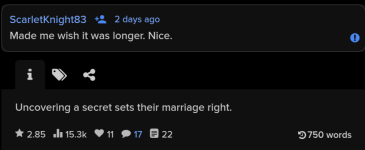
I had forgotten about this anonymous comment I got until the "fastest written" thread prompted me to review the story.
Holy shit. The ending was perfect, Just when one thinks they are going to get more seeing more text on the screen STOP.

I had to stop touching my self at that time and enjoy the delicious little tease of orgasim delayed with the hard stop.

Very erotic and in a way audience participation.
The truth is, looking back at it, the ending IS kind of abrupt, for story symmetry reasons that, in retrospect, I don't think worked entirely well. I think the story as a whole is good, just would be even better with a few more paragraphs at the end.

In addition, the 'more text on screen' to which they refer is actually my closing author's note. It was SUPPOSED to have a breakline to separate it from the main work, but due to the months-old graphical glitch, it still doesn't show up right. So I totally get that someone reading would think there was more story and then find themselves cut off even more abruptly. (The note actually even sort of addresses the abrupt ending, because I talk about the importance of aftercare and why I chose to leave it out of this particular story...)

The thing I don't know for sure, and the aspect that leaves me shaking my head, is this: Was this the commenter's way of sarcastically disapproving of all of the above, or do they actually have a tease-and-denial kink and legitimately and sincerely loved it? I honestly can't tell. Valid either way, to be honest, but...
 
Screenshot_20260216-125144.png

This one... I'm not sure if it's a positive on wanting more of the story and not picking up on the implication, or if it's deeply uncomfortable as the story ends with the implication that the husband is about to force his wife to fuck him on her livestream.

If it's the latter, I have bad news for them as the way I'd always intended the story to continue would involve a couple of viewers banding together to "fix" the husband after realizing what they saw wasn't just an act as they initially believed it to be.
 
This one... I'm not sure if it's a positive on wanting more of the story and not picking up on the implication, or if it's deeply uncomfortable as the story ends with the implication that the husband is about to force his wife to fuck him on her livestream.

If it's the latter, I have bad news for them as the way I'd always intended the story to continue would involve a couple of viewers banding together to "fix" the husband after realizing what they saw wasn't just an act as they initially believed it to be.
You need to up your weirdness for readers to be properly creeped out. Like this:

1771266848728.png
 
You need to up your weirdness for readers to be properly creeped out. Like this:

View attachment 2596709
Hang on. I need to pull up the comments on some of my older stories, lol. They are on my old laptop.... I guess being sick is a good excuse to finally transfer everything over.

I don't remember the exact comment, but one that I got was basically "I expect fucked up shit on AO3 not on Lit, this was great."
 
Lowth lived 200 years after Shakespeare in the 1800s. And he is responsible for God knows how many of the more stupid English Grammar ‘rules' that plague school kids, and that good writers get shat upon for breaking to this very day.

The idiot inflicted not ending sentances with prepositions on us
Which gave us the classic joke:

A Cambridge University professor sat next to a Texan rancher on an airplane. By way of introduction, the chatty rancher drawled, "So, pardner, where you frooom?"

To which the pf. sniffed, "From where I come, we don't end a sentence with a preposition."

Texan: "Oh, my mistake! Let's try that agaaain! Where you frooom, ass hole!?"
 
Back
Top