For Those Who Might Be Wondering Why We Might Be In Ukraine

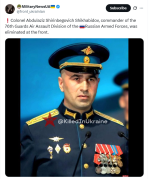
Always good to see Russian Divisional commanding officers elimimated. Generally that's very disruptive.
1746540901095.png
 

Ukrainian Air Force strikes Russian command post in Donetsk region


Thjis was from a couple of days ago: The Ukrainian Armed Forces reportedly launched a significant strike against a Russian command post in the Donetsk region, an area crucial for managing Russian offensives towards Pokrovsk. This command post was strategically located near the occupied city of Bakhmut. This operation was reported by Ukraine's General Staff, which confirmed that the Ukrainian Air Force recently delivered a devastating blow to the command post of the 6th Motorized Rifle Division in Bakhmut, an area temporarily under Russian occupation. This attack has significantly impaired the Russian forces' ability to direct operations near Pokrovsk, according to the statement. While the extent of Russian casualties is not yet determined, efforts are underway to ascertain the impact.

https://uawire.org/ukrainian-air-force-strikes-russian-command-post-in-donetsk-region#
 
One can only wonder what the situation in Ukraine would be right now if DonOld and the MAGAt republicans hadn’t undermined the Ukrainians and the allied coalition for the last year or so.

🤔 😑 🤬

We. Told. Them. So.

🌷

Also:

Slava Ukraini!!!

👍

🇺🇦
 
Trump's so called effort to stop the conflict clearly blew up in his face. It makes it possible for even more humiliation because the only nation left with the capacity to impose a settlement now is China. If Xi could achieve that, the humiliation of Trump and the USA would be severe. In recent weeks China has been rapidly cutting back on its purchase of Russian Oil and Gas and has diversified its purchases, even including Canada (oil) and Australia (LNG Gas), along with Middle eastern suppliers. It is early days but China is starting to squeeze Russia hard. As the Russian situation gets more difficult, it begs the question, what price will China demand of Russia to maintain support?
 
Trump's so called effort to stop the conflict clearly blew up in his face. It makes it possible for even more humiliation because the only nation left with the capacity to impose a settlement now is China. If Xi could achieve that, the humiliation of Trump and the USA would be severe. In recent weeks China has been rapidly cutting back on its purchase of Russian Oil and Gas and has diversified its purchases, even including Canada (oil) and Australia (LNG Gas), along with Middle eastern suppliers. It is early days but China is starting to squeeze Russia hard. As the Russian situation gets more difficult, it begs the question, what price will China demand of Russia to maintain support?
It would be ironic if it was Xi that stepped in, forced Putin to concede and moved Chinese troops in to gaurantee Ukraine's borders. Russia would collapse and China would get Siberia as a bonus.
 
Trump's so called effort to stop the conflict clearly blew up in his face. It makes it possible for even more humiliation because the only nation left with the capacity to impose a settlement now is China. If Xi could achieve that, the humiliation of Trump and the USA would be severe. In recent weeks China has been rapidly cutting back on its purchase of Russian Oil and Gas and has diversified its purchases, even including Canada (oil) and Australia (LNG Gas), along with Middle eastern suppliers. It is early days but China is starting to squeeze Russia hard. As the Russian situation gets more difficult, it begs the question, what price will China demand of Russia to maintain support?

One caveat: China does NOT have “the capacity to impose a settlement”. China has its own problems, and the deals with Canada, Australia, etc, for oil & gas are part of a larger strategy related to the tariffs.

Russia is still driving the car on Ukraine for the axis of evil. And Russia can’t afford to give up the fight at this point. (Chloe posted a cogent argument for that in post #6065.)

Russia is going to have to be defeated through attrition, imho. (We should be a year further along towards that outcome, but DonOld and the MAGAt republicans SABOTAGED the effort.)

It is what it is.

😑

🤬

We. Told. Them. So.

🌷

Slava Ukraini!!!

👍

🇺🇦
 
It would be ironic if it was Xi that stepped in, forced Putin to concede and moved Chinese troops in to gaurantee Ukraine's borders. Russia would collapse and China would get Siberia as a bonus.
I agree that China holds most of the cards though would be a fraction more conservative in suggesting that China would not take the whole of Siberia but would restrict itself to the Amur basin (to which it has an entirely legitimate legal claim) and the Russian far east. That would give China resources, more direct access to the Sea of Japan and enable the isolation of North Korea, which to China is a pain in the neck.

I disagree with Lazaran in post 6074 and am fairly certain that China could and will push severely weakened Russia out of the far East. It might take 10 to 20 years but they will get there. Neither America nor Europe will be relevant to either the process or the eventual outcome. China has the Russians hooked and will take their time in reeling them in. For a nation which has persisted for 2,500 years the Tariff 'war' is a temporary inconvenience.

Chloe's analysis at 6065 is interesting and that economic collapse is distinctly possible, but I am less certain of the detail or the timing.
 
I disagree with Lazaran in post 6074 and am fairly certain that China could and will push severely weakened Russia out of the far East. It might take 10 to 20 years but they will get there. Neither America nor Europe will be relevant to either the process or the eventual outcome.

I think the majority of the US wouldn't care at all.

Chloe's analysis at 6065 is interesting and that economic collapse is distinctly possible, but I am less certain of the detail or the timing.

It's coming to a head now. Xi has few options and, according to the news, he's going to capitulate in order to save his cushy job from the defenestrators.
 
When Russia attacked Ukraine, they were fighting civilians, local Police. Firefighters and literally anyone who volunteered armed with AK47’s and whatever else was at hand, which wasn't much - and with that they fought Russia to a standstill.

Three years on, Ukraine is no longer the same. The ZSU is now the strongest and largest military and Europe, and armed with one of the most diverse weapon arsenals on the planet with some of the best tech from around the world. Night vision equipment, electronic warfare, APC's and IFV's, tanks, artillery, SAM systems, drones, logistics, training, ammunition.

 
When Russia attacked Ukraine, they were fighting civilians, local Police. Firefighters and literally anyone who volunteered armed with AK47’s and whatever else was at hand, which wasn't much - and with that they fought Russia to a standstill.

Three years on, Ukraine is no longer the same. The ZSU is now the strongest and largest military and Europe, and armed with one of the most diverse weapon arsenals on the planet with some of the best tech from around the world. Night vision equipment, electronic warfare, APC's and IFV's, tanks, artillery, SAM systems, drones, logistics, training, ammunition.


And the anti-2nd Amendment people tell us that an unorganized militia isn't needed because we have the National Guard and military.

Like everything they else they spout, their progressive social justice beliefs tend to get crushed when reality arrives.
 
Victory Day 2025: Putin's Last Grand Parade?

Underneath his chipmunk grin, Putin knows that he's in trouble. Trump isn't playing nice, Ukraine is burning down bits of the empire every night, and motorcycle rushes are not a war-winning tactic.
Andrew Tanner, May 7


A couple weeks back, I suggested that Putin’s regime might turn to killing its own people in a false flag attack then blame the incident on Ukrainian drones. At the time, I’d completely forgotten about Moscow’s annual dress-up ball and parade held to celebrate the fall of Berlin in 1945. Well, it’s nearly May 9th, and Ukrainian intelligence as well as the ATESH partisan movement inside Putin’s crumbling empire are warning of FSB-organized terror operations around the big event. Putin’s deeper ploy with proposing a three-day ceasefire around May 9th may be making it look like Ukraine attacked a sacred ruscist event. You’d think a play like this would be too obvious for Moscow, but Putin doesn’t have many other cards and may not be able to resist the symbolism at this stage. Of course, it would be both hilarious and appropriate for elements of Putin’s own regime to instead take the chance to off him themselves.

For anyone in the ruscist nightmare not named Vladimir Putin, the best-case outcome in the Ukraine War is the little man getting zeroed out without delay, allowing some subordinate to take over who can immediately do what Khrushchev did with Stalin and blame all failures on his predecessor. Putin’s successor could then takes Trump’s ridiculous proposed deal to lock in Moscow’s gains since 2014 in exchange for basically nothing and even retreat a bit along portions of the front in occupied Ukraine to sell the message.

Pro-war hardliners can be assuaged by hanging a few Putin associates out to dry on allegations of corruption and promising that the inevitable next round of the war will go much better for Moscow. Team Trump will be ecstatic to force Zelensky into accepting a comprehensive ceasefire since he’s publicly agreed to one, betting that Putin can never say yes. That opens the door to peace talks and probably elections that will likely see a more reliably western-influenced Zaluzhnyi take over in Kyiv with a mandate to pretend that someday Ukraine will reclaim the occupied territories through diplomacy, somehow.

All the big power players in D.C. and Moscow would be more than satisfied with that outcome. The only thing standing in their way now is Putin, who can’t accept a frozen conflict again after spending three years and a million casualties promising Ukraine’s final destruction for the glory of mother russia.

Putin presently faces the toughest choice of his life as a consequence of his failed war. Running out of viable military resources, he can’t keep on pretending that Ukraine’s lines are bound to break eventually, not long past the end of 2025, anyway. Mobilization of every resource in the empire is his only hope of sustaining enough combat power in Ukraine to hold the line into 2026. Any failure to stop Ukraine’s impending counteroffensives will strip away the illusion of invincibility that he’s bet his regime on. But expanded mobilization will come with destabilizing consequences on the social front and further accelerate the already rapid deterioration of his economy.

Instead of pulling back from an obvious failure of a war, Putin is bent on pressing forward at the cost of other people’s blood. He thinks that because he’s got a few million more bodies who can be thrown away without immediately breaking the economy, all is well. You can tell the guy is a lawyer advised mainly by economists and corrupt generals. If his enemies don’t fold, he’s toast.

For all the real challenges that wave after wave of orcs on motorcycles may present to Ukraine’s defenders at the tactical level, Putin’s army is still down to seizing a couple fields on a good day - only to lose them again a great deal of the time now that Ukraine is back to playing active as opposed to area defense. The tactical gains don’t ever add up to a major operational level success, which means there will be no strategic breakthrough that turns the tide in Putin’s favor.

This is not rocket science (you seem to have a problem with that too, Elon Musk). But a wholly ineffective paradigm still prevents proper broader understanding of this conflict’s nature or course.

Ukraine firmly holds the strategic initiative now, steadily building up combat power behind the lines even as Moscow’s declines through abuse. While D.C. and Moscow carry on their ceasefire dance while Putin orders pointless costly advances to prove he’s invincible, every indicator that I’ve monitored since 2021 warns of setbacks when Ukraine is ready to prove that Kursk was only a taste of what Ukraine’s defenders can do.

This is the summer of 2022 all over again. Ukrainian forces are again quietly building up advantages in equipment and doctrine that, when unleashed at scale, will once more shock the world, leaving the boring talking heads on TV grasping for new incredible pet theories to explain how it happened.

It’s amazing, really, just how far Ukraine has come in a little more than three years - something only rarely acknowledged by foreign media. In 2022, I was in no way confident that Ukraine would get this far, to say nothing of thinking about actually winning back the territory Putin stole. Until the Kharkiv and Kherson counteroffensives didn’t lead to the nuclear demonstration that Putin had begun threatening as standing ruscist doctrine demanded, I suspected that the conflict would wind up frozen, Team Biden playing off Ukraine losing another huge chunk of territory as a victory and proclaiming old blundering Joe the savior of Kyiv.

But instead of forcing a strategic showdown, Putin blinked, resorting to mass missile terror and mobilization. And not because the Biden Administration made a few hollow threats about intervention that would amount to the start of the very third world war they’d decided could never be allowed to happen. It was Xi Jinping telling Putin that there are lines which must not be crossed, and not American policy, that kept the nuclear Pandora’s box shut for a little longer.

Two and a half years later, Putin’s armies are sending civilian vehicles at Ukraine’s drone-backed front lines. Donkeys are appearing in logistics trains - and not because they’re suited to the terrain. The Soviet arsenal of real military kit has been largely depleted, right on schedule. It takes one or two hundred casualties to seize a single field, with the cost increasing every month as Ukrainian tactics and doctrine are refined.

Since 2022, the disparity in real combat power has diminished to the point that Putin really might stage a series of false-flag terror attacks and blame them on Ukraine to justify further mobilization. I expect that Ukraine will either refrain from hitting anything on ruscist home turf from about May 7 to May 10 to avoid adding fuel to the fire - or ignore the event entirely, hitting a couple of Moscow’s military sites to demonstrate its discretion compared to the enemy. The latter is probably the best move, since if the orcs are planning an atrocity against their own civilians, it won’t matter if Ukrainian drones were in the air or not.

Perhaps the very best news over the past few months is that Ukrainian casualties are reported to be declining even as Moscow’s remain brutally high. The Ukrainians are blazing a trail towards a form of warfare that can substantially reduce the human toll, safeguarding friendly lives and civilians trapped in the middle in a way that American, Israeli, and Muscovite operations consistently fail to. That could prove to be even better news for the future than Ukraine’s growing strength. Drones can substantially mitigate the longstanding cost-precision tradeoff. Excuses for harming civilians en masse are wearing mighty thin.

Yet, as I repeat every week or so: while drones radically alter the vital rhythms that keep a military organism intact and functional, they are merely an added ingredient in the endlessly evolving combined arms warfare mix. They alter risk calculations and affect the scale at which operations have to happen, but in the end the key to successful operations in the Network Age is no different than in any other: move faster and hit harder than the enemy can cope in multiple dimensions and scales.

For every battlefield measure, a countermeasure exists. The essence of the art of war is working out how to smoothly and efficiently get sufficient resources where they need to be in time. Unfortunately for many military personnel currently serving around the world, the institutions they are part of are often more concerned with looking a certain way than accomplishing their mission. Identity can be a hell of a drug.
 
Overview of the Fronts

Although US involvement in pushing talks to end the Ukraine War has not ended, the past week has seen a significant and sustained shift in the Trump Administration’s tone with respect to Ukraine. This has been paired with a strong intensification in orc efforts to advance that’s as big of a tell as Putin’s ploy with proposing a three-day truce.

But aside from some slight shifts in where Moscow’s attacks have been weighted lately, the operational intent of the current assault wave is as simple as Putin’s broader strategy for survival: keep Ukrainian troops spending time and energy holding the line to sustain the impression that it cannot be cracked. The orcs want to force Ukraine to scatter reserves everywhere so that they cannot concentrate on the vulnerable southern theater.

If Ukraine’s campaign this summer stalls like the one in 2023 did, Putin must reason, then a renewed diplomatic push in fall could push Trump to pile pressure on Ukraine again. The costs of doing that this spring mounted too quickly for Trump, hence his reversion towards the polling mean the past couple weeks. His administration has given the green light to Ukraine purchasing supplies from American industry, for example, and mostly cut back on efforts to flatter Putin into concessions by parroting his propaganda, with Hegseth and Witkoff appearing likely scapegoats for failing to secure a ceasefire.

If Putin can raise costs in a different dimension, though, especially if Europe does not adequately resource Ukraine’s counteroffensive this summer and the US gets bogged down bombing Iran, Trump might be induced to pull another about-face. Still, Putin has not forgotten that he badly needs a serious victory to be able to freeze the conflict without risking another Wagner-style revolt at home.

A whole lot of hardcore nationalists in his empire are finding Putin’s inability to win a severe challenge to their worldview. While clinging to the delusion that Ukraine isn’t real and their empire has a right to do whatever it wants in the world (a clear reflection of their own fragile egos), they’re also seeking reliable explanations (but won’t like the answers) for why the front line isn’t moving despite enormous effort spent over what is now a solid 5% of the average russian lifespan. That’s a force which has brought down more than one Muscovite regime of yore.

A very telling indicator of how Muscovite military planning is now driven as much by perception management as common sense is the routine effort to claim advances by showing a soldier waving a flag somewhere. Most open-source coverage will generally use such evidence to mark an advance and change in territorial control based on physical presence of forces, which is totally justified. But because most journalists don’t understand what makes for a meaningful advance in military terms, some lone orc in the ruins waving a flag a few hours before he gets wiped out is prone to being portrayed as a shock attack that has crumbled Ukrainian lines. Adding meaning to the data is what analysts do - it’s part of why journalists secretly dislike us almost as much as they do generative AI, shoddy as it usually is thanks to training data derived from low quality sources.

The irony is that most efforts at cognitive or information warfare are so thinly transparent as to represent a total waste of resources. If you want to lose a fight, play to the crowd. War is not won on points, it’s about material survival. At least, for those actually in one. Yet propaganda wars are waged nevertheless, despite lack of evidence they do more than socialize their own society to distrust everything they’re told.

So, to sum up: Putin is still attacking for show, despite dwindling resources and dramatic improvements in Ukrainian capabilities. This can’t possibly go wrong for him, can it?
 
Northern Theater

Kharkiv remains static despite a few battles for positions waged most days, and Chernihiv quiet except for the odd skirmish or infiltration attempt, so the action in the north is still focused on Sumy and the border areas of Belgorod and Kursk. Here opposing Ukrainian and ruscist-North Korean groupings are still fighting on the Muscovite side of the border, plus a few small hamlets inside Ukraine that keep absorbing groups of orcs.

Sumy is one of those areas where the lines as they appear on maps are deceptive, with at least ten kilometers of gray zone subject to rapid drone attack separating both sides’ main positions. Between there will usually be small teams performing various jobs that do come into contact, but most attacks as described by Ukrainian reports involve a determined effort by a group of orcs to take up position closer to where maps show Ukraine in control. Overall, Moscow wants a buffer zone in Sumy to prevent a future incursion into Kursk, and Ukraine wants Moscow to try exactly this.
Within this grey zone, fighting can be intense and dynamic without triggering an open-source map update. Citizen reporting generally cannot function at a finer resolution than daily level updates, hence it taking a week to generate enough data to generate reliable conclusions about what is about to happen. Longtime readers will likely have noticed that where I lay out more optimistic projections for either side is during moments where a weekly sampling window happens to capture the first half of a larger-scale advance. Project out from a smaller sample, and error increases. But nothing says the orcs aren’t doing the same thing - and must, if they want to avoid being caught out.

Ukrainian troops appear to have breached the Sumy-Kursk border in a new area, attacking towards the Kursk-Belgorod district border in what looks like an attempt to strike orc troops moving to retake Popova and Demidovka from their right flank. It doesn’t appear that Ukrainian teams were able to reach Goptarovka, but the orcs definitely had to move troops to meet this new threat, giving drone operators a chance to work on them.

Ukraine’s goal in Kursk has always primarily been to draw off proportionally more ruscist combat power than Ukraine is forced to commit to the northern theater. According to Ukrainian media the Ukrainians never had more than 20,000-25,000 personnel assigned to the Kursk operation at any given time, including logistics and support elements that stayed in Sumy. Moscow dispatched around four times as many soldiers over several months, basically losing an army of 60,000 in the process of building up one with the requisite 90,000 bodies that Moscow required to push Ukraine out of the populated areas of the province. The dead and living were all needed to take Pokrovsk.

Right now, by launching small spoiling attacks with the brigades still assigned to Sumy, Ukraine is probably holding the area with half as many troops as were there in prior months. Many Kursk veterans will be resting - haven’t been hearing much from 82nd, 80th, or 95th Air Assault lately for a reason. Other standout brigades like 47th and 21st Mechanized are apparently still present in a supporting role, with assault regiments like the 225th and 33rd to take the lead in operations.

A major orc breakthrough is more unlikely than a sudden Ukrainian offensive into Belgorod - or even Kursk, with some reports suggesting an operation might be beginning in Glushkovo, west of where the orcs have been failing to break into Sumy. See where that stands in a week. 21st Mech has been fighting well since the core of it returned to Ukraine from Sweden, and their participating in a surprise attack would not be a shock. As of now, several orc videos showing the destruction of Ukrainian engineering equipment suggests breach attempts have been made and repelled, but often these are followed a day or so later by evidence of Ukrainian success somewhere else. A strike on a headquarters in nearby Tetkino could suggest an attempt to decapitate and then attack a target orc unit.

Whatever is happening, it’s good to probe ruscist flanks frequently. The political impact of losing even a single settlement draws thousands of troops to an area. A comparatively small Ukrainian attack can force the orcs to waste a lot of resources even if it was never meant to go far. As I’ll lay out in much more detail in a future post, there are three essential steps to advancing in the Network Age without suffering crippling casualty rates: 1. Blind and overwhelm, 2. Clear access routes, 3. Reinforce and fortify. Drones lead the way, followed by engineers and scouts, then the assault troops come to take control, and if one step fails, the operation aborts. While Moscow imitates the tactics that led the Germans to defeat in 1918, Ukraine’s task is to mimic the Allied victory in the subsequent Hundred Days Campaign that broke the Kaiser’s army to end World War One.
 
Eastern Theater

The Kupiansk front went relatively quiet this week, with Ukraine-based Centre for Defence Studies suggesting that Moscow’s forces are regrouping ahead of another bid to expand the bridgehead over the Oskil. CDS also forecasts that Moscow will renew frontal assaults on Ukraine’s bridgehead east of the Oskil in an attempt to reach Kupiansk.
Both claims seem plausible, given the failure of ruscist flanking operations on this front to date. The bridgehead at Dvorchina that’s been slowly expanding since winter still can’t sustain heavy equipment, so the reach of the orcs within remains limited. Motorcycle rushes might allow the enemy to spread out some, but all that’s liable to do is encourage more orc infantry to move into a trap.

Motorcycle assaults do cause Ukrainian defenders problems, because the one or two in ten orcs that survive to reach Ukrainian positions will attempt to seize them. And with Ukraine’s frontline positions now held by fire teams of 3-6, ten enemy soldiers getting too close is enough to force a withdrawal to the next tree line. But sustaining this deeper and deeper into Ukrainian territory is simply not viable. This sort of skirmish work is now a job for drones.

I continue to see a potential opportunity for a Kursk-like raid into this part of Belgorod, as indicated on the map. The upstream portions of the Oskil would make a nice buffer that should help interfere with orc efforts to reach Kupiansk.

More concerning than Kupiansk right now is the Borova front, which has recently seen further expansion of the ruscist bridgehead over the Zherebets. So far no large-scale Ukrainian counterattack has been registered, and Ukrainian sources suggest that Moscow has a major numbers advantage in the area. Third Assault Brigade and the corps it is building around itself has to be very wary of an encirclement attempt so long as Moscow maintains the bridgehead to the south as well as a presence on the east bank of the Oskil to the north.

Elimination of one or both will eventually be necessary to avoid pulling back towards the Oskil. This won’t represent a major reversal, but will make subsequent orc pushes towards Borova and ***** easier to organize, complicating the operational situation in this area. Ukraine might actually be using Third Assault Corps to hold the last bit of Luhansk district not yet occupied by the enemy for political purposes, but that’s not a sustainable choice unless the flanks are secured.

The Siversk and Chasiv Yar fronts have been mostly static this week, probably because the local orc commanders are having to reinforce and resupply before resuming operations (again). Siversk is one of the most vulnerable portions of Ukraine’s front at present in a purely geographic sense, but is defended by tough brigades that have probably been acting as a coherent corps for a long time, based on performance and the promotion of a couple brigade commanders assigned to the area to corps leaders. Renewed orc pressure should be expected soon. (I really did not intend to have so many re-words in this paragraph)

It’s been very hot on the southern edge of the Kostyantynivka front, by contrast, the space between Toretsk and Malynivka coming under heavy orc attack again this week. Moscow is going after Kostyantynivka from this angle pretty much as I forecast was the best move a year ago, before the orcs decided to make their misguided play for Pokrovsk instead. One orc motorcycle push along the Bychock appears to have actually been reasonably successful, with Ukrainian POWs taken in Tarasivka. I have to wonder if a seam between 157th Mechanized and 109th Territorial was exploited before the orc push was later wiped out.

The orcs will get some wins - statistically speaking, that has never been in question. It’s whether these reliably add up to anything worth the cost that’s important. I’m not casting judgement on whatever Ukrainian formation is actually responsible for the area, particularly given the recent trend of Ukraine letting orc rushes penetrate a few kilometers so they can be efficiently wiped out.

Moscow may now have another path across the Bychock, but until the flanks are secured, it will just be another chokepoint swarmed by drones. Losing people as POWs does suggest something went wrong, but sometimes bad luck intersects with competent foes. Be nice if Moscow would treat them appropriately and send them home in a prisoner swap, but with the orcs there are no guarantees on even that much.

Across this sector Ukrainian forces seem to be wisely pulling back from more vulnerable positions and inflicting damage as they go while holding firm on the Bychok flank and the Kleban-Byk reservoir area northwest of Toretsk. Typically positioning a defense behind a river line is the easiest way to hold it, but for a year and a half Ukraine has repeatedly held onto bridgeheads. My assumption is that this has been proven favorable for the efficient destruction of orcs.
Though Ukrainian command continues to report that Pokrovsk is Moscow’s top priority, I have to wonder if that isn’t intentional misdirection on Kyiv’s part. Evidence is starting to point towards Moscow resorting to a costly frontal assault on free urban Donbas this summer, with efforts on the flanks intended mainly to distract, not achieve a true breakthrough and encirclement of Ukrainian troops on a strategic level.

In that case, cutting the Pokrovsk sector off from Kostyantynivka is a necessary prerequisite, but taking Pokrovsk is not, despite the ongoing threat Ukrainian forces there pose to the ruscist left flank. If I’m right, this makes Moscow’s efforts southwest of Pokrovsk all about keeping Ukrainian forces too busy to effect a major counterattack - or the goal could be purely political, reaching the Dnipro district border for show. Either way, lacking the force to actually take Pokrovsk, threatening it or a deeper flanking move to the west is all the orcs can credibly accomplish.

Though the Pokrovsk area in general is seeing a rapid increase in the intensity of orc attacks, so far Ukraine is fending them off, even pushing the last waves back from a ring of towns surrounding Pokrovsk. Ukrainian troops are in essence shoving the enemy off the town’s outer walls while the orcs try to expand their presence on the south bank of the Solona in a bid to keep the bridgehead on the north side alive.

Ukrainian strikes are so badly affecting ruscist logistics in this area that they’re resorting to erecting nets over key roads. Ukraine simply uses artillery to blast open a section then flies drones into the hole. Another example of an orc adaptation applied at the wrong scale. Ukraine has employed similar tactics, but mostly in rear areas only vulnerable to damage by relatively inaccurate rocket strikes. Where HIMARS can function like a super sniper, Moscow uses massed barrages to achieve the same - usually less - effect. A frontal assault on Pokrovsk remains a possibility, but this didn’t work out too well in Toretsk, where Moscow has the advantage of being able to shelter forces inside a major occupied urban area just ten kilometers away. Breaking into Pokrovsk would prove a one-way trip for thousands of orcs.

Further south, the Novopavlivka front is also drawing a disproportionate level of orc attention, Moscow seeking a purely political triumph like taking a slice of Dnipro district but also threatening a broader envelopment of Pokrovsk to the west. Here Ukrainian forces are still pulling back field by field, though lately it’s looking as if a solid perimeter may be forming up, the towns of Bahatyr and Oleksiivka anchoring it along the Vovcha. The orcs are trying hard to reach them and working to apply pressure to the flanks, but Ukraine’s defense will only get tougher the closer the orcs get to Novopavlivka.

I expect the ruscist push here to peter out well before it gets to the confluence of the Mokri Yali and Solona with the Vovcha near Novopavlivka - the visible operational goal. Perhaps because of their difficulties, the orcs have made another attempt to find Ukraine’s western flank, attacking towards Zelene Pole. Once more, a lot of people were sacrificed to seize a few fields in the grey zone.
 
Southern Theater

Moscow is still slowly trying to ramp up attacks in the south in another attempt to keep Ukrainian forces tied down. But the large assaults on the Orikhiv front from a few weeks back haven’t gone anywhere since, and there hasn’t been any suggestion that Ukraine is having to rush reinforcements to the area. There are no prospects for a Ukrainian counteroffensive here, but Orikhiv is nowhere near at risk of falling or even being approached. What ground might have been gained in the large mass assault attempted here a couple weeks ago has already been cleared by Ukrainian forces.

On down the Dnipro in Kherson, the orcs are always trying to grab islands in the delta and threaten to establish a bridgehead on the far bank. Ukraine maintains several forward positions of its own across the river that Moscow is always pressing the local orc commanders to remove. But the odds are stacked against any large-scale crossing right now. Ukraine’s coastal brigades don’t seem to be having any trouble punishing the enemy any time they send some doomed souls over the Dnipro in boats.

Now, the appearance of naval drones armed with guided missiles and drones may shift the equation somewhat in the future. If naval-based fire support can be made strong enough, small brief landings along the coast might be managed. Though once Ukrainian troops dig in anywhere, they’re mighty hard to displace. The very last thing Moscow needs right now is having to send thousands more troops to Kherson - or Crimea.

To a degree, Moscow is using the south in the same way Ukraine is the north: deploying enough troops to pose a threat and prevent a surprise offensive, but mostly tying up reserves. Moscow can no longer hope to surround and destroy Ukraine’s forces east of the Dnipro, only stretch them as much as possible along the flanks in hopes that a pure frontal assault will work out.

The fact that the road from Bakhmut to Sloviansk has not yet drawn a sustained series of orc meat waves makes me suspect Putin’s endgame this summer involves one final all-out mass push on a narrow front - Wagner’s assault on Bakhmut times ten. That’s probably his best move short of declaring a unilateral ceasefire, finding some internal scapegoats to purge, and clinging to power through the backlash. Yet it’s almost certain to fail. Putin has been applying linear solutions to an exponential curve for too long. He no longer has the ability to get ahead of events. Welcome to Zugzwang, Vlad. You choose how quickly you lose.
 
Naval Matters

In honor of some more history being made by the Ukrainians, I’ll jump straight to the section where I evaluate developments on the Black Sea front. As you might have heard, Ukrainian naval drones scored their first-ever jet kills this week, using trusty AIM-9 Sidewinder missiles of some variety to swat a couple Su-30 jets from the sky off Crimea and Novorossisyk.

This victory came during a broader Ukrainian attack on the Novorossisysk area that may have used something like a hundred and fifty aerial and a couple dozen naval drones, though Moscow is obviously not a reliable source. Results of the attack have not been determined, whether due to defensive success or Moscow getting better at keeping citizens from filming endless orc defense blooper reels. Even now, they’re still shocked enough when Ukrainian drones fly over to provide some excellent confirmation of their type and targets. Never civilians, note. So far.

Honestly, I don’t see this as a revolutionary development so much as an inevitability long foreseen. Helicopters have proven to be one of the more effective countermeasures to naval drones, able to use their superior speed relative to anything afloat to choose when and how to engage in such a way that their crews are at the least risk. As soon as drones started carrying guns, helicopters couldn’t just hover overhead and pick them off. Once Soviet-era R-73 (AA-11 Archer to us 90s flight sim nerds) missiles were integrated into Ukraine’s Magura-class drones, helicopters began to fall.

So the orcs began using their much-depleted Black Sea naval aviation regiment to hunt Ukrainian drones. But lack of effective precision weapons led to bombing and even strafing runs at low altitude and speed - not a happy condition for a multirole jet to endure. It didn’t take long for a Ukrainian development team to figure out how to integrate a different brand of missile, probably with a longer effective range.

Probably won’t happen again, because as soon as the orcs get burned with their aviation they adapt to become much more conservative. Now they’ll have to rely on more expensive standoff missiles to hit drones which cost less than the means deployed to destroy them. And these are vulnerable to intercept, too. Air defense drones escorting surface attack drones in a flotilla rather beautifully disaggregates the core military functions of a warship across distinct platforms. I’d bet that’s the future of coastal warfare, and the key to winning any fight over Taiwan.

I have to admit being much aided in this prediction by having played another real-time strategy game with applicability to training how to think about military policy systems. Supreme Commander and it’s sequel Forged Alliance featured a faction that did exactly this with naval units. The way these titles and their predecessor, Total Annihilation (great names, huh?) all worked, the object is generally to keep a combined-arms force perpetually engaged across important parts of the map. Done right, the player simply tells units built at factories to join a formation patrolling an area. Weight of firepower and the efficiency of the unit mix determines which side is slowly pushed back towards their main base, where resources are gathered near factories. Whichever side cannot effectively expand their resource base loses.

Games are supposed to imitate life. What I never expected to see was the orcs do their damnedest day in and out to act like they’re AI agents in a game.
 
Strike Campaigns

Ukraine is slowly dismantling Putin’s war machine, one factory and facility at a time - two or even three on a good night. One way (no pun intended) or another, night after night the drones come, and they usually hit something Putin cannot afford to have out of action for long. The orcs might be good at scaling up production of a solution once they find one, but they sure aren’t proving able to get ahead of even the most predictable curves.

You’d think that after months of watching stuff burn about once a week, Putin would have ordered a massive national investment in interceptor drones and people trained to use them. Instead, that chipmunk-faced twit is having friendly journalists toss softball questions about how great things are going over tea in one of Putin’s dachas. Old Adolf acted like that too, even near to the end, holding dinner parties every night where he’d harangue guests with diatribes even as his cities were pummeled into dust and armies retreated towards Berlin.

The orcs are still able to inflict damage on Ukraine with their own missiles and drones, but only sporadically and rarely to a degree that important operations are affected. Ukraine’s Viper fleet is an increasingly important part of that success.

Aviation Fight

Once again the Czechs are taking their due vengeance for decades of oppression by Moscow, adding to their coup of organizing the purchase of millions of shells for Ukraine from international markets by jointly setting up an F-16 flight school. Living outside of Prague learning to fly a Viper for a few months is a fitting reward for having to dash at treetop level towards ruscist missile systems to drop bombs on advancing orcs. Among other dangerous missions.

Though there haven’t been any more big announcements of aircraft deliveries lately, Ukraine’s partners have generally been sending a new tranche of Vipers and Mirages about the time pilots finish conversion training. A minimum of 16 Vipers have been confirmed delivered as of early 2025, with two lost in action. Probably double that number of pilots have arrived. With numerous aircraft pledged for spare parts and others already held back for training, it’s fair to assume that all 14 Vipers in the count are operational, at least a dozen combat-ready at a given time. I’d bet on the number being closer to twenty, with a proportional number of pilots.

As for the Mirages, confirmed numbers are 4, at least two more on the way and potentially as many soon available. This is why I expect Ukraine to operate two Viper and one Mirage squadrons by the end of the year, around 12 ready aircraft in each, which along with another eight Patriot systems - two more pledged last week - should finally give Ukraine a mostly-effective, almost-comprehensive air shield. No word on Gripens for Ukraine, but it ought to be noted that Czechia has leased a dozen from Sweden for about ten years now, the contract up in 2027.

I can easily envision a scenario where Czechia’s Gripen lease winds up in Ukrainian hands this year as part of a deal where Poland or Germany covers Czechia’s airspace until it receives new fighters already on order. Or realizes that it probably isn’t sensible for every small European country to have one or two fighter squadrons covering airspace surrounded by allied countries, just saying.

The Netherlands, Belgium, Czechia, Austria, Switzerland, Portugal, Slovakia, Hungary, and Romania, among others, could all be better off pooling their aviation assets. Just send contingents out here to Pacific America for training when they need to practice in spaces where you can play with electronic warfare without upsetting commerce too much. The Growler community up by Seattle has a nice playground off the coast, I hear.

Leadership & Personnel

Ukraine is still standing up its new corps, moving faster than official news reports suggest, I expect. Overall, the process looks to be structured as it should be: experienced, proven commanders are placed in charge of the new corps regardless of whether they are career military or not. Certain brigades don’t necessarily form the core of the corps (English and it’s weird homonymns) in an official sense, but you have to expect that a leader familiar with a particular formation will rely on it more in the field.

The final functional composition of each corps is also still unclear. My standing assumption that the five or so line brigades will be bound to supporting formations, like artillery and drone, appears to be sound. It will be interesting to find out if Ukraine does ultimately create a heavy brigade in each corps that plugs a tank battalion into an assault regiment to power offensive operations.

There is also a possibility that the top six or so drone regiments and brigades will evolve into full-on divisions, each supporting multiple corps rather than subordinated to them. This arrangement isn’t immediately intuitive, but the scale at which drone operations take place might make it more logical.

If there exists a simulation package somewhere that can systematically test questions like this, I’d sure like to know about it. And if not, get paid to help develop it.

Separately, an intriguing possibility thanks to Ukraine’s well-advanced drone game is the potential for a fairly thinly held, drone-backed front to allow a greater proportion of Ukraine’s soldiers to get proper rest than ever before. Though there hasn’t been any word about the long rotations that so many veteran soldiers badly need, Ukraine might be achieving a greater degree of organic restoration by having to less frequently rotate soldiers into frontline positions.
 
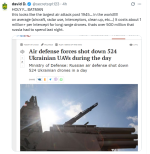
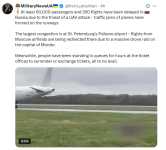
This is the 3rd day of 200+ drone attacks on Russia. With no signs of slowing. The #;s are comimg from both sides and backed up by airport closures and radar tracks. And its grounding civilian aircraft jets heading for Moscow for fear of being shot down by anti air missiles and canons. Good show by Ukraine. Incoming passengers stranded whereever they were still flying into Russia from.

Apparently Crimea is now under a massive drone attack also.


1746635600826.png
 
A coal plant?! That's gotta be the work of ecoterrorists!

LOL. And I have absolutely no idea why you would want to "enrich" coal, but whatever, I assume there's a reason and I assume this will hit Russia economically
 
Back
Top