In the old days, Swiss mercenaries would be hiring out to both sides.Another Swiss-owned chemical factory inside Russia targeted. Fascinating that the Swiss will not sell mllitary equipment or ammo to Ukraone vut are quite happy owning factories inside Russia that produce chemicals needed by the Russian munitions plants. The hypocrisy is staggering.
Navigation
Install the app
How to install the app on iOS
Follow along with the video below to see how to install our site as a web app on your home screen.
Note: This feature may not be available in some browsers.
More options
You are using an out of date browser. It may not display this or other websites correctly.
You should upgrade or use an alternative browser.
You should upgrade or use an alternative browser.
For Those Who Might Be Wondering Why We Might Be In Ukraine
- Thread starter Rightguide
- Start date

ChloeTzang
Literotica Guru
- Joined
- Apr 14, 2015
- Posts
- 19,738
Kupiansk front turns into mass execution zone as Russian soldiers murder their commanders, steal trucks, and vanish
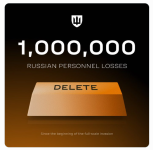
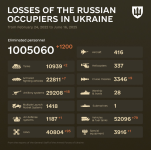
In the Kupiansk direction, as Russian losses officially hit an unprecedented 1 million KIA and seriously WIA, the breaking point has finally come. Russian soldiers are beginning to turn their rifles on their own commanders rather than face certain death in futile assaults. In a growing wave of mutiny and desertion, Russian soldiers have started killing their officers, seizing vehicles, and fleeing deep into Russian territory and away from the frontline. In one of the most brutal recent examples of growing disorder within Russian ranks, several Russian soldiers near the settlement of Nyzhnia Duvanka in the Luhansk region turned on their own. By shooting and killing the military police platoon commander and two of his barrier troop subordinates and running away, they sparked a frantic search operation by Russian authorities. The deserters left their comrades to lie dead on the road while fleeing to save their lives from both Ukrainian and Russian fire.This violent mutiny did not emerge in a vacuum; it is directly tied to the hopeless bloodbath unfolding near the Kupiansk front, specifically at the Pischane funnel. For months, Russian forces have tried and failed to break through Ukrainian defenses here. The Ukrainians have created a deadly trap by controlling the flanks, exposing any Russian assault to relentless drone and artillery fire from both sides. Yet Russian commanders continue to send wave after wave of infantry into the funnel, hoping to drive a wedge through Ukrainian lines. Every new wave knows exactly how it will end, as almost no one from previous groups returns alive. The systematic nature of these assaults has been likened to mass execution, with soldiers pushed forward not for tactical gain but to serve as human battering rams.
To make matters worse (for the russians, not for the Ukrainians), the Russian troops are being sent into combat in improvised Mad Max-style vehicles, like the Gaz-69, which entered production in 1952, the year of Stalin’s death, and regular cars fitted with rudimentary armor or even none. Improvised motorcycle squads and barely armored vehicles now lead the charge, only to be annihilated by Ukrainian FPV drones well before reaching the contact line. These desperate measures highlight not only material shortages but a total disregard for the lives of Russian troops. Ukrainian surveillance drones ensure that almost no movement goes undetected, meaning most assaults are decimated long before they engage the defenders and only the odd survivor actually makes it to the contact line itself.
Despite the carnage, desertions in the Russian army remain surprisingly rare. The reason lies in the sheer brutality of the punishments for refusing to fight. Soldiers who resist are subjected to medieval-style torture. Some are thrown into pits without food before being forced to fight each other to the death to earn the right to live another day. In one documented case, soldiers were tied behind vehicles and dragged through the dirt, while other deserters were forced to bury each other alive as punishment and to serve as an example. In the ***** area, a surrendering Russian soldier was spotted by Russian drone operators and targeted by his own artillery. This highlights the impossible choice facing many: surrender and be killed or desert and be hunted. For some, turning against their officers seems to be the only escape.
This toxic atmosphere has bred a surge in violent retaliation. Russian soldiers, driven to the brink by the realization that dying in a pointless assault is their fate if they continue, are increasingly likely to choose to kill their commanders instead, as it is safer than being spotted attempting to surrender to the Ukrainians. Meanwhile, commanders themselves contribute to the decay by labeling active soldiers as deserters to avoid paying their wages, denying them medical care, and forcing under-equipped and untrained men into combat. A recent appeal by the families of men from the Russian 54th Motorized Rifle Regiment revealed horrifying conditions: soldiers were beaten and handcuffed, robbed of personal belongings, and left to die without evacuation. Wounded men are forced to crawl back to safety without help. Those who cannot crawl are simply left to die, and the dead are simply abandoned, confirmed by footage showing bodies of dead Russian soldiers that haven’t moved for months. They are left their for the now wild pigs to eat - if there's no body, they are listed as missing rather than dead and there is no payout to the family's.
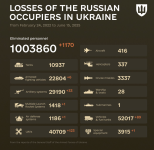
The downward spiral is accelerating. Russian military losses have just surpassed one million casualties, including killed, wounded, and captured. Equipment losses are equally staggering, with 10,000 destroyed and damaged tanks and over 20,000 armored vehicles of various types - and the old Soviet stockpiles have been stripped bare of anything easily repairable. Hence the use of Mad Max vehicles and motorcycles. There's very little left for use in day to day assaults. Lacking armor, modern vehicles, or meaningful support, commanders now rely on the WW1 tactis of sheer manpower and suicidal frontal attacks to advance the line ever so slowly. But the more men are lost, the worse morale gets, and the more inclined troops are coming to view their superiors as the enemy instead of the Ukrainians they are forced to fight.
Overall, such events create a vicious cycle.
The collapse of discipline and the dehumanizing tactics employed by Russian commanders will inevitably lead to more incidents where soldiers turn their weapons on their leaders. To prevent this, the officers are only doubling down on cruelty, inventing new, more barbaric punishments. This internal rot may not only undermine Russia’s ability to continue the war, but it could also ultimately sabotage its war effort from within. Inevitably, at some point this will lead to a 1917 moment, and the collapse of the Russian Army, either locally or across the entire front.
When that moment comes, the ZSU can cry havoc, and unleash the dogs of war....
https://euromaidanpress.com/2025/06...der-their-commanders-steal-trucks-and-vanish/
ChloeTzang
Literotica Guru
- Joined
- Apr 14, 2015
- Posts
- 19,738
Iran’s air defense failure sends shockwaves to Russia
Israel’s high-tempo aerial campaign against Iran is triggering concern among Russian defense analysts and military circles, as parallels emerge between the exposed vulnerabilities of Tehran’s air defense systems and Moscow’s own troubled record in Ukraine. Following Israeli strikes that penetrated deep into Iranian territory and destroyed key air defense assets with minimal resistance, Russian military observers have begun openly questioning the reliability of their own systems. According to Russian-language military forums and unofficial commentary shared across pro-Kremlin channels, the Israeli operation has amplified existing doubts about Russia’s capacity to withstand a coordinated assault from a technologically advanced adversary such as NATO. As one commentator put it, “Everyone here understands this is exactly what would happen to Russia if any NATO country decided to act.”
While Ukraine has relied on cost-effective systems such as HIMARS launchers, modified drones, and older-generation AGM-88 HARM anti-radiation missiles to degrade Russian defenses, Israel’s strikes against Iran have involved large-scale, advanced cruise missiles and multi-layered air assault strategies. Despite these differences in scale and sophistication, the outcomes have exposed similar weaknesses in Russian and Iranian air defense architecture—much of which is rooted in shared design principles and legacy platforms.
Defense analysts in Moscow are reportedly acknowledging that Iranian systems—some modeled on or directly derived from Russian technologies—were unable to provide any sustained resistance even during the second day of Israeli airstrikes. One recurring assessment circulating in Russian defense circles states, “Absolutely powerless air defense, when what we see in the crosshairs is all we’ve got.” Russian concern is also being fueled by hard data. According to the independent monitoring group Oryx, Russia has lost at least 335 air defense systems since its full-scale invasion of Ukraine began in February 2022. These losses include 18 S-400 launchers, one S-350, over 30 Pantsir-S1 units, and nearly 60 Tor systems. The figures are drawn from visually confirmed battlefield losses and are considered a conservative estimate. While Russia has repeatedly touted the effectiveness of systems like the S-400 in deterring Western aircraft and missiles, combat experience in Ukraine has shown otherwise. The persistent effectiveness of Ukrainian HIMARS strikes and drone attacks—some conducted with relatively low-cost platforms—has led to growing skepticism about Russia’s claim to field a fully layered and resilient air defense network.
Now, with Iran’s own Russian-supported defenses failing in the face of an Israeli campaign, Moscow’s military establishment is being forced to reassess both doctrine and capability. The fear, voiced increasingly openly, is that in the event of a NATO-led operation, Russia’s strategic missile assets and high-value infrastructure could be targeted and destroyed in a matter of hours. The Israeli campaign, while not directed at Russia, has acted as a live demonstration of what advanced, coordinated airpower can achieve against outdated or poorly integrated air defenses—many of which share direct lineage with Russia’s own systems. As the air war over Iran enters its next phase, the consequences are being felt far beyond the Middle East.
For Moscow, the message is clear: if Tehran’s defenses failed this quickly, similar vulnerabilities could exist much closer to home.
https://defence-blog.com/irans-air-defense-failure-sends-shockwaves-to-russia/
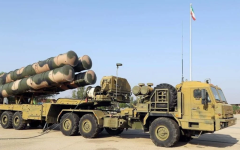
Israel’s high-tempo aerial campaign against Iran is triggering concern among Russian defense analysts and military circles, as parallels emerge between the exposed vulnerabilities of Tehran’s air defense systems and Moscow’s own troubled record in Ukraine. Following Israeli strikes that penetrated deep into Iranian territory and destroyed key air defense assets with minimal resistance, Russian military observers have begun openly questioning the reliability of their own systems. According to Russian-language military forums and unofficial commentary shared across pro-Kremlin channels, the Israeli operation has amplified existing doubts about Russia’s capacity to withstand a coordinated assault from a technologically advanced adversary such as NATO. As one commentator put it, “Everyone here understands this is exactly what would happen to Russia if any NATO country decided to act.”
While Ukraine has relied on cost-effective systems such as HIMARS launchers, modified drones, and older-generation AGM-88 HARM anti-radiation missiles to degrade Russian defenses, Israel’s strikes against Iran have involved large-scale, advanced cruise missiles and multi-layered air assault strategies. Despite these differences in scale and sophistication, the outcomes have exposed similar weaknesses in Russian and Iranian air defense architecture—much of which is rooted in shared design principles and legacy platforms.
Defense analysts in Moscow are reportedly acknowledging that Iranian systems—some modeled on or directly derived from Russian technologies—were unable to provide any sustained resistance even during the second day of Israeli airstrikes. One recurring assessment circulating in Russian defense circles states, “Absolutely powerless air defense, when what we see in the crosshairs is all we’ve got.” Russian concern is also being fueled by hard data. According to the independent monitoring group Oryx, Russia has lost at least 335 air defense systems since its full-scale invasion of Ukraine began in February 2022. These losses include 18 S-400 launchers, one S-350, over 30 Pantsir-S1 units, and nearly 60 Tor systems. The figures are drawn from visually confirmed battlefield losses and are considered a conservative estimate. While Russia has repeatedly touted the effectiveness of systems like the S-400 in deterring Western aircraft and missiles, combat experience in Ukraine has shown otherwise. The persistent effectiveness of Ukrainian HIMARS strikes and drone attacks—some conducted with relatively low-cost platforms—has led to growing skepticism about Russia’s claim to field a fully layered and resilient air defense network.
Now, with Iran’s own Russian-supported defenses failing in the face of an Israeli campaign, Moscow’s military establishment is being forced to reassess both doctrine and capability. The fear, voiced increasingly openly, is that in the event of a NATO-led operation, Russia’s strategic missile assets and high-value infrastructure could be targeted and destroyed in a matter of hours. The Israeli campaign, while not directed at Russia, has acted as a live demonstration of what advanced, coordinated airpower can achieve against outdated or poorly integrated air defenses—many of which share direct lineage with Russia’s own systems. As the air war over Iran enters its next phase, the consequences are being felt far beyond the Middle East.
For Moscow, the message is clear: if Tehran’s defenses failed this quickly, similar vulnerabilities could exist much closer to home.
https://defence-blog.com/irans-air-defense-failure-sends-shockwaves-to-russia/
ChloeTzang
Literotica Guru
- Joined
- Apr 14, 2015
- Posts
- 19,738
Ukraine targets Russian drone production chain in latest strikes....
Ukrainians are launching coordinated precision strikes to diminish the effectiveness of Russian drone strikes against Ukraine. With strikes aimed at fiber optic and battery factories, the Ukrainians are targeting every element of the Russian production chain that enables them to produce drones. While Ukraine holds an edge in drone quality, production, and adaptability, Russian drone strikes remain a major obstacle for the Ukrainians, bolstered by Russian mass production of lethal fiber-optic variants.
Overall, the Ukrainians are conducting a strike campaign deep inside Russia to inflict tremendous blows to Russian drone production, which will reduce to a lower intensity of drone strikes against Ukrainian civilian and military infrastructure. The lowered number of drones launched in strikes against Ukraine, in combination with the work of Ukrainian air defense, will lead to a point where the impact of their strikes is reduced to a minimum. The reduction of drone operations will also relieve Ukrainian logistics that have been suffering from fiber optic drone strikes, while the forces at critical frontline positions will be able to properly reinforce and dig in at their positions.
https://euromaidanpress.com/2025/06/14/ukraine-strikes-russian-drone-factories/
Ukrainians are launching coordinated precision strikes to diminish the effectiveness of Russian drone strikes against Ukraine. With strikes aimed at fiber optic and battery factories, the Ukrainians are targeting every element of the Russian production chain that enables them to produce drones. While Ukraine holds an edge in drone quality, production, and adaptability, Russian drone strikes remain a major obstacle for the Ukrainians, bolstered by Russian mass production of lethal fiber-optic variants.
- Recently, the Ukrainians struck the Kronshtadt plant in the city of Dubna near Moscow, collapsing the roof of the factory. Kronshtadt has led Russian drone development for 15 years, producing and designing advanced drones for the Russian army.
- On top of that, the Ukrainians struck the Elma technopark in Zelenograd to the north of Moscow, inflicting damage to the main building of it. The facility, located in the heart of Zelenograd, hosts the development of IT, microelectronics, robotics, and medical technology.
- Right before that, the Ukrainians struck the Energia plant in the city of Yelets during a night strike, which caused a strong explosion visible in the distance. Satellite footage revealed that the factory suffered significant damage, with the partially collapsed roof of the production hall revealing that the fire engulfed everything inside. This factory is used to produce batteries for Russian drones, missiles, aircraft, and naval systems.
- Ukrainians also targeted the fiber-optic factory in Saransk. A direct drone strike caused severe damage to the main building, setting it on fire. To ensure the factory remained out of commission, as it is the only fiber optic plant in Russia, the Ukrainians launched a follow-up strike just as the repairs were completed.
- This was complemented by an even more devastating strike against a hidden Russian drone assembly factory in the city of Obukhovo in Kaluga Oblast. The Ukrainians managed to strike the plant and cause huge fires and several explosions, which forced the local officials to evacuate the area.
- It is also important to note that, as previously reported, Ukrainians struck the massive Yelabuga drone factory with 6 fab bombs, the primary Russian facility producing most of Russia’s Shahed drones.
Overall, the Ukrainians are conducting a strike campaign deep inside Russia to inflict tremendous blows to Russian drone production, which will reduce to a lower intensity of drone strikes against Ukrainian civilian and military infrastructure. The lowered number of drones launched in strikes against Ukraine, in combination with the work of Ukrainian air defense, will lead to a point where the impact of their strikes is reduced to a minimum. The reduction of drone operations will also relieve Ukrainian logistics that have been suffering from fiber optic drone strikes, while the forces at critical frontline positions will be able to properly reinforce and dig in at their positions.
https://euromaidanpress.com/2025/06/14/ukraine-strikes-russian-drone-factories/
ChloeTzang
Literotica Guru
- Joined
- Apr 14, 2015
- Posts
- 19,738
Why? FFS it's obvious. He's been bought and paid for by Putin.
And I'm glad it;s not just me that thinks so
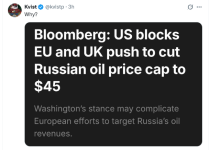
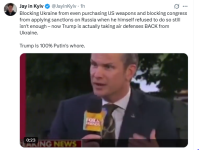
And I'm glad it;s not just me that thinks so
Last edited:
ChloeTzang
Literotica Guru
- Joined
- Apr 14, 2015
- Posts
- 19,738
Russian pilots really need to work on their landings.
Another Swiss-owned chemical factory inside Russia targeted. Fascinating that the Swiss will not sell mllitary equipment or ammo to Ukraone vut are quite happy owning factories inside Russia that produce chemicals needed by the Russian munitions plants. The hypocrisy is staggering.
I suspect the Swiss have financial interests inside Ukraine as well…
And I haven’t heard any grumbling from the Swiss about those attacks on the chemical plants…
Just the Swiss being Swiss.

Putin condemns Israeli efforts to stop Iran’s nuclear weapons program in a phone call with DonOld.
DonOld weakly mentions the war in Ukraine should end:
https://www.cnbc.com/amp/2025/06/14...mns-israels-strikes-on-iran-kremlin-says.html


We. Told. Them. So.

DonOld weakly mentions the war in Ukraine should end:
https://www.cnbc.com/amp/2025/06/14...mns-israels-strikes-on-iran-kremlin-says.html
We. Told. Them. So.
ChloeTzang
Literotica Guru
- Joined
- Apr 14, 2015
- Posts
- 19,738
This is quite a good overview of Ukraine's hit on the strategic bombers. Lots of great detail
ChloeTzang
Literotica Guru
- Joined
- Apr 14, 2015
- Posts
- 19,738
Putin condemns Israeli efforts to stop Iran’s nuclear weapons program in a phone call with DonOld.
DonOld weakly mentions the war in Ukraine should end:
https://www.cnbc.com/amp/2025/06/14...mns-israels-strikes-on-iran-kremlin-says.html
Nobody's taking any notice of Chump on ending the Ukraine war anymore. Putin's obviously giving him his marching orders and Zelensky and Ukraine have, I think, accepted that he's a Russian agent and there will be no more help, and probably more sabotage, from the Trump Administration even tho there are people at lower levels trying to keep the assisstance flowing thru. The good thing at least is Chump can't go to overt, or even the GOP Congress might grow enough testicles to stand up. Lindsay Graham is at least pushing on sanctions.
ChloeTzang
Literotica Guru
- Joined
- Apr 14, 2015
- Posts
- 19,738
Russians in Crimea pack up, cut their losses and escape
Once dreaming of living by the sea, now mass-selling apartments and fleeing back. Russians who moved to Crimea after the occupation are disappointed by the heat, lack of jobs, air raid alarms, and Russian military bases, OBOZ reports. After the annexation in 2014, Russia began large-scale militarization of Crimea, turning it into a military base for the Black Sea Fleet and a springboard for further aggression. This military activity has caused widespread pollution: during training exercises and combat operations, explosives, fuel, lubricants, and heavy metals contaminate the air, soil, and water, leading to degradation of the local flora and fauna.
Real estate agents in Crimea confirm: more than half of new property owners are trying to sell or rent out their apartments. “Residents from Siberia, the Urals, even Moscow suburbs increasingly contact us asking to sell or rent out their property,” says Kseniia, a Crimean realtor speaking anonymously. When you start working with them, it turns out they have lived here for a year or two, some even five years, but concluded Crimea is not for them. The reasons vary, from the climate not suiting them to military actions, she continues.
Many Russians came here to live peacefully by the sea, enjoying the fruits and beaches, but reality turned out differently. Constant air raid alarms, explosions, military equipment on the streets, and frequent inspections create an atmosphere of ongoing tension. “Neither they nor their children can endure constant air raid alarms, let alone explosions. Some told me their children start to panic. They are irritated by the military bases literally scattered across the Southern Coast of Crimea,” Kseniia adds.
Besides military issues, Crimea lacks decent jobs with reasonable salaries. The tourism business has shrunk due to the war, and most office workers and managers simply cannot find work here. “If you’re a plumber, electrician, mechanic, builder, or air conditioner technician, you can find work here. But salaries will be Crimean, not Moscow level,” says Mykola, a resident of Yalta.
Infrastructure and healthcare problems also do not contribute to comfortable living. Crimea lacks international chain stores, and medical services are often expensive and inaccessible. “Corruption thrives in medicine, nobody pays attention to medical insurance here, and you have to buy medicine and even bandages out of pocket,” reads the report. Local Crimeans also have a negative attitude toward the newly arrived Russians, blaming them for price hikes, pollution, and uncivilized behavior. The Russians, in turn, call locals rude and backward. Add to this the harsh Crimean climate, with intense heat in summer, cold, rainy winters, mud everywhere, and sea storms, and it becomes clear why many hurry to return home.
For now, Crimea remains a place for summer vacation for most Russians, and their dream of a peaceful life by the sea has yet to come true.
Sounds like they're voting with their feet and their wallets, and they know the writing's on the wall.
https://euromaidanpress.com/2025/06...-and-sight-of-tanks-become-their-new-reality/
ChloeTzang
Literotica Guru
- Joined
- Apr 14, 2015
- Posts
- 19,738
ChloeTzang
Literotica Guru
- Joined
- Apr 14, 2015
- Posts
- 19,738
ChloeTzang
Literotica Guru
- Joined
- Apr 14, 2015
- Posts
- 19,738

Russians in Crimea pack up, cut their losses and escape
Once dreaming of living by the sea, now mass-selling apartments and fleeing back. Russians who moved to Crimea after the occupation are disappointed by the heat, lack of jobs, air raid alarms, and Russian military bases, OBOZ reports. After the annexation in 2014, Russia began large-scale militarization of Crimea, turning it into a military base for the Black Sea Fleet and a springboard for further aggression. This military activity has caused widespread pollution: during training exercises and combat operations, explosives, fuel, lubricants, and heavy metals contaminate the air, soil, and water, leading to degradation of the local flora and fauna.
Real estate agents in Crimea confirm: more than half of new property owners are trying to sell or rent out their apartments. “Residents from Siberia, the Urals, even Moscow suburbs increasingly contact us asking to sell or rent out their property,” says Kseniia, a Crimean realtor speaking anonymously. When you start working with them, it turns out they have lived here for a year or two, some even five years, but concluded Crimea is not for them. The reasons vary, from the climate not suiting them to military actions, she continues.
Many Russians came here to live peacefully by the sea, enjoying the fruits and beaches, but reality turned out differently. Constant air raid alarms, explosions, military equipment on the streets, and frequent inspections create an atmosphere of ongoing tension. “Neither they nor their children can endure constant air raid alarms, let alone explosions. Some told me their children start to panic. They are irritated by the military bases literally scattered across the Southern Coast of Crimea,” Kseniia adds.
Besides military issues, Crimea lacks decent jobs with reasonable salaries. The tourism business has shrunk due to the war, and most office workers and managers simply cannot find work here. “If you’re a plumber, electrician, mechanic, builder, or air conditioner technician, you can find work here. But salaries will be Crimean, not Moscow level,” says Mykola, a resident of Yalta.
Infrastructure and healthcare problems also do not contribute to comfortable living. Crimea lacks international chain stores, and medical services are often expensive and inaccessible. “Corruption thrives in medicine, nobody pays attention to medical insurance here, and you have to buy medicine and even bandages out of pocket,” reads the report. Local Crimeans also have a negative attitude toward the newly arrived Russians, blaming them for price hikes, pollution, and uncivilized behavior. The Russians, in turn, call locals rude and backward. Add to this the harsh Crimean climate, with intense heat in summer, cold, rainy winters, mud everywhere, and sea storms, and it becomes clear why many hurry to return home.
For now, Crimea remains a place for summer vacation for most Russians, and their dream of a peaceful life by the sea has yet to come true.
Sounds like they're voting with their feet and their wallets, and they know the writing's on the wall.
https://euromaidanpress.com/2025/06...-and-sight-of-tanks-become-their-new-reality/
Russia still needs Crimea as a military base - now - and in the future. They can’t push west without it.
All the civilians could leave (they really can’t) and Russia would still try to hold out in Crimea.
It does highlight how critically important it is that Russia fail in its attempt to seize Ukraine.
A new Russian Ukraine would be to the west what the current Russian Crimea is to Ukraine; A absolute thorn in the side / security nightmare.
Side note:
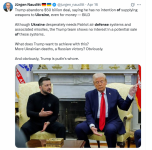
I honestly believe Ukraine could have seized Crimea this year or early next year if the U.S. had maintained the level of military support that President Biden had secured. Enter Trump & the MAGAt republicans…
We. Told. Them. So.
ChloeTzang
Literotica Guru
- Joined
- Apr 14, 2015
- Posts
- 19,738
ChloeTzang
Literotica Guru
- Joined
- Apr 14, 2015
- Posts
- 19,738
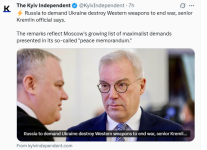
Russia keeps adding maximalist demands that will never be cmplied with as conditions for a ceasefire
- first it was all the nnnsense about denazification an demilitrirization of Ukraine
- rthgen they added in the Baltic States
- now they demand all Ukraine's western weapons be destroyed
Basically, Russia has a death wish and WANTS to be crushed. No other explanation.
- first it was all the nnnsense about denazification an demilitrirization of Ukraine
- rthgen they added in the Baltic States
- now they demand all Ukraine's western weapons be destroyed
Basically, Russia has a death wish and WANTS to be crushed. No other explanation.
ChloeTzang
Literotica Guru
- Joined
- Apr 14, 2015
- Posts
- 19,738
Russia’s top generals are being hunted—and eliminated—with chilling precision. Ukraine’s intelligence machine is rewriting the rules of modern warfare, using data, drones, and deception to strike deep behind enemy lines. This isn’t just a war of weapons—it’s a war of algorithms, and Russian's military is being decapitated.
ChloeTzang
Literotica Guru
- Joined
- Apr 14, 2015
- Posts
- 19,738
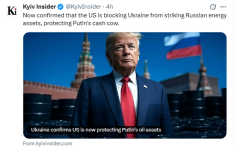
US is now protecting Putin’s oil assets
After more than a year of speculation and unofficial commentary, two of Ukraine’s top officials have now publicly confirmed what many analysts long suspected: the United States has asked Ukraine not to strike Russian oil and energy infrastructure. The first acknowledgment came from President Volodymyr Zelensky following a large-scale Russian missile, drone, and ballistic attack on Ukraine’s energy facilities. Speaking after the attack on Kremenchuk, Zelensky said, “It happened right after Putin’s conversation with Trump. After the Americans asked us not to strike Russian energy facilities.”He described the timing of the Russian assault as “a spit in the face” to global efforts aimed at ending the war.
The statement marked the first direct confirmation from Ukraine’s head of state that the country’s Western allies, particularly the United States, have placed restrictions on targeting Russia’s energy sector—despite the fact that Russia has made Ukrainian energy infrastructure a central focus of its wartime campaign. Hours later, Ukraine’s First Deputy Prime Minister Yulia Svyrydenko reinforced the message in a statement of her own. “Some allies have asked us not to strike Russian energy infrastructure—even as Russia wages all-out war on ours: targeting power plants, oil and gas infrastructure, hydroelectric dams—every form of energy we rely upon.”
The comments provide the clearest public evidence to date that Kyiv has been operating under external pressure to avoid actions that could destabilize global energy markets, even as its own grid, heating infrastructure, and fuel reserves face repeated attacks. According to Ukrainian officials and several open-source intelligence assessments, Kyiv paused strikes on Russian refineries for roughly 45 days in the lead-up to the 2024 U.S. presidential election, resuming them on election night. The timing, while not officially acknowledged, suggests a political calculus: to avoid complicating the U.S. domestic environment while continuing a campaign that Ukraine sees as vital to weakening Russia’s war effort. Western concern over the potential economic fallout of sustained attacks on Russian oil facilities—particularly regarding global fuel prices—has long shaped the informal boundaries of the conflict. But the public confirmation of these limits, especially in the face of continued Russian strikes on Ukrainian civilian infrastructure, raises difficult questions about proportionality, deterrence, and the sustainability of long-term support.
President Zelensky argued that the war “would have ended long ago” had the international community responded with firmer action, including stronger sanctions and enforcement of a meaningful oil price cap.
Svyrydenko echoed that view, describing the Russian oil sector as the financial backbone of both the current invasion and future military aggression. While U.S. officials have not commented on the latest remarks, the growing divergence between Ukraine’s strategic imperatives and Western caution highlights a tension at the heart of the alliance: how to support Ukraine’s self-defense while managing the global consequences of escalation. For Ukraine, the case appears increasingly clear. To reduce Russia’s ability to wage war, it must target the resources that finance it. And until that is allowed without constraint, officials suggest, Moscow will remain confident it can act without meaningful economic consequence.
Under Trump, the United States no longer acts in its own interest. It blocks weapons to Ukraine and protects Russian energy revenues. Trump is the first U.S. president openly influenced by Russia. Under his leadership, America has stopped being a sovereign nation. The America that once stood for freedom no longer exists. The only thing that makes this possible is Europe not stepping up sufficiently and instead trying to placate Trump to keep him engaged. It's time for the EU to acknowledge reality. Trump's America is no longer a friend and ally, but rather, it's going it's own way and Trumpsinterested and policies are inimical to the free world.
https://kyivinsider.com/ukraine-confirms-us-is-now-protecting-putins-oil-assets/
ChloeTzang
Literotica Guru
- Joined
- Apr 14, 2015
- Posts
- 19,738
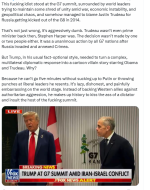
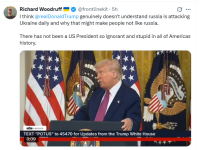
He's a one man disaster who sucks Putin's cock and who 's going to manage to start WW3...
Vance has been incredibly quiet lately. Positioning himself for when he has to exercise the 25th and take over?
Vance has been incredibly quiet lately. Positioning himself for when he has to exercise the 25th and take over?
ChloeTzang
Literotica Guru
- Joined
- Apr 14, 2015
- Posts
- 19,738
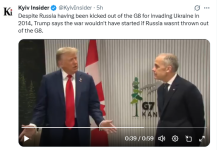
Why does Trump always lie so blatantly? It's as if he has no idea of reality and expects no-one else too.
He blames Trudeau and Obama for Russia being expelled from the G8. In 2014. When Russia invaded and seized Crimea. I think he doesn't even realize Russia was kicked out of th G8 in 2014, he probably thinks t was in 2022.....and he seems to have no comprehension that Stephen Harper was the Canadian Prime Minister back then. H really isn't in tpuch with reality - less so than Biden, because at least Biden's handlers knew.
He blames Trudeau and Obama for Russia being expelled from the G8. In 2014. When Russia invaded and seized Crimea. I think he doesn't even realize Russia was kicked out of th G8 in 2014, he probably thinks t was in 2022.....and he seems to have no comprehension that Stephen Harper was the Canadian Prime Minister back then. H really isn't in tpuch with reality - less so than Biden, because at least Biden's handlers knew.
ChloeTzang
Literotica Guru
- Joined
- Apr 14, 2015
- Posts
- 19,738
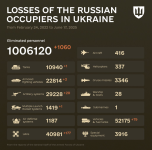
Meanwhile, the ZSU continues to eliminate Russians....

Lance_Castro
Gynephiliac
- Joined
- Oct 5, 2024
- Posts
- 5,105
I like the way he ended the war in 24 hours.

ll74
Your Best Friend
- Joined
- Aug 22, 2013
- Posts
- 67,470
Quoting before deletionI like the way he ended the war in 24 hours
ChloeTzang
Literotica Guru
- Joined
- Apr 14, 2015
- Posts
- 19,738
“Nothing to say to Zelenskyy”: Trump retreats from G7 as Russia launches biggest terrorist attacks on Kyiv yet
Trump has run out of excuses to justify helping Putin and rather than meet Zelensky and tell him he's chozse to support Russia, he chooses to run away instead.
Trump left the 2025 G7 Summit a day earlier than planned. At the event, he suggested that the war in Ukraine might have been avoided if Russia had not been expelled from the G7 in 2014. The next day, Russia launched one of the largest terrorist attacks on Kyiv, killing 14 civilians and striking residential houses. “Better to leave than to face the truth," is how former Ukrainian Foreign Minister Volodymyr Ohryzko explains US President Donald Trump’s behavior at the G7 summit. “He has nothing to say to Zelenskyy. He can’t find a single argument to justify his defense of Putin. This is one of those situations where it’s easier to just leave,” the diplomat explained. According to Ohryzko, all Ukraine can expect from Trump right now is (minor) weapons sales and intelligence sharing. Genuine support must come from Europe, but only if European leaders stop “being afraid of their own shadow.”
Meanwhile, civilian deaths mount as Russia unleashes terror attacks on Kyiv, and in a strange contradiction to his blustering rhetoric on Iran, US President Donald Trump stays silent on Moscow’s war crimes. Trump has called for a peace agreement with Moscow to end the war in Ukraine. Yet, when it comes to Iran, he has taken a hardline stance: demanding not a ceasefire, but a total abandonment of the nuclear program, per CBS News. At the same time, he has made no effort to pressure Russia into any kind of ceasefire, instead seemingly focusing on forcing Ukraine to surrender.
https://euromaidanpress.com/2025/06...unches-biggest-terrorist-attacks-on-kyiv-yet/
Similar threads

- Replies
- 4
- Views
- 153

- Replies
- 32
- Views
- 2K
- Replies
- 73
- Views
- 3K

Share: