Wat’s Carbon Water-N-Stuff Thread - Concepts In Iron And Wood!!!

We're already in at the Creedmoor.


The PRC is a maybe.


There's the old Swede, but that's a relic. I still like how it shoots.
 
I don't like people. I don't like any kind of people. When you get them together in a big lump they all get nasty and dirty and full of trouble. So I don't like people including you. That's what a misanthropist is.

~ Mickey Spillane


🤣 :nana:
 
Focus,
not on the rudeness of others,
not on what they've done
or left undone,
but on what you
have & haven't done

yourself.

~ Dhammapada
 
Last week, Wat took possession of twice as many firearms as one of our former libturd posters used to say was all the guns that anyone “should” own.


That’s probably all he could afford.


We’ll ignore the three and a half cases of ammunition that came along with it.


😬
 
Last week, Wat took possession of twice as many firearms as one of our former libturd posters used to say was all the guns that anyone “should” own.

That’s probably all he could afford.

We’ll ignore the three and a half cases of ammunition that came along with it.
Thanks for publicly announcing the magnitude of your armory, as well as the subjects of your resentment. It will probably help establish means and motive sometime in the future.
 
Thanks for publicly announcing the magnitude of your armory, as well as the subjects of your resentment. It will probably help establish means and motive sometime in the future.
You're probably right if you could ever find a watermelon to testify against him. :cool:
 

Ballistic Coefficient (BC) Explained​


From the first time somebody put a rock in front of black powder in a tube, the shooter wanted to know where he needed to aim to hit the target. It is common knowledge that to determine a trajectory we need to know the muzzle velocity, the distance to the target, and where the firearm is zeroed. We also need to factor in atmospheric conditions, but that’s another topic.

Now comes the difficult part: We need to figure out how long it takes our projectile to get to the target. Calculating Time of Flight (TOF) lets us know how long gravity has to work on the projectile. Once we have this information we can ascertain the bullet’s fall and drift.

To come up with TOF we have to determine the rate at which the projectile is slowing down. In other words, we have to calculate the drag on the projectile. However, this gets even more complicated because the drag on the projectile is not constant, but changes with velocity.

Imagine the challenges facing a ballistician back in the late 1800s: There are no computers, no radar and, at best, this person has access to a very crude chronograph. The only way to define the drag on a projectile is to use the chronograph to measure the projectile’s retained velocity at various intervals down range. The velocity data would then be used to calculate the drag between each interval. It was an extremely tedious, expensive, and time-consuming effort to get the velocity and drag profile for just one projectile, let alone hundreds of different types.

But the ballisticians of this era figured out that by using a simple ratio, Ballistic Coefficient (BC), they could determine a reasonably good approximation of the drag of any projectile by comparing it to a standard projectile drag, as determined above. This would allow reasonably accurate retained velocity and TOF calculations. The initial standard projectile, the G1 projectile, was of a German artillery projectile. They carefully measured the drag of this projectile and also measured the TOF and retained velocity versus distance. However, the G1 standard is a poor representation of a modern low-drag projectile and in the 1940s the G7 standard came along, representing a modern, boat-tail US artillery shell. Images of both the G1 and G7 standard projectiles can be found on the internet.

The most common method to determine BC is to compare the retained velocity—over a known distance—of a projectile to the standard G1 or G7 projectile. The tables of velocity, distance and TOF are called the Siacci tables and can be found at jbmballistics.com. A chronograph makes it easy to determine retained velocity at specific distances downrange and compare those velocities to the standard projectiles.

One simple way to think about BC is as a representation of how well a projectile, like a hunting or target bullet, hangs on to its velocity as it travels downrange. The higher the BC value of a bullet, the better it resists the drag exerted by the atmosphere.

~ Dave Emary
 
1697945436084-png.2282308
 
I reckon so.


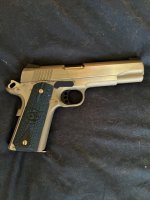
And there's the .45 version that showed up also.


Trigger seems a bit tight. I've pondered fiddling with it.
 
Back
Top