Present tense. Do you like it?

Present tense is fine. It works in many cases. I usually enjoy stories in past tense a little more, because I think it seems more natural and provides more narrative flexibility, but for certain kinds of stories present tense works fine. I almost never write in present tense.
 
I love present tense. Like anything else in a writer's kitchen, it's a spice you learn to cook with, but not necessarily something that needs to go into every meal. Three out of my four highest-rated stories here use it, because it's the right tense for the job. But that's just, like, my opinion, man...
 
I write explicitly in third person, present tense. I want the reader to be looking over the shoulder of the main characters and I write as such.

So far I’ve had a mixed bag of reviews on the style. I’m just not comfortable switching it to first person: I want the novel to be as if we’re there in the room seeing it from the perspective of a good faith voyeur, if you like.
 
oh hey, maybe like nature documentaries?

The ibex cranes her head up from the grass, listening intently, before returning to her grazing. She has no idea that the three lionesses have successfully surrounded her, crouched just a few meters away, preparing to strike.
So true! Why is this? Might it have something to do with a hierarchical sense that we humans have a right to invade other species as well as we can.
 
After reading through this thread, I've decided that my dislike of present tense is confined to 3rd person narratives.
I wish people would do things like this. Now I'm thinking of a way to make 3P present tense work.

Drawing a blank so far, though.
 
oh hey, maybe like nature documentaries?

The ibex cranes her head up from the grass, listening intently, before returning to her grazing. She has no idea that the three lionesses have successfully surrounded her, crouched just a few meters away, preparing to strike.
I got up from the couch, thinking I had the answer about nature documentaries, that they're narrating a visual that you're seeing in real time. But by the time I got AH open, it dawned on me that documentaries about people are not usually narrated in present tense.

So the question remains.
 
I got up from the couch, thinking I had the answer about nature documentaries, that they're narrating a visual that you're seeing in real time. But by the time I got AH open, it dawned on me that documentaries about people are not usually narrated in present tense.

So the question remains.
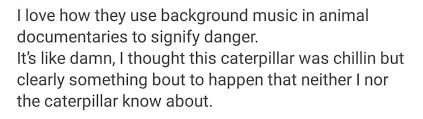
How often do documentaries about people have suspense as a major mood? The essence of the David Attenborough documentary, really, is suspense.

1766858894222.png

Like, the central structure in a David Attenborough scene is: here is an animal or plant. It has a goal. An unexpected obstacle will threaten to derail that goal. Will it succeed or will it fail? And we don't know the answer until we see it on screen.

I think in documentaries about people, the events and people they're talking about are well-known enough that we the audience are pretty much immune to suspense. Yes, Charles Lindbergh will make it across the Atlantic; no, Amelia Earhart will not.
 
it dawned on me that documentaries about people are not usually narrated in present tense.
"This is Jen. She's just been called in to HR. Craig from HR has received a complaint about Jen's cleavage, and he's going to give her a warning. He hopes that he'll see for himself whether the warning is merited, though. It's one of the biggest perks of Craig's job. He knows who's been acting inappropriately, and if he's lucky he can take advantage of that.

"Unsuspecting, Jen knocks on Craig's door. He calls her in, taking in her low-cut blouse. Her skirt is a little short too, but that's not his concern just now."
 
Last edited:
"This is Jen. She's just been called in to HR. Craig from HR has received a complaint about Jen's cleavage, and he's going to give her a warning. He hopes that he'll see for himself whether the warning is merited, though. It's one of the biggest perks of Craig's job. He knows who's been acting inappropriately, and if he's lucky he can take advantage of that.

"Unsuspecting, Jen knocks on Craig's door. He calls her in, taking in her low-cut blouse. Her skirt is a little short too, but that's not his concern just now."
That sentence is OK, but I wouldn't want a whole story written that way.
 
That sentence is OK, but I wouldn't want a whole story written that way.

Yeah, I could probably enjoy a comedic 750-word story in this style, probably not much more than that!
The example I wrote was clearly parody, and it's a joke that would quickly overstay its welcome. There has to be a way for it to work in a longer piece, something more serious, but I can't think of anything just now.
 
Yeah, I could probably enjoy a comedic 750-word story in this style, probably not much more than that!
I got to thinking about @StillStunned's sentence and wondering how many sentences could be added before my dislike of 3rd person present tense took over. I'm a fan of vignettes. I can imagine a 3rd person present tense vignette being enjoyable.
 
"This is Jen. She's just been called in to HR. Craig from HR has received a complaint about Jen's cleavage, and he's going to give her a warning. He hopes that he'll see for himself whether the warning is merited, though. It's one of the biggest perks of Craig's job. He knows who's been acting inappropriately, and if he's lucky he can take advantage of that.

"Unsuspecting, Jen knocks on Craig's door. He calls her in, taking in her low-cut blouse. Her skirt is a little short too, but that's not his concern just now."
This needs more mentions of Craig being "in his natural environment," and how he's "part of the ecosystem" that is endangered by the sudden appearance of a "new, very invasive species" of busty Jen (Tittisaurus jennicus sp.) which threatens to "upset the delicate ecological balance".
 
The example I wrote was clearly parody, and it's a joke that would quickly overstay its welcome. There has to be a way for it to work in a longer piece, something more serious, but I can't think of anything just now.

Obviously this is short form, but I think something like this could be spun out to Literotica length and maybe spiced up if sexyfuntimes are needed:

I walk into the nursing home, sign my name in the visitors' register, head for room 58. Sometimes she's in the dining area or the lounge, but most often she's in her room. I introduce myself.

She smiles at me and tells me about her family, and I talk about mine. I reminisce about the times I had with my wife. "She sounds lovely," says the lady in room 58, and I nod agreement.

I leave at 7:55 pm, five minutes before visiting hours end, and head home. I think about young love as I drift off to sleep.

In the morning I have my exercise class, and then I catch the bus into town to find something nice for my favourite nephew's birthday. Dinner at five-thirty. Then I head back out to the bus stop and ride for three stops.

I walk into the nursing home, sign my name in the visitors' register, head for room 58. Sometimes she's in the dining area or the lounge, but most often she's in her room. I introduce myself.
 
Present tense is fine. It works in many cases
My opinion is that “sure, it works, it isn’t breaking anything” is a good-enough reason for an author to use it, but as a reader and critic, it’s ok to recognize when good-enough is all the author has achieved.

Better-than-good-enough is when the present tense is doing something and when its employment was deliberate, thoughtful, necessary and effective. And the reader and critic can tell when there’s more to its reason for being used than merely-good-enough.
 
Last edited:
Back
Top