I saw the "Report" option and thought of reporting you to Dr McKinney...The comma that should be after "Tom" is proper, known as an "Oxford comma". Without it, certain sentence constructions lose clarity. Like @IWroteThis , I am a little anal about my use of Oxford commas and have never tripped the AI detector in any of the 100+ stories I have up.
I've never touched Grammarly nor any other nagging-mother grammar checker in 50 years of writing. I suppose during the first half of that timespan, doing so would have been a little difficult.I had several great English and composition teachers (plus one really awful one!), all influences on how I approach and execute the art. I can picture my favorite, Dr. McKinney, all but falling on the floor in laughter if he found out I was using the skills he taught me to write smut!
Navigation
Install the app
How to install the app on iOS
Follow along with the video below to see how to install our site as a web app on your home screen.
Note: This feature may not be available in some browsers.
More options
You are using an out of date browser. It may not display this or other websites correctly.
You should upgrade or use an alternative browser.
You should upgrade or use an alternative browser.
What has happened to this site?
- Thread starter j267
- Start date

anthrodisiac
Weirdo Archaeopteryx
- Joined
- Oct 12, 2025
- Posts
- 2,015
I deliberately don't put spaces between my em dashes in my story submissions here so it doesn't get flagged as AI. ChatGPT ruined em dashes, and now I can't use them because someone's like — "AI totally wrote that."

SugarStorm
Sapphic Storysmith
- Joined
- Jan 13, 2025
- Posts
- 165
I’m not saying em dashes have nothing to do with whatever AI detection Lit is using, but there are plenty of successful authors on the site who use them in all sorts of ways: sometimes as a single dash/hyphen (-), sometimes as a double dash (--), and sometimes as a proper em dash (—). Some have spaces before and after, others do not.I deliberately don't put spaces between my em dashes in my story submissions here so it doesn't get flagged as AI. ChatGPT ruined em dashes, and now I can't use them because someone's like — "AI totally wrote that."
I personally use — with no spaces, but I’m considering moving away from them. The HTML snippet I use — isn’t formally supported by Lit, according to their own documentation, and I’m getting increasingly nervous that a future update will break it... Much like what happened with the <center> tags. A single dash or a double dash seems like the safer option, honestly.
At this point I think it’s less about punctuation and more about overall voice and consistency.
Last edited:

Writer61
Literotica Guru
- Joined
- Feb 17, 2024
- Posts
- 1,702
I also use Grammarly for proofreading and, quite recently, have also had stories in limbo. However, I withdrew them while I waited for a series to be created. On resubmission, within a day, all three were approved, complete with their Oxford commas.OK. I use Grammarly. I use it for proofing and similarly, I have had stories, or chapters rather, stuck in the Literotica limbo.
So, I don't think it is Grammarly per se. While I imagine that Oxford commas could trigger more scrutiny, it seems like an odd 'tell'.
Using it, or not, is a style thing. This Wikipedia post explains the situation.Grammarly wants to add the comma before the “and” in those cases. Probably the correct thing to do, but a small change that doesn’t really affect the writing.
Seems like unnecessary work.I will keep doing this on future submissions to see if that continues to work.

ShelbyDawn57
Fae Princess
- Joined
- Feb 28, 2019
- Posts
- 4,938
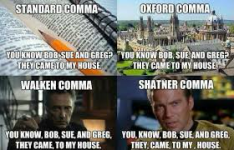
The Oxford comma is only "proper" if and when, #1, as you said, the alternative would be ambiguous or misleading, or #2, adherence to a particular style guide which calls for it is required. Besides those two circumstances, calling it "proper" is an opinion, not a real rule. There are other style guides, linguistic registers, and regional conventions which drop it except where it improves clarity, and they aren't somehow less "proper." They're just different versions of proper.

alohadave
Keep on keeping on
- Joined
- Dec 6, 2019
- Posts
- 3,999
You can turn off generative AI in Grammarly and it'll only act as a SPaG checker.OK. I use Grammarly. I use it for proofing and similarly, I have had stories, or chapters rather, stuck in the Literotica limbo.

MetaBob
Literotica Guru
- Joined
- Sep 13, 2018
- Posts
- 3,731
FWIW, I've used the free online version of Grammarly for every story I've posted here over the past 2-4 years, and never had a single problem with being accused of using AI. It wants to make suggestions for how I could rephrase things, but I don't even look at those suggestions, which would require me to activate a subscription, which I'm not about to do.Grammarly, no matter how you think or tell us how you're using it, is a well-known offender. It's simple - manually write, edit and proofread, or don't expect to publish here.
What I use Grammarly for is a final check before submitting for publication. It usually catches a few misspellings or doubled words, but 90%+ of what it suggests is crap, which is why I don't think a paid subscription would be worthwhile. It's easy enough to ignore the suggestions that I think are crap.
I use em-dashes ("--") all the time. My publisher doesn't like that and has been technically correct whenever we've disagreed, but I keep using them anyway and don't have any problem here except that, as with ellipsis, which I write with spaces between the words that precede it and the words that follow, sometimes one of those spaces gets removed before the story is posted. I don't mind.I deliberately don't put spaces between my em dashes in my story submissions here so it doesn't get flagged as AI. ChatGPT ruined em dashes, and now I can't use them because someone's like — "AI totally wrote that."
Edit: added reply to @anthrodisiac
Last edited:

TheLobster
Comma Aficionado
- Joined
- Jul 26, 2020
- Posts
- 4,419
As a self-proclaimed comma aficionado, who uses them copiously, including in places where they aren't technically necessary — though I'm trying to break the habit — I feel obliged to inform everyone has doubts, misgiving, or inhibitions about the Oxford comma (or any other usage of comma, or semicolon; or, indeed, any another punctuation mark) that I've been using all of them in my stories, quite extensively, and I am yet — knock on wood! — to cop an AI-based rejection 

crookedletter
bendy
- Joined
- Jun 14, 2024
- Posts
- 929
Mark me down as pro Oxford comma. Which is a source of a surprising amount of discord in my marriage. My wife is very much anti Oxford comma.
I also use em dashes a lot.
But I promise, I'm a real boy.
I also use em dashes a lot.
But I promise, I'm a real boy.

CurrentParameter
Pretend Writer
- Joined
- Jul 29, 2023
- Posts
- 15
I copy and paste from Word into a text editor and then from the text editor to Literotica. This is the way I have always done it. I then validate the spacing in the text editor. It is being flagged on the text, not on any secret encoding.I think it is more likely that Grammarly, even when used only for spelling and grammar checking, leaves traces in .doc/.docx files.
Consequently, I have switched to uploading in .rtf format.
MetaBob
Literotica Guru
- Joined
- Sep 13, 2018
- Posts
- 3,731
One of my editing things is that I generally dislike commas except when I think they're necessary. Mostly I remove them. But I will use the Oxford comma, or no commas at all, almost every single time. On the very few occasions when I don't, I require a good reason not to.Mark me down as pro Oxford comma. Which is a source of a surprising amount of discord in my marriage. My wife is very much anti Oxford comma.
I also use em dashes a lot.
But I promise, I'm a real boy.
Grammarly doesn't like that, but screw Grammarly.
Examples from works in progress, one of which I hope to submit later today:
She turned her head into his chest, sighed happily, and smiled.
Jess dressed deceptively casual in stretchy designer jeans that hugged every curve of her spectacular legs and ass and hips and waist like yoga pants, a brown leather belt that must’ve been purely decorative, a soft white cable-knit top with a modest neckline that revealed just a hint of her cleavage and the very tops of her growing breasts, an unbuttoned brown blazer with a subtle herringbone pattern, strappy brown leather 3-inch heels, simple small gold hoop earrings, her hair down in an easy ponytail, and very light makeup.
Edit: I considered changing this sentence:
"On the very few occasions when I don't, I require a very good reason not to."
... to this one, because I didn't like that it included a comma:
"I require a very good reason not to on the very few occasions when I don't."
It's debatable whether reordering that sentence improved matters. I eventually decided to keep the original sentence because having too many short connecting words felt unclear: "not to on the". I did remove the second use of "very", however.
Last edited:
crookedletter
bendy
- Joined
- Jun 14, 2024
- Posts
- 929
Yeah, I guess it's worth clarifying I occasionally just leave out all the commas, stringing together ands if I like the rhythm of it better. But if I'm using commas I throw the Oxford one in there too.One of my editing things is that I generally dislike commas except when absolutely necessary. Mostly I remove them. But I will use the Oxford comma, or no commas at all, almost every single time. On the very few occasions when I don't, I require a very good reason not to.

Britva415
"Alabaster," my ass
- Joined
- Nov 19, 2022
- Posts
- 7,334
Oh, the original is WAY better because it's unambiguous.I considered changing this sentence:
"On the very few occasions when I don't, I require a very good reason not to."
... to this one, because I didn't like that it included a comma:
"I require a very good reason not to on the very few occasions when I don't."
It's debatable whether reordering that sentence improved matters. I eventually decided to keep the original sentence because having too many short connecting words felt unclear: "not to on the". I did remove the second use of "very", however.
In the altered version, you can't tell what it is that "you don't." Don't require? Don't do? I mean, I can tell because the fact that it's already an occasion when you "do require" is given, so "you don't" has to mean you "don't do," but it really isn't as transparent.
If the second version said "... when I don't do so," that wouldn't be difficult to parse.
Britva415
"Alabaster," my ass
- Joined
- Nov 19, 2022
- Posts
- 7,334
And don't nobody go pretending that it's always required for clarity.Hot take:
WHEN it is required for clarity, it isn't an Oxford comma at all. It's only an Oxford comma when it isn't necessary for clarity.
Or that it never introduces ambiguity, itself.
These "prevents ambiguity" or "ensures ambiguity" assertions aren't some universal truth - for either style.
crookedletter
bendy
- Joined
- Jun 14, 2024
- Posts
- 929
Is that actually true? My understanding is Oxford comma is just the term given to the last comma in a list of three or more. I can't find any definition that specifies it's only called that in specific cases.Hot take:
WHEN it is required for clarity, it isn't an Oxford comma at all. It's only an Oxford comma when it isn't necessary for clarity.

VerbalAbuse
Literotica Guru
- Joined
- May 8, 2022
- Posts
- 1,245
I do have a very short story (750 words) returned with AI complaints.
I could share it, post it.
I have posted on other sites -- no problem.
Then you can tell me that AI would write such a mess.
I could share it, post it.
I have posted on other sites -- no problem.
Then you can tell me that AI would write such a mess.
Britva415
"Alabaster," my ass
- Joined
- Nov 19, 2022
- Posts
- 7,334
Well, you wouldn't, would you.Is that actually true? My understanding is Oxford comma is just the term given to the last comma in a list of three or more. I can't find any definition that specifies it's only called that in specific cases.
Britva415
"Alabaster," my ass
- Joined
- Nov 19, 2022
- Posts
- 7,334
But:Well, you wouldn't, would you.
I believe that "THE Oxford comma" is the one which is named that by a style guide which names it that, when one is adhering to that style. If one isn't adhering to that style at all, or is adhering to a style which conspicuously avoids the name "Oxford," then well
Let's say you're beholden to one of the style guides which says don't use the Oxford comma. Or maybe it doesn't name "Oxford" comma specifically, maybe it just says don't put any comma by any name (other than "comma," duh) there unless/except when it's required for clarity.
So - when you do, is that necessarily an "Oxford" comma? Seems to me, "no."
But I wasn't even just talking about that particular refutation. I was just shitposting a
Hot take

anthrodisiac
Weirdo Archaeopteryx
- Joined
- Oct 12, 2025
- Posts
- 2,015
I've been trying to pare back my em dash use, because I will definitely overuse them if I'm not actively policing myself. My thoughts tend to be winding and tangential, and a lot of my characters weirdly have this tendency (such a bizarre coincidence...). I'll generally use them in place of parentheses (big fan of using them informally, something about it feels offputting when writing prose) or if there's an intrusive thought/concept in the middle of a sentence.I use em-dashes ("--") all the time. My publisher doesn't like that and has been technically correct whenever we've disagreed, but I keep using them anyway and don't have any problem here except that, as with ellipsis, which I write with spaces between the words that precede it and the words that follow, sometimes one of those spaces gets removed before the story is posted. I don't mind.
The other case I tend to use it is when I could normally use another punctuation, but want to be dramatic or put the reader in a more tense mindset. There's something to be said about the psychological impact of an em dash.
Mediocre example:
They saw the monster and then ran for the car.
They saw the monster, then ran for the car.
They saw the monster—then ran for the car.
Em dashes in this case can be used to make a sentence more staccato than if you were to use normal punctuation or a conjunction like and. It makes the two actions more visually distinct, and shorter, punchier sentences generally induce more tension than long, winding ones. Em dashes are a nice medium between a Shatner-esque period-fest and a flowing, complete sentence.
Britva415
"Alabaster," my ass
- Joined
- Nov 19, 2022
- Posts
- 7,334
The Oxford University Press takes that shit pretty seriouslyAs Vampire Weekend so eloquently put it,
"Who gives a fuck about an Oxford comma?"
Reductio ad quidquid:
"Who gives a fuck about the OUP?"
MetaBob
Literotica Guru
- Joined
- Sep 13, 2018
- Posts
- 3,731
Between these three example sentence versions, the second is clearly preferable for me.The other case I tend to use it is when I could normally use another punctuation, but want to be dramatic or put the reader in a more tense mindset. There's something to be said about the psychological impact of an em dash.
Mediocre example:
They saw the monster and then ran for the car.
They saw the monster, then ran for the car.
They saw the monster—then ran for the car.
Again, for me, the choice of whether to use a comma, semicolon, em-dash, ellipsis, parentheses, or a period is becoming a conscious choice; all six could theoretically be used interchangeably, though of course not in every situation. For a semicolon, both phrases must be complete sentences, but closely related. If I want more impact, I will use a period even if full sentences are not the result. Ellipsis signifies a pause or words trailing off. I hardly ever use parentheses any more because em-dashes serve a similar function but seem more direct and less like they're asides or internal dialog.
I dislike using "and then" intensely. One word or the other can usually be omitted with no loss of clarity, while "then" implies a temporality that is usually unnecessary, though in the case of your examples, that temporality, that consequence of one action stemming from another, seems necessary, making "and" redundant.
Some example from my current work in progress, that I hope to submit tonight:
He was tired in the best possible way; she’d been even more insatiable than usual last night.
“It certainly was. You seemed … even more into it than usual.”
“Yes. But for me, I’m used to starting and managing complex projects. I take charge. I enjoy that. I have to take control in a work environment.”
Annnnddd … I heard from camp that Cian has been sketching some of his photos. They want to display one he made of a dragonfly. They say it’s really good and they’re right — they included a photo in their e-mail.
Last edited:
TheLobster
Comma Aficionado
- Joined
- Jul 26, 2020
- Posts
- 4,419
It's only an Oxford comma if it's made in the Oxfordé region of France, otherwise it's just a sparkling punctuation mark.Hot take:
WHEN it is required for clarity, it isn't an Oxford comma at all. It's only an Oxford comma when it isn't necessary for clarity.
Similar threads
- Replies
- 21
- Views
- 297


- Replies
- 18
- Views
- 566


- Replies
- 126
- Views
- 4K

Share: